Handloom Weaving: Create Organic Shapes
A course by Juliana MaiaVisual artist and Weaver
A course by Juliana Maia, Visual artist and Weaver

Explore compositions of color and fabric to design unique pieces using a handloom
A loom is so much more than a tool for making rugs and decorative tapestries, it's a powerful form of artistic expression where multiple disciplines can be interwoven to tell a story. Visual artist Juliana Maia combines this ancient technique with other contemporary art forms and applies her creations to different mediums and objects.
In this course, learn to create textile patterns on a handloom using colorful fabric fragments. Discover the artistic possibilities of this tool and learn to weave vibrant compositions with a variety of textures and stitches, from lashing on to binding off.
What will you learn in this online course?
17 lessons & 20 downloads

Basic materials
5 minutes, 50 seconds

Heald comb loom: presentation
5 minutes, 47 seconds

Collecting shapes and colors to weave
2 minutes, 34 seconds

free drawings
4 minutes, 20 seconds

Paper pattern drawings
6 minutes, 40 seconds

Warp: technical sheet and warp 1
17 minutes, 56 seconds
What's included in this course?
Start the course by getting to know your teacher, Juliana Maia, who tells you about her professional career, her leap from architecture to visual arts, and how she found a powerful form of expression in the art of weaving. She also shows you her most distinguished projects and major sources of inspiration.
Next, go over the materials you need to weave on a handloom and get familiar with the loom itself, exploring its components and accessories as well as how they work. Search for references and create your own color palette before you begin experimenting with shapes and compositions.
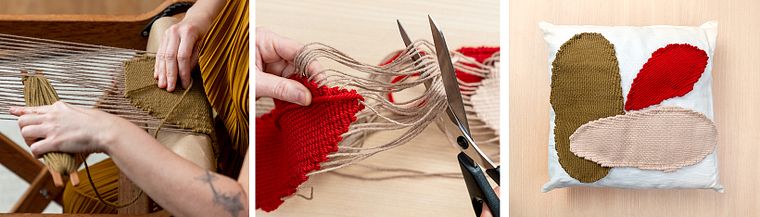
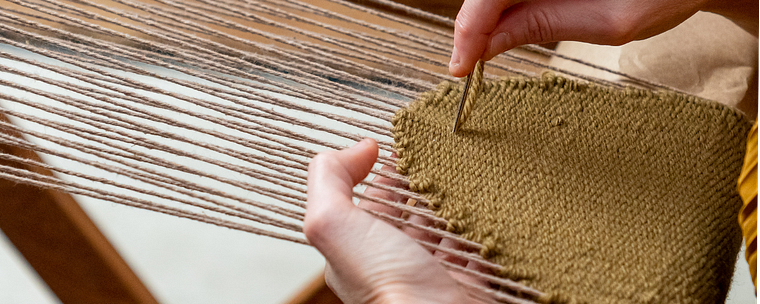
Using your preliminary designs, draw full-size versions of the fragments you're going to weave. Juliana then shows you how to lash on and transfer your patterns so you can start weaving. She also teaches you how to create texture and volume and bind off your finished fragments.
Once your pieces are ready, experiment with different combinations and arrangements and then sew them to a cushion cover. Juliana ties everything together by giving you some tips on how to preserve your art and attach it to different surfaces.
What is this course's project?
Weave textile fragments on a handloom and create patterns to sew onto a cushion cover.
Who is this online course for?
Anyone who wants to learn the techniques for weaving on a handloom and anybody with a passion for textile arts and crafts.
Requirements and materials
No prior knowledge is needed to take this course.
For materials, you need a rigid heddle loom (or any other type of handloom), twine or cotton thread for the warp, yarn, scissors, a tapestry needle, pencil, and paper.
Reviews
- 10 months ago
Interesante. Deseando empezar
- 11 months ago
This is one of the best weaving courses I have done, full of ideas, inspiration and techniques. Juliana is very good at explaining everything clearly, she is a great teacher - I wish I could attend more classes with her! I learn't a lot about weaving and the course has made me want to explore this type of weaving further.
- 1 year ago
The most detailed course I have taken so far. Juliana Maia is a natural teacher and a master in her field. Easy to understand and very well-structured class. Thank you. Um curse super detalhado. Juliana Maia ensina naturalmente e é uma mestra em sua disciplina. O curso é super detalhado e fácil de entender. Obrigada
- 2 years ago
Embora eu não pretenda realizar o projeto final do curso, achei relevantes e muito bem explicadas as aulas dedicadas ao funcionamento e utilização do tear. Certamente o conteúdo é agregador e útil para ser combinado com outras técnicas de tecelagem, cestaria e tingimento natural. Recomendo.
- 2 years ago
maravilhoso

She has participated in both group and solo exhibitions, including A Tessitura do Gesto, which took place in 2021 at the Arte Plural Gallery in Recife. When she's not creating, Juliana shares her knowledge by teaching textile art courses across Brazil.
Content
- U1
Introduction
- Presentation
- influences
- U2
Preparing to get your hands dirty
- Basic materials
- Heald comb loom: presentation
- Collecting shapes and colors to weave
- free drawings
- U3
the fragments
- Paper pattern drawings
- Warp: technical sheet and warp 1
- Warp: technical sheet and warp 2
- Warp: placing on the loom
- Plot: weaving the first fragment 1
- Plot: weaving the first fragment 2
- Plot: continuing the other fragments
- Finishes
- U4
Finishing and taking care of the pillow
- Sewing the fragments on the pillow
- Finished part care tips
- Other applications
- FP
Final project
- Manual tapestry with geometric pattern
What to expect from a Domestika course
Learn at your own pace
Enjoy learning from home without a set schedule and with an easy-to-follow method. You set your own pace.
Learn from the best professionals
Learn valuable methods and techniques explained by top experts in the creative sector.
Meet expert teachers
Each expert teaches what they do best, with clear guidelines, true passion, and professional insight in every lesson.
Certificates
PLUSIf you're a Plus member, get a custom certificate signed by your teacher for every course. Share it on your portfolio, social media, or wherever you like.
Get front-row seats
Videos of the highest quality, so you don't miss a single detail. With unlimited access, you can watch them as many times as you need to perfect your technique.
Share knowledge and ideas
Ask questions, request feedback, or offer solutions. Share your learning experience with other students in the community who are as passionate about creativity as you are.
Connect with a global creative community
The community is home to millions of people from around the world who are curious and passionate about exploring and expressing their creativity.
Watch professionally produced courses
Domestika curates its teacher roster and produces every course in-house to ensure a high-quality online learning experience.
FAQs
The course is intermediate level, ideal for those who already have some experience in weaving or crafts and want to deepen their skills in composition, fragment creation, and assembling original pieces on the loom.
Yes, it’s recommended to have a heddle loom to follow the practical exercises, along with materials like wool yarn, tapestry needle, scissors, kraft paper, and a warping board.
You’ll need a heddle loom, wool yarn, tapestry needle, shuttle, kraft paper, scissors, warping board, pencil, pastel chalk, measuring tape, and paper templates.
You’ll learn how to create textile fragments, compose organic pieces, develop sketches, set up the warp, sew and finish cushions, plus techniques for finishing and caring for your work.
The course covers warping setup, sketch creation, cutting templates, threading the yarn, weaving fragments, hidden stitching, invisible finishing, and patchwork composition for cushions and tapestries.
The course walks you through calculating, setting up, and adjusting warp threads on the loom, including how to properly use the warping board, distribute threads evenly, and adjust tension with the right tools.
Yes, the course teaches techniques you can use to make rugs, wall tapestries, placemats, and upholstery using woven fragments.