
Rediscover your surroundings by creating watercolor sketches of people, places, and fisheye perspectives
Your everyday life is an endless source of inspiration when it comes to sketching. In fact, urban sketcher Lapin believes that everything is sketchable: from your first cup of coffee to dinner with your friends. And a great urban sketcher not only depicts what is in front of them, they also convey the feeling of a place. Lapin has mastered the ability to tell a story with his sketches, through constant practice and curious observation, filling 200 sketchbooks in the last 18 years. His clients include Air France, the City of Barcelona, Le Parisien Magazine, Deutsche Telekom, PlayStation, Heineken, Marks & Spencer, Monoprix, Aigle, Peugeot, Porsche, and more.
In this course, Lapin teaches you how to tell the stories of your everyday life, using fineliners, watercolors, but most of all, your unique perspective. See how to sketch from observation, discover the curvilinear perspective, and express your original stories with depth and feeling.
What will you learn in this online course?
15 lessons & 17 downloads

What We Will Do in the Course?
3 minutes, 56 seconds

Line and Color Techniques
8 minutes, 42 seconds

Inspiration and Themes
11 minutes, 34 seconds
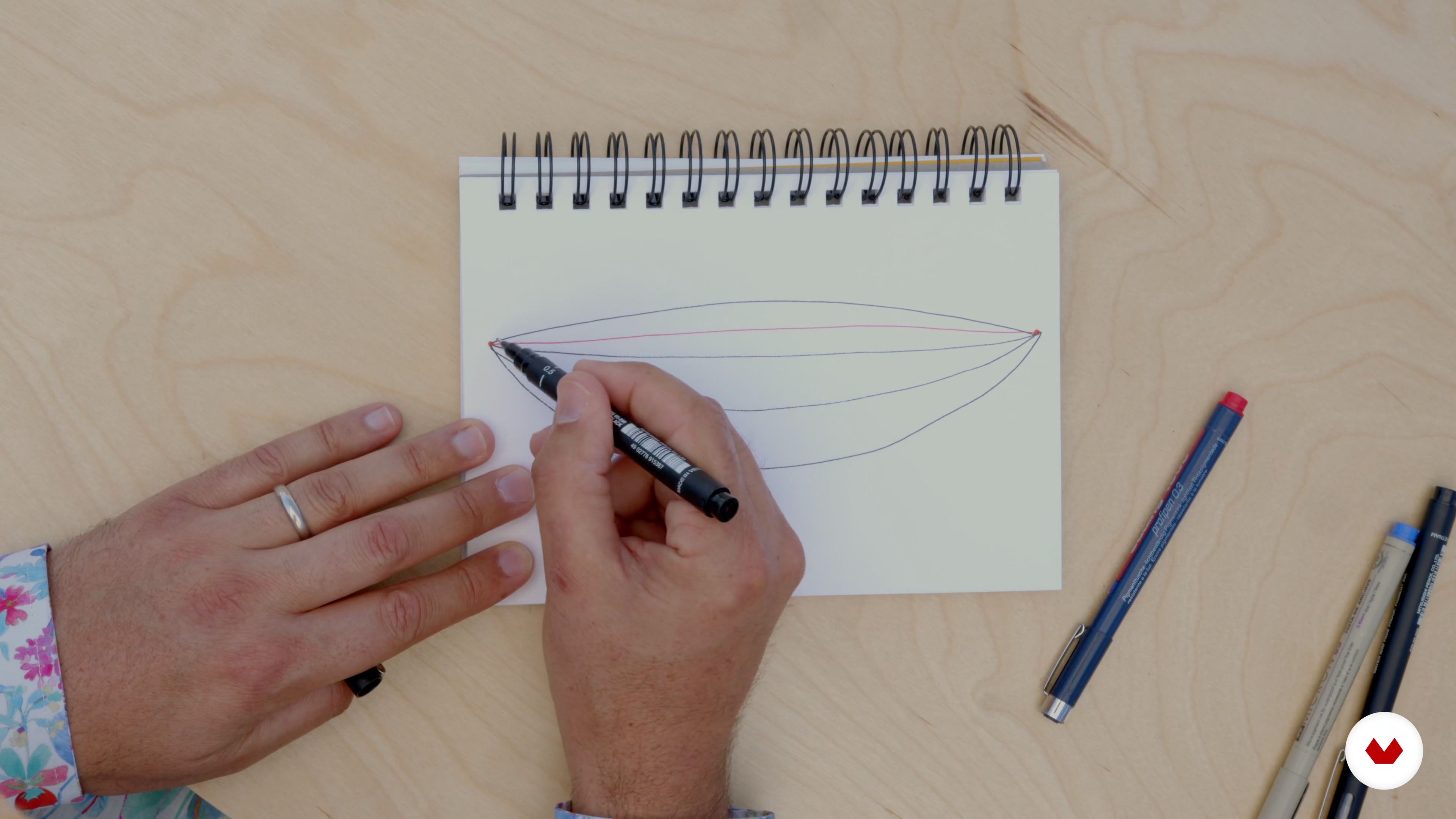
Outdoor Views: Guidelines of the Curvilinear Perspective
3 minutes, 26 seconds
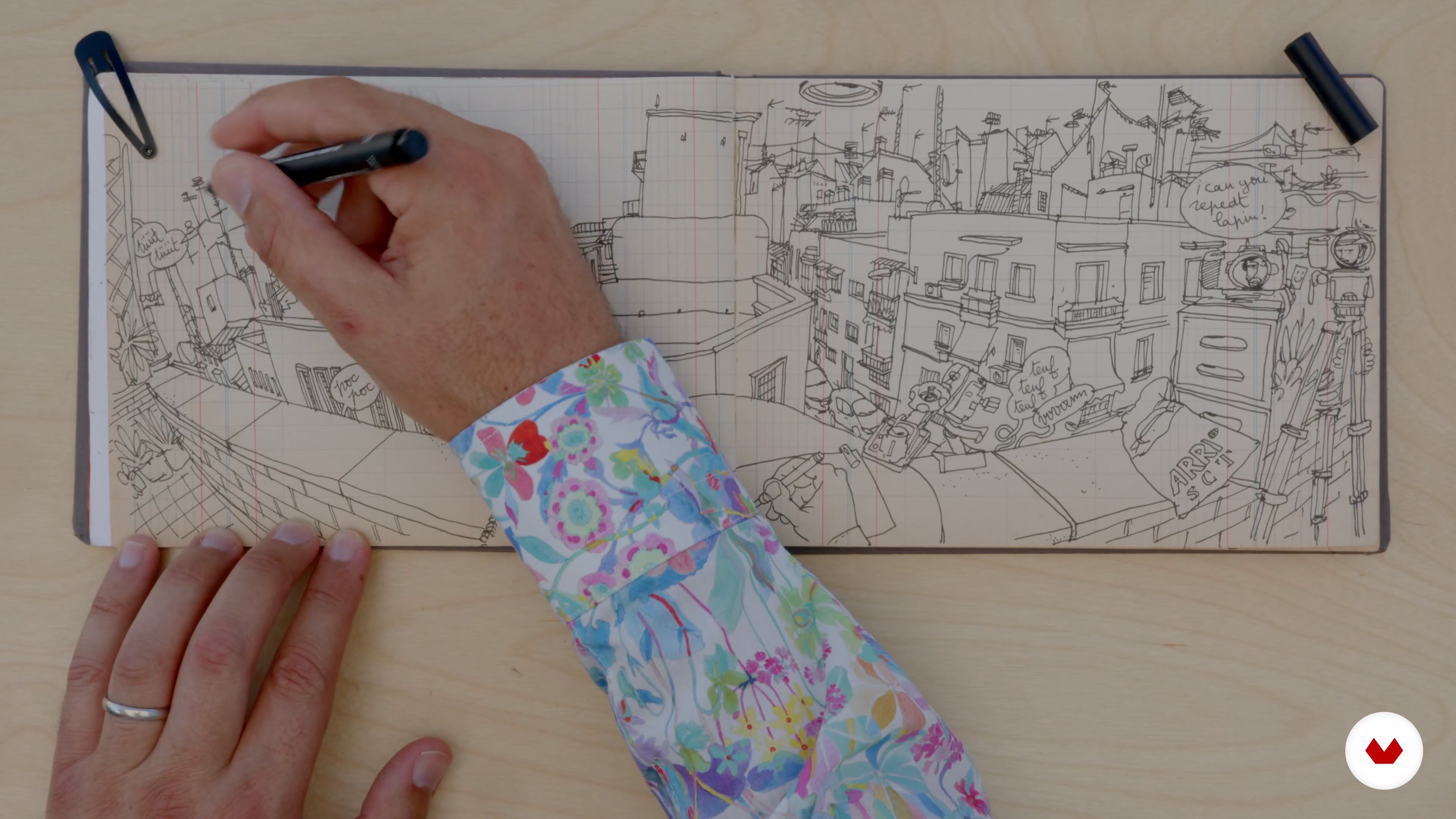
Linework
20 minutes, 28 seconds
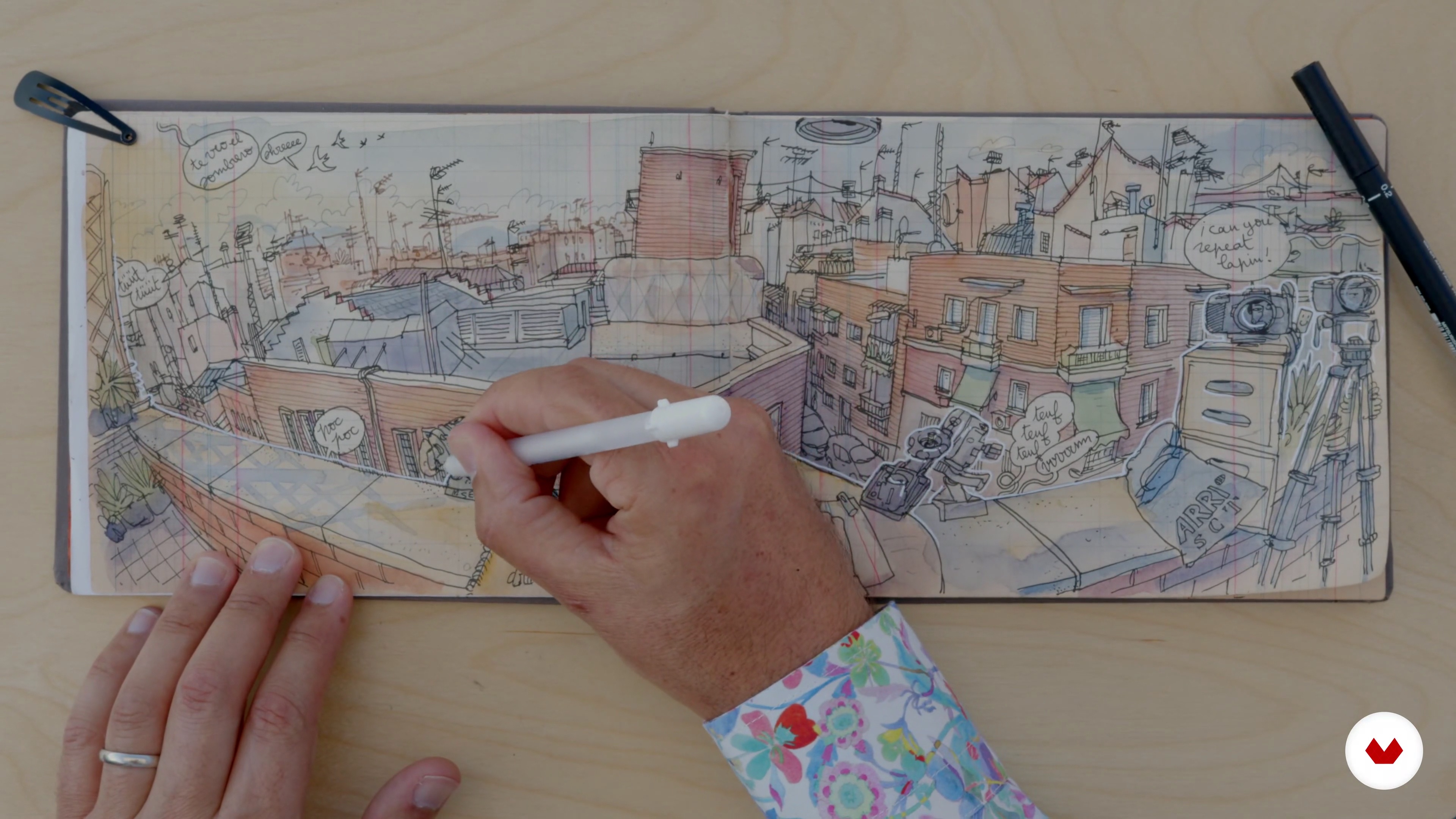
Color and Texture
13 minutes, 56 seconds
What's included in this course?
Lapin begins by telling you about his passion for the art of sketching, how he braved the transition between graphic design to becoming a full-time urban sketcher, and shares his main sources of inspiration along the way.
Discover the urban sketcher’s manifesto. Go through the minimal sketching gear you need for the course, focusing on Lapin’s personal favorites. He tells you how he makes the most out of each item and how you can apply them to your sketches throughout the course.
Learn Lapin’s intuitive technique to sketch from observation using a black fineliner for contour and a reduced watercolor palette for volume to start the first practical exercise. Next up is perspective, going from classical to curvilinear perspective. Practice the cylindrical perspective to create curvaceous horizontal lines and the spherical perspective—also known as fisheye perspective—to curve both horizontal and vertical lines using simple observation techniques.
According to Lapin, a good sketchbook must contain a dinosaur and a spaceship, but what are you passionate about? Once you’ve outlined your themes, start practicing and learning how to improve with Lapin’s advice. Learn how to sketch objects by creating a composition of some of your favorite objects, to warm up your hand and practice Lapin’s sketching from observation technique.
Then, learn Lapin’s unique caricature-style portraits, composed of big heads and little bodies, followed by sketching an outdoor view to practice the cylindrical perspective you saw previously. Throughout your practical exercises, Lapin shows you how to add storytelling elements to your work such as speech bubbles, people, descriptions and soundtracks, prompting you to always be observant of your surroundings when sketching. See how Lapin incorporates colored pencils and a white gel ink pen to add more depth to your work.
In the final unit, Lapin focuses on the storytelling aspect in your sketches, prompting you to move away from the typical postcard-style sketches and focus on telling a more personal story. Finally, he’ll show you how to share your work on social media and take part in the urban sketching community.
What is this course's project?
Fill a sketchbook with anecdotes from your everyday life, inspired by your surroundings, friends, and family, to sketch some personal stories, as well as documenting your travels. Use Lapin’s techniques to capture the moment and learn how to take part in the Urban Sketching scene on social media.

Projects by course students


Who is this online course for?
This course is for art lovers with a beginner's level in sketching who want to learn how to express their surroundings using a sketchbook and their imagination.
Requirements and materials
No previous sketching experience is required to take this course, all you need is curiosity and enthusiasm!
As for materials, you will need a sketchbook (either A4 or A5), a black waterproof fineliner (0.2 mm), a small watercolor set (12 half pans is enough), 2-3 refillable water brushes, a rag to clean your brushes, colored pencils, a folding stool, other fineliners if possible (gray, ochre, green, blue, red, white gel ink pen).

Reviews
- 2 months ago
Me gusta como cuenta su experiencia!
- 3 months ago
Excellence in motion!
- 4 months ago
what a great course. I was avoiding portraits and felt insecure doing them but something in Lapin approach made all the difference to me. thank you! soon ill share my sketch book
- 4 months ago
Vor allem eine Selbstdarstellung des Künstlers, wie leider bei den meisten Kursen von domestika
- 5 months ago
Buenas directrices y consejos muy útiles que con toda seguridad aplicaré

In 18 years, he has filled over 200 sketchbooks, published 30 books, and was named the official air and space painter for the French Army in 2019. He’s a member of the Urban Sketching Community since 2008 and teaches Illustration Masters students at Elisava in Barcelona, as well as his own urban sketching workshops. His clients include the French Army, Air France, the City of Barcelona, Le Parisien Magazine, PlayStation, Heineken, Marks & Spencer, Aigle, Peugeot, Porsche, and Formula One.
Content
- U1
Introduction
- About Me
- Influences
- What We Will Do in the Course?
- U2
Material, Line and Watercolor
- Materials
- Line and Color Techniques
- Perspective
- Inspiration and Themes
- U3
Sketching From Observation
- Warm Up Exercises
- Portrait
- Outdoor Views: Guidelines of the Curvilinear Perspective
- Linework
- Color and Texture
- U4
Building a Community
- Storytelling
- Following and Sharing Content on Instagram
- Building a Community
- FP
Final project
- Urban Sketching: Express Your World in a New Perspective
What to expect from a Domestika course
Learn at your own pace
Enjoy learning from home without a set schedule and with an easy-to-follow method. You set your own pace.
Learn from the best professionals
Learn valuable methods and techniques explained by top experts in the creative sector.
Meet expert teachers
Each expert teaches what they do best, with clear guidelines, true passion, and professional insight in every lesson.
Certificates
PLUSIf you're a Plus member, get a custom certificate signed by your teacher for every course. Share it on your portfolio, social media, or wherever you like.
Get front-row seats
Videos of the highest quality, so you don't miss a single detail. With unlimited access, you can watch them as many times as you need to perfect your technique.
Share knowledge and ideas
Ask questions, request feedback, or offer solutions. Share your learning experience with other students in the community who are as passionate about creativity as you are.
Connect with a global creative community
The community is home to millions of people from around the world who are curious and passionate about exploring and expressing their creativity.
Watch professionally produced courses
Domestika curates its teacher roster and produces every course in-house to ensure a high-quality online learning experience.
FAQs
Curvilinear perspective is a drawing technique that curves lines to mimic how the eye sees wide-angle views, like panoramas or fisheye effects. It helps artists accurately depict scenes that span a large field of view, making sketches appear more immersive and realistic.
This course is designed for intermediate artists who are comfortable with basic drawing and perspective, but want to expand their skills to advanced techniques like curvilinear and panoramic sketching.
You’ll need a sketchbook, fineliner pens, a compact watercolor set, color pencils, gel or jelly roll pens, and possibly a water brush. Basic portable sketching materials are sufficient; no advanced equipment is required.
You’ll learn how to efficiently post sketches, use hashtags, apply filters, tag locations, write engaging descriptions, and build connections with the art community for better visibility and engagement on Instagram.
The course covers classical, cylindrical, and spherical perspective, teaching you to intuitively apply these systems to complex cityscapes, panoramas, and wide-angle views for more accurate and dynamic sketches.
Yes, the course offers strategies for joining Urban Sketchers chapters, organizing meetups, and connecting with local and global sketching communities to enhance your art practice and motivation.
You’ll learn layering watercolor washes, using warm and cool colors, mixing neutral grays, creating highlights with gel pens, and applying fineliner for linework and texture in both urban and portrait sketches.