


Bauhaus: timeless design lessons that still guide creativity

Bauhaus: an enduring legacy, beyond a school, a movement that transformed design
.
Throughout the history of design, few schools have left such a deep and lasting mark as the Bauhaus. Founded in 1919 in Germany by Walter Gropius, the Bauhaus was not just an educational institution, but a revolutionary movement that forever transformed the way we understand art, architecture and design.
At a time of social reconstruction after World War I, the Bauhaus sought to unite art, design and functionality, eliminating the barriers between disciplines. Its goal was clear: to create beautiful and useful objects for daily life.
Today, more than a century later, its principles continue to inspire generations of creatives who seek a balance between aesthetics, utility, and innovation.
This article rescues the timeless lessons of the Bauhaus to apply them in the current context of digital, graphic and architectural design.
The origin of the Bauhaus.
The Bauhaus was born in Weimar with the vision of integrating art and industry. Gropius believed that design should be at the service of people, and that artists and craftsmen could work together to create a new modern aesthetic.
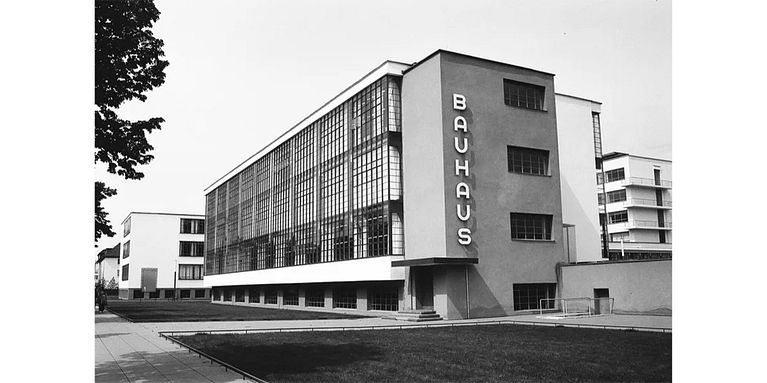
In its fourteen years of existence (1919-1933), the school passed through three cities -Weimar, Dessau and Berlin- and evolved alongside key figures such as Paul Klee, Wassily Kandinsky, Marcel Breuer or László Moholy-Nagy..
His motto, "form follows function", synthesizes an essential idea: beauty is born of utility..
Although the Nazi regime forced its closure in 1933, the influence of the Bauhaus spread throughout the world[/b] through its teachers and students, who continued to spread its ideas in the United States and Europe.
Timeless Bauhaus principles.
The principles of the Bauhaus are as simple as they are profound, and remain valuable guides for any creative process:
- Simplicity and functionality: eliminate the unnecessary to emphasize the essential.
- Rational use of color and geometry: basic shapes and primary colors that convey clarity and harmony.
transmit clarity and harmony.
- Craftsmanship and modernity working together: valuing the manual process without renouncing technological innovation.
- Interdisciplinary collaboration: merging art, architecture, design and visual communication in the same aesthetic language.
These pillars allow a design to transcend fashions and maintain its validity over time.

Bauhaus lessons for today's creatives.
Beyond history, the Bauhaus offers lessons applicable to contemporary design. Its legacy is still present in every decision that seeks functionality, balance and visual sense..
Conscious Minimalism
In a world saturated with stimuli, the principle "less is more" becomes more relevant than ever. A clean design allows the message to stand out and the user experience to be clear and direct.
Design for experience.
Bauhaus artists understood that an object or a composition did not exist just to be contemplated, but to be used. Today, that idea translates into UX/UI design, where the user experience is at the center of everything.
Materials and experimentation.
The school encouraged curiosity and research. From wood and metal to typographies and abstract shapes, the designer had to explore materials to discover new expressive possibilities.
The value of the creative process.
For Bauhaus teachers, the process was as important as the end result. Each sketch, mock-up or prototype represented an opportunity for learning and improvement. [/i

Influences that we still see today.
- The Bauhaus legacy is perceived in all areas of contemporary design:
- In typography, with the use of geometric and clean fonts such as Futura or Helvetica.
- In graphic design, with balanced compositions and basic color palettes.
- In furniture and architecture, with functional, minimalist and modular structures.
In branding, where visual coherence and simplicity communicate confidence and modernity.
Movements such as modernism, Scandinavian design or even today's digital design owe much to the Bauhaus philosophy, which knew how to combine art and technology with a humanist vision..
Practical inspiration for your own project.
If you are a designer, illustrator or visual artist, you can apply the Bauhaus principles in your creations:
- Work with a limited palette of colors and geometric shapes Restriction stimulates creativity.
- Design with purpose: each element should have a clear function.
- Experiment with materials and textures in your projects, whether digital or physical.
- Seek harmony between aesthetics and utility, a balance that defines good design.
Even in the digital age, reinterpreting the Bauhaus means going back to the origin: create with intention, intelligence and sensitivity..
Explore more about design on Domestika
If you are passionate about design and want to continue deepening in its fundamentals, in Domestika you will find courses dedicated to color theory, typography, design history and contemporary techniques that continue to drink from the Bauhaus.
Discover more at Domestika - Design[/b]
The Bauhaus was not just a school: it was a way of thinking about the world. Its message is still valid because it reminds us that creativity does not depend on the tools, but on the look with which we observe reality.
At a time when design evolves at the speed of the click, the principles of the Bauhaus invite us to stop, reflect and create with purpose.
Because, in the end, good design does not age: it transforms.[/b


0 comments