
Running Away
Running Away
by Engy Ibrahim @engiibrahim7
- 16
- 2
- 2
Introduction
This project is an illustration inspired by a quote from Alchemised by SenLinYu, a story that explores loss, endurance, and the psychological cost of survival.
The quote reflects on the idea of running away as a destination — when escape becomes the only goal, and a person gives everything they have just to reach it, without thinking about the personal cost of this.
I wanted to translate this idea visually by showing a character moving toward “escape” as if it were a physical place, only to discover that reaching it does not bring the relief she imagined. The image focuses on the moment after she arrives: the anticlimactic stillness, the exhaustion of the journey, and the quiet realization that something essential has been lost along the way.
This theme resonated with me personally, and I wanted to explore it through a poetic, narrative illustration that turns an abstract emotional state into a concrete visual moment.
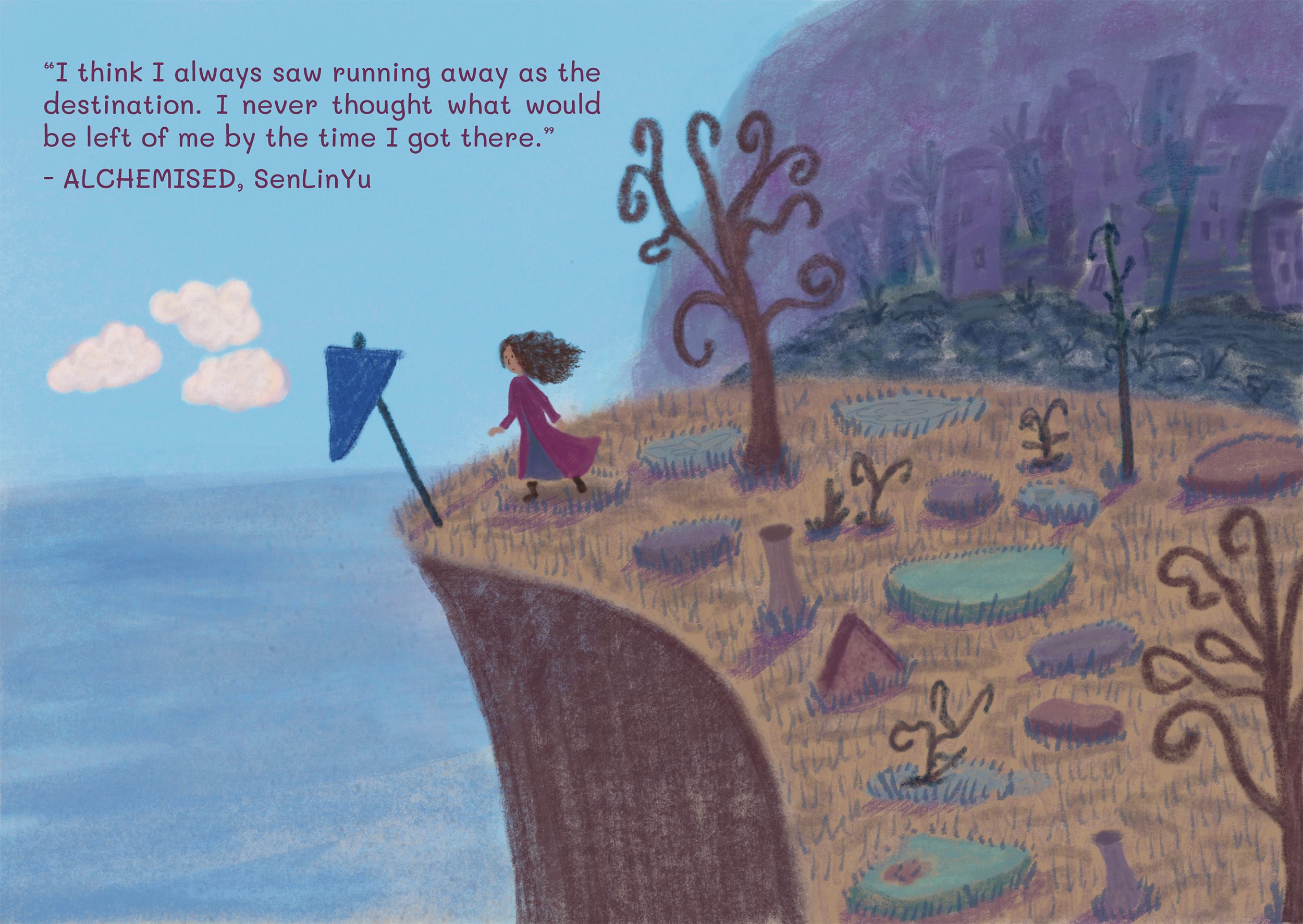
Supplies
Sketchbook
Used for initial pencil sketches for exploring ideas and developing the composition.
iPad with Procreate
Main tool for creating the final illustration, including drawing, painting, and color exploration using built-in brushes.
Adobe Photoshop
Used for final adjustments and for placing and refining the quote typography within the composition.
Step 1: Analyzing the quote and brainstorming
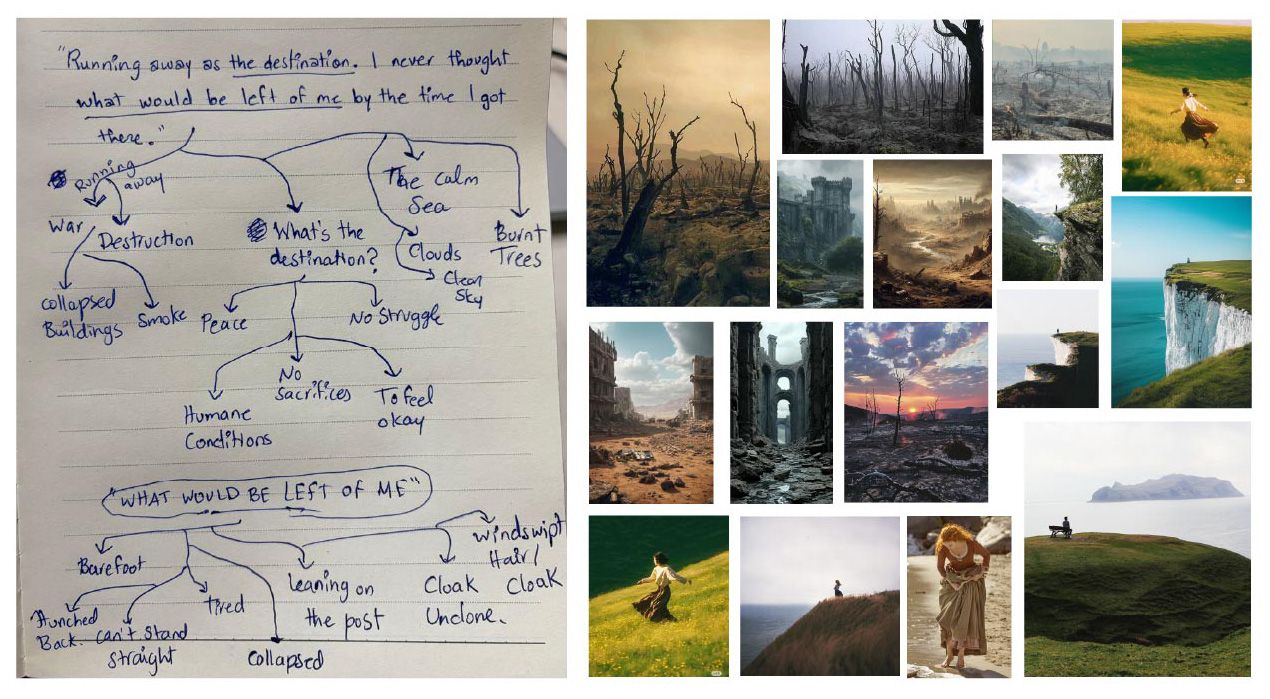
I started by breaking the quote into the main ideas that needed to appear in the illustration. In this case, they were: running away, the destination, and what’s left of me.
So the image had to show that the woman is fleeing from something, that there is a destination she is trying to reach, and that she has lost parts of herself along the way.
I took each of these ideas and started breaking them down into possible visual elements. I wanted the illustration to feel connected to the book, but not be too literal or constrained by it.
For “running away,” I thought about what she is escaping from in the story: war and destruction. I searched for references using words like war and destruction and looked for elements that captured that feeling, such as collapsed buildings, smoke, burnt trees, dark colors, and rubble.
For “destination,” I started thinking about what she is running toward. I imagined something like a flag or a beacon at the very edge. Then I asked myself: if I were in her place, what would I be looking for? Probably peace, humane conditions, and a place where I could finally feel okay. So I looked for calm, peaceful images: the ocean, clouds, clear skies, and the idea of an island far away — something that feels like a dream, but is very hard to reach.
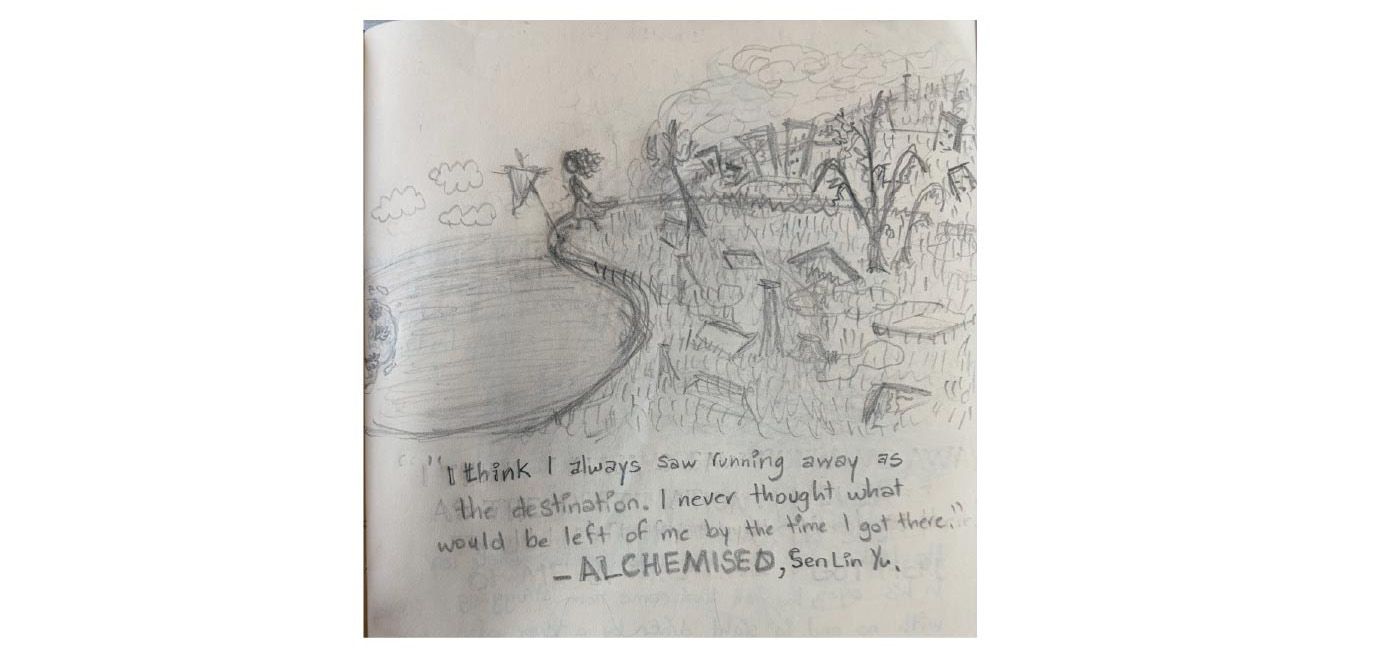
Step 2: Pencil sketch
Usually, during the brainstorming phase, an image suddenly starts to form in my head. It can happen at any point, often triggered by a photo or a word.
When that happens, I sketch it immediately. Most of the time, I need to do several sketches to get the feeling right, but in this case, the idea came together in the first sketch.
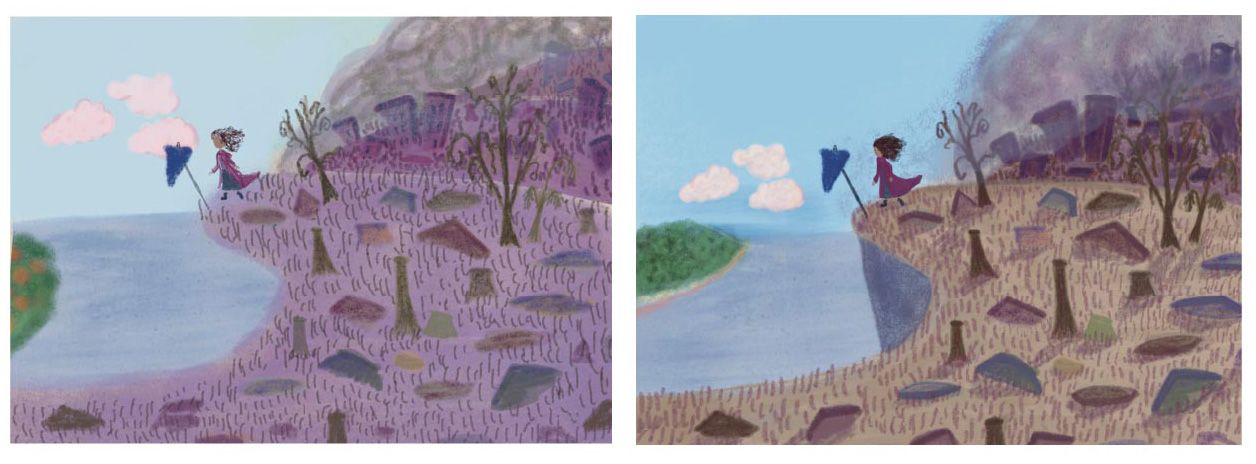
Step 3: Color roughs and developing the drawing
I rarely work in black and white because I feel like I can’t fully see the image without color. So after the initial sketch, I moved directly into color roughs.
I started exploring colors while also developing the drawing at the same time. I kept adjusting both until I reached the overall color scheme and the general shape of the image. But at this point, I felt that the woman did not yet look drained or like she had lost parts of herself.
Step 4: Showing the “what’s left of me” part
I started asking myself: if I were in her place and suddenly realized how much I had lost, how would my body look?
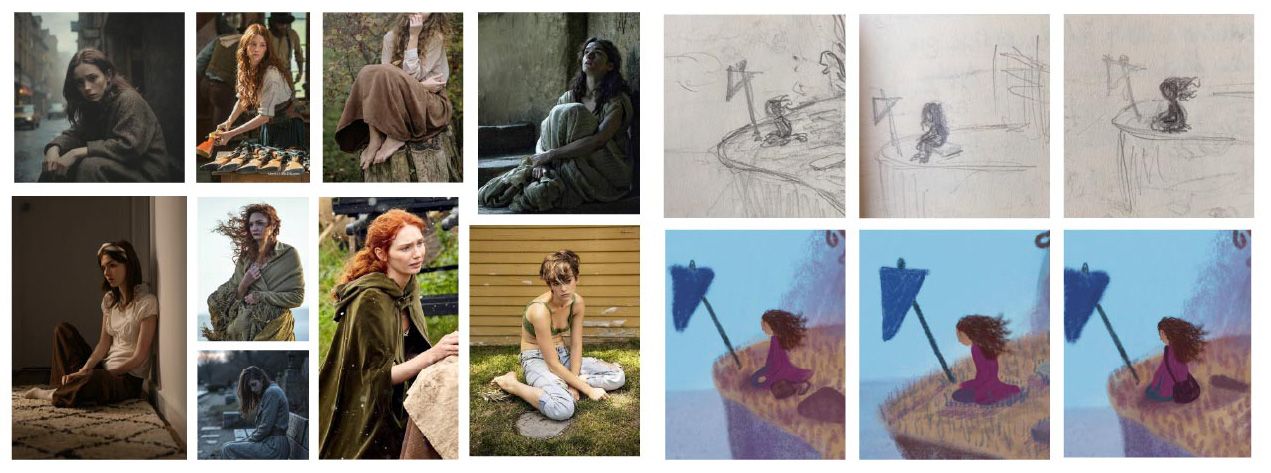
I imagined I would be almost collapsed. So I looked for references of medieval women (to fit the atmosphere of the image) and also for figures that looked tired, collapsed, or deflated.
And I started creating posture options focusing on adjusting her hunched back, her legs, and the position of her head to make her feel more exhausted and broken. I changed the drawing so that her body language showed that collapse.
Step 5: Adjusting the composition and environment
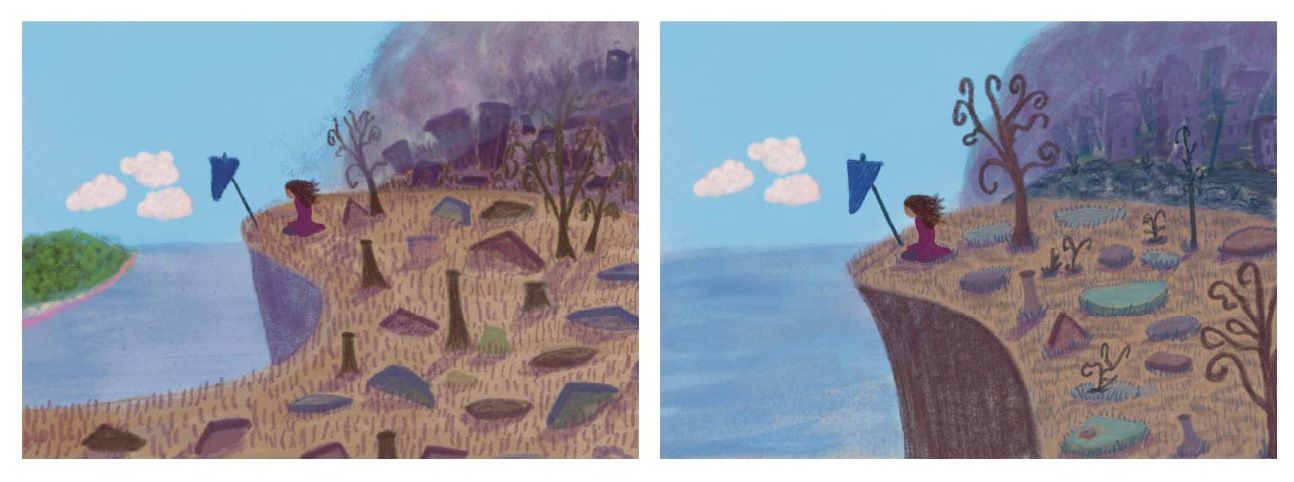
At this point, the image felt too crowded, and the woman was no longer the clear focus. She also felt too far away emotionally.
The colors around her were also too warm and distracting, so I zoomed in and adjusted the composition to bring more attention to her. I started simplifying the environment, changing colors, and reducing some elements.
I eventually decided to remove the island completely, so the feeling of emptiness and loss would become even more present.
Step 6: Going back to the original posture
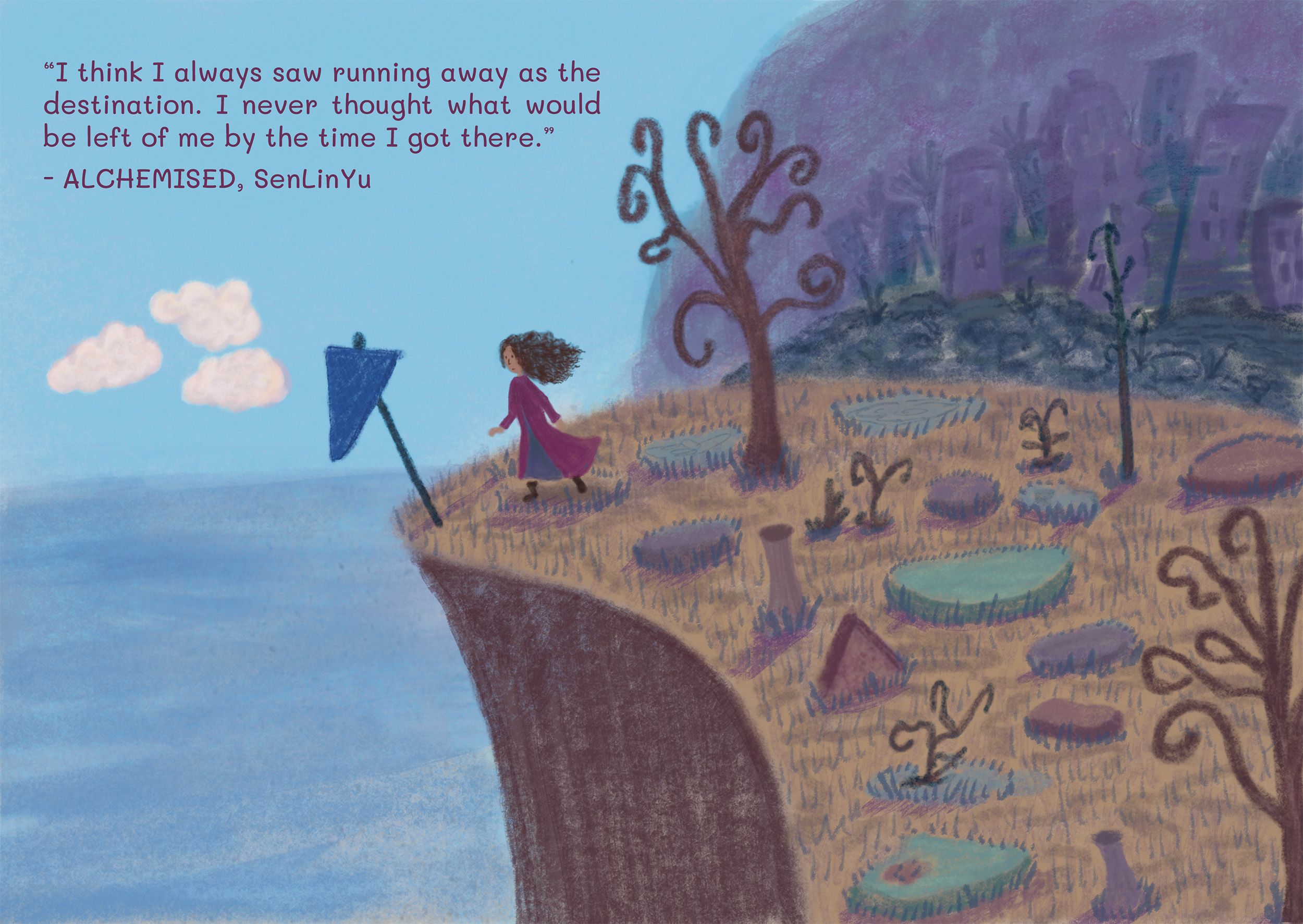
After all these changes, the composition started to feel too static. I realized that in trying to show “what’s left of me,” I had lost the feeling of escape and movement.
So I decided to go back to a standing, more dynamic posture, but redraw it based on the original sketch, keeping the lines looser and less rigid. This way, the figure could still feel exhausted, but also in motion — still trying to escape.
And then I added the quote so it's part of the composition using a handwritten font that gives a clear yet human feeling.

2 comments
What a beautiful piece of work and process, thank you for sharing it!
@marelle Thank you so much! :)
Log in or join for Free to comment