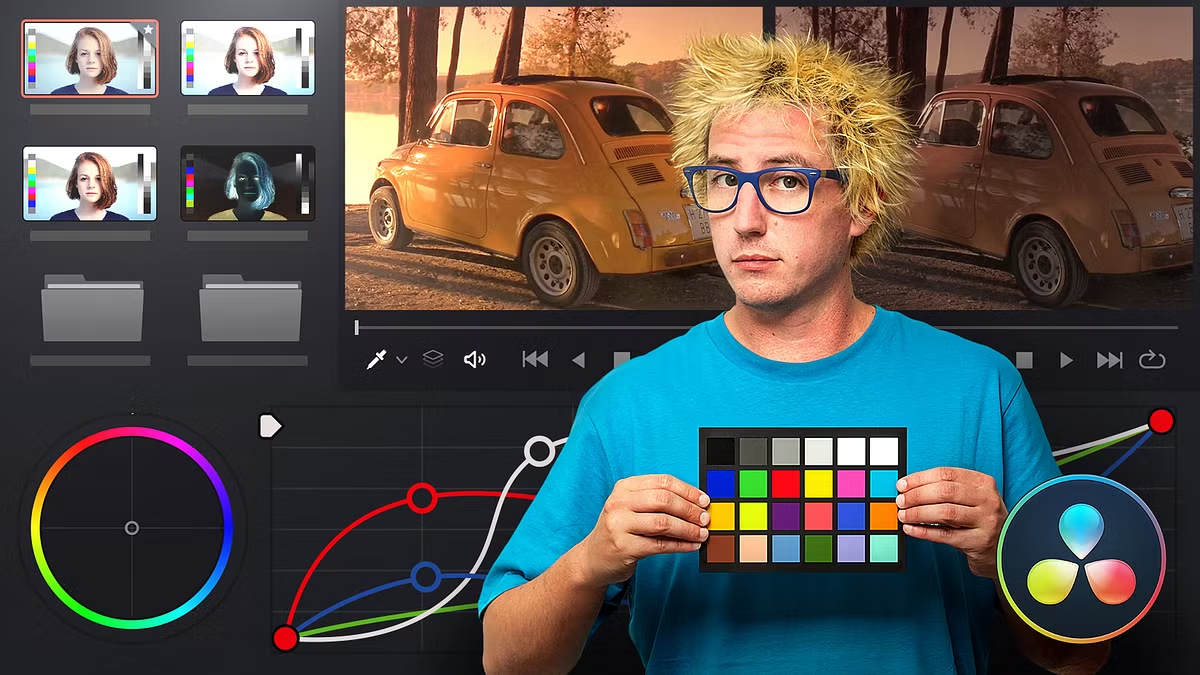
Introduction to DaVinci Resolve for Color Correction
A course by Juanmi CristóbalVideo Editor and Director of Photography
A course by Juanmi Cristóbal, Video Editor and Director of Photography

Learn the tools to apply color correction to your audiovisual products from scratch
Ready to explore the industry-leading software for adding a specific style of color, brightness, and contrast to your audiovisual pieces? Juanmi Cristóbal—founder of the production company Fourminds—is prepared to guide you through the ins and outs of DaVinci Resolve and help you do just that.
Get started by learning what color grading is and how it can enhance your work before taking your first steps with DaVinci Resolve. Explore and configure the interface and discover the process of exporting your projects from a video editing program.
In the second course, dive into primary corrections—those that are applied to the entire image—and automatic corrections. Then, learn how to optimize brightness and color balance and work on both neutral and your own style of grading.
Next, move on to applying secondary corrections, which are those that are applied to specific areas of the image. Learn to use specific colors and inverted nodes before progressing to Power Windows and tracking.
Once you’re familiar with the tools, go hands-on with the most creative tools used for color grading. In this course, expand your knowledge of black-and-white shots, bleach bypass and stabilization effects, noise reduction, and other useful resources for your audiovisual projects before working with the Magic Bullet Looks plug-in.
In the final course of this Domestika Basics, focus on the process of exporting your project. Explore the interface of the Delivery module and discover the different codecs and formats on the market. Wrap up the course by learning to consolidate your files for export and create other configurations that facilitate collaboration with other post-production professionals.
Technical requirements
⦁ A computer running Windows 10 or macOS 10.13.6 Sierra (or higher) ⦁ DaVinci Resolve 16 (You can download the free version of the program from the manufacturer's website.) ⦁ A powerful graphics card running CUDA is recommended
Recommended software & tools for this course
Reviews
- 1 month ago
Es demasiado básico y no es la última versión que cambia mucho
- 5 months ago
Es super completo el curso. Muchas graciaas.
- 7 months ago
Me ha encantado, yo venia de 0 y he aprendido muchísimo sobre las herramientas que tengo disponibles y para q se usan.
- 7 months ago
Muy buen curso, pude comenzar a usar Davinci Resolve inediatamente y se ha convertido en mi herramienta principal, muy claro y didactico Juanmi en todas sus explicaciónes. Recomiendo el curso totalmente.
- 8 months ago
--

In 2016, he joined his partners Javier Barbero and Sergio Llast to create the AV production company Fourminds, which works in both film and advertising and with clients like Samsung, Wacom, Rolling Stone, and Canal Sur.
In addition to teaching at Domestika, he shares his knowledge of technical photography, video editing with Premiere Pro, and DSLR video recording with students at the Escuela Arte Granada.
Content
- U1
Presentation
- Presentation
- U1
Presentation
- Presentation
- U2
Why correct the color of our work. Objectives of grading
- Why correct the color of our work. Objectives of grading
- U2
Make automatic corrections
- Make automatic corrections
- U3
Explore the interface of the Color module of DaVinci Resolve I
- Explore the interface of the Color module of DaVinci Resolve I
- U4
Explore the color module interface of DaVinci Resolve II
- Explore the color module interface of DaVinci Resolve II
- U5
Organize a project Import from Premiere Pro
- Organize a project Import from Premiere Pro
- U6
Configure essential settings according to the project
- Configure essential settings according to the project
- U7
Nodes What are they and how do they work
- Nodes What are they and how do they work
- U8
Practice
- Practice
What to expect from a Domestika course
Learn at your own pace
Enjoy learning from home without a set schedule and with an easy-to-follow method. You set your own pace.
Learn from the best professionals
Learn valuable methods and techniques explained by top experts in the creative sector.
Meet expert teachers
Each expert teaches what they do best, with clear guidelines, true passion, and professional insight in every lesson.
Certificates
PLUSIf you're a Plus member, get a custom certificate signed by your teacher for every course. Share it on your portfolio, social media, or wherever you like.
Get front-row seats
Videos of the highest quality, so you don't miss a single detail. With unlimited access, you can watch them as many times as you need to perfect your technique.
Share knowledge and ideas
Ask questions, request feedback, or offer solutions. Share your learning experience with other students in the community who are as passionate about creativity as you are.
Connect with a global creative community
The community is home to millions of people from around the world who are curious and passionate about exploring and expressing their creativity.
Watch professionally produced courses
Domestika curates its teacher roster and produces every course in-house to ensure a high-quality online learning experience.
FAQs
Color grading in DaVinci Resolve is the process of adjusting and harmonizing a video's colors to achieve visual consistency and enhance storytelling. It's a crucial step in professional audiovisual post-production.
This course is designed for people with intermediate video editing skills, as it covers advanced color theory concepts and DaVinci Resolve tools.
You’ll need DaVinci Resolve installed on your computer and basic video editing knowledge to get the most out of this course.
You’ll learn how to perform primary corrections to adjust exposure, white balance, and contrast, plus secondary corrections using advanced tools to tweak specific areas of the image.
The course teaches you how to craft unique visual styles using LUTs, advanced effects, and creative techniques to customize your videos’ look.
Inverted nodes let you select and modify specific parts of the image by inverting the selection, making it easier to fine-tune particular areas of your footage.
You’ll learn how to use Power Windows to isolate specific areas in the image, allowing you to make localized adjustments to color, brightness, or contrast within defined zones.