
Calligraphy for an Ex Libris
A course by Ricardo Rousselot SchmidtCalligrapher, Typographer, and Designer
A course by Ricardo Rousselot Schmidt, Calligrapher, Typographer, and Designer

Learn the secrets of Chancery hand with a great maestro
Ricardo Rousselot–calligrapher, typographer, and designer who has worked for brands such as Nike, La Casera, La Vanguardia, El Corte Inglés, Panrico, Nestlé, and Borges, among others–teaches you the basics to delve into the exciting world of calligraphy.
The Chancery hand is a Renaissance alphabet that emerged at the beginning of the 15th century. In this online course, learn more about its history, ductus, and all the best tips and tricks for doing it to the best of your ability.
What will you learn in this online course?
17 lessons & 20 downloads
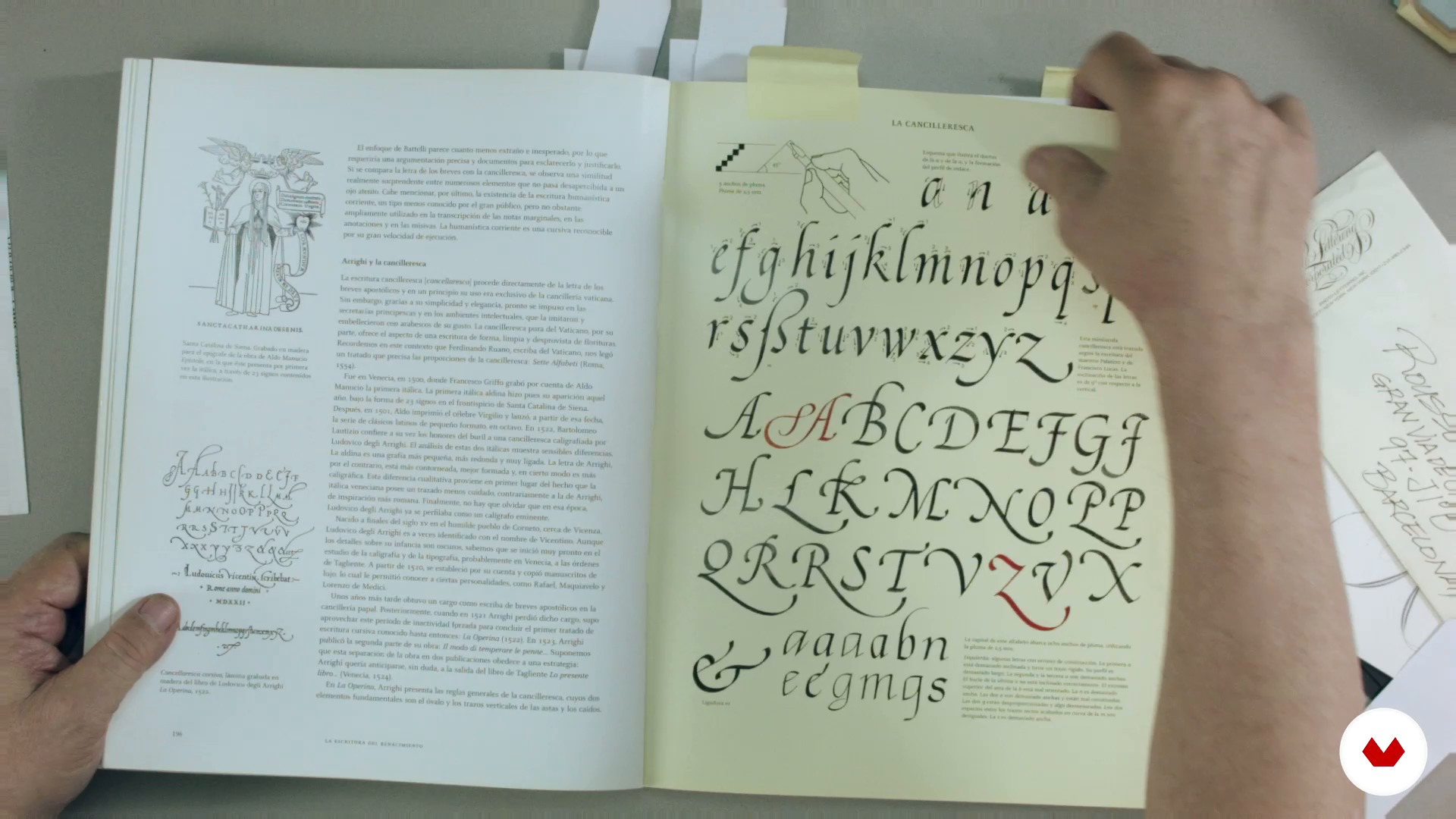
Influences
14 minutes, 23 seconds

A bit of history about the chancellery
12 minutes, 37 seconds

Writing tools 1
17 minutes, 0 seconds
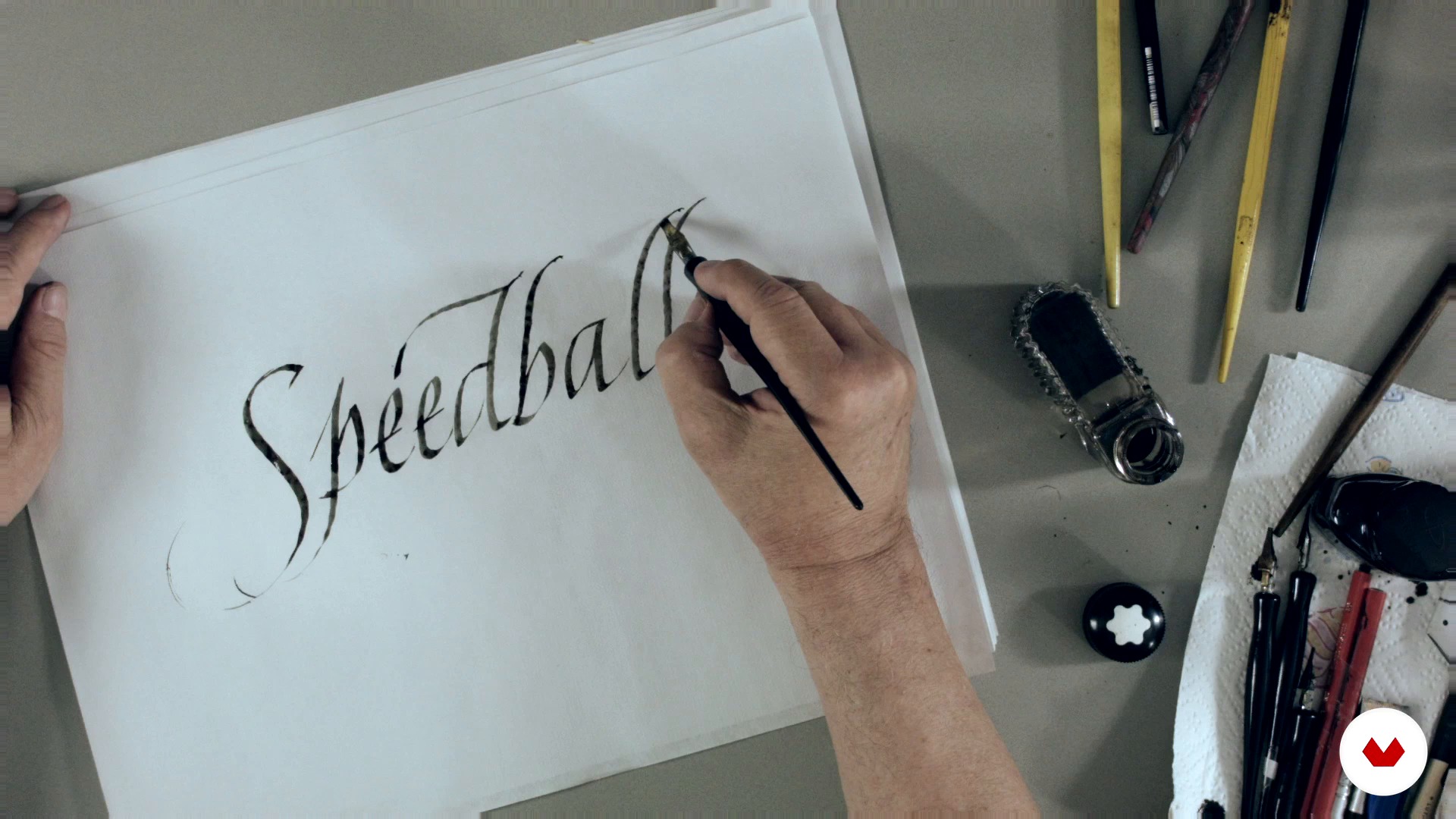
Writing tools 2
7 minutes, 3 seconds

Paper
2 minutes, 48 seconds
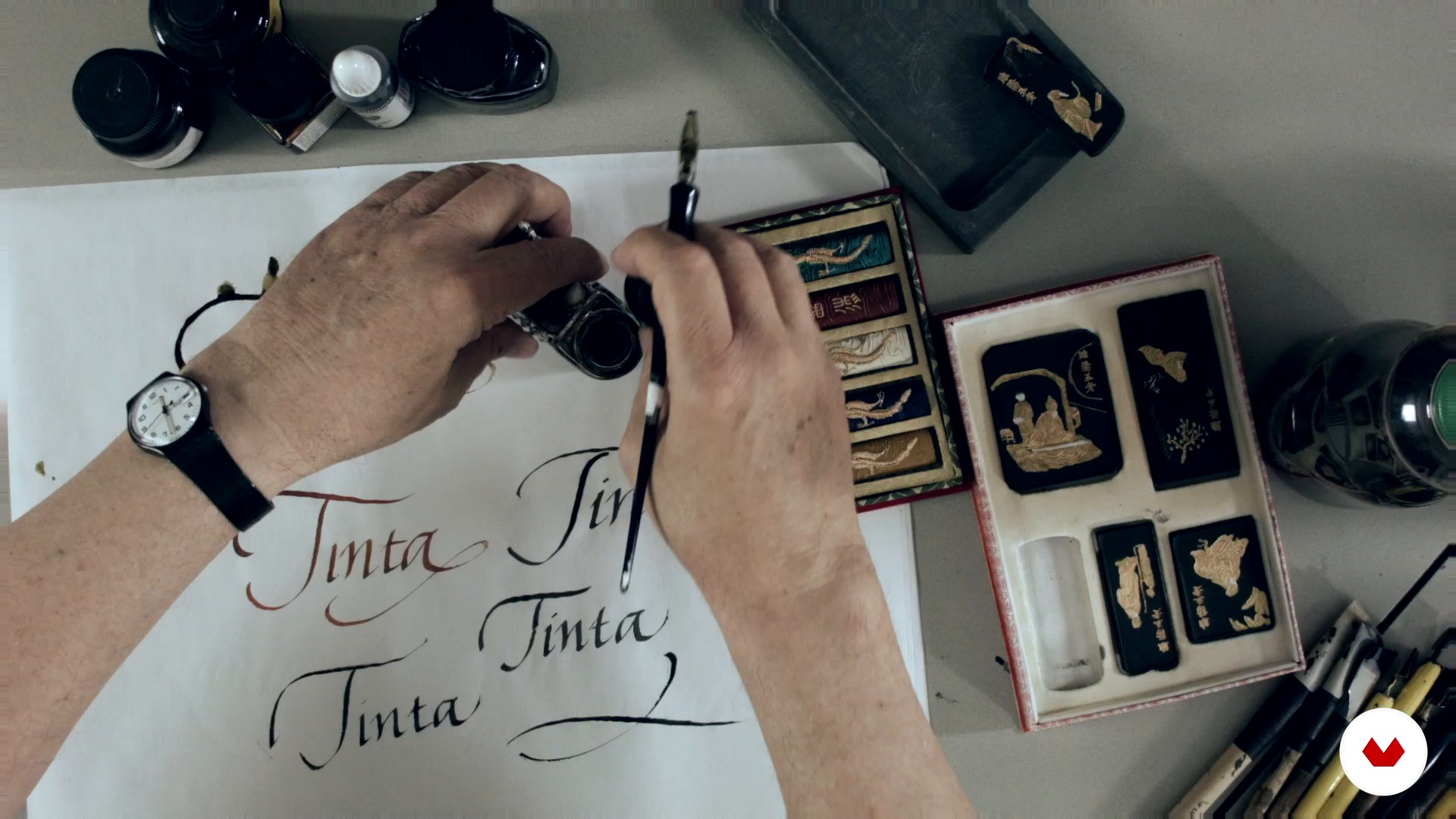
The inks
11 minutes, 40 seconds
What's included in this course?
Begin by learning about Ricardo Rousselot's career and work, then delve into the authors, books, and images that have influenced him the most.
Discover the history of Chancery hand and the necessary tools for writing: pens, inks, and paper.
Afterwards, Ricardo explains the ductus, that is, the method, direction, sequence, and speed at which the strokes or features that make up the letters are drawn.
When you're ready, it's time to start writing. Following Rousselot's indications, learn to master the morphology of the letter, the spacing, and interlettering, as well as the upper and lower case letters.
At the end of the course, after numerous exercises, use Chancery hand to draw an EX LIBRIS or personal mark, adding the ornamentation typical of the period, although modern today.
What is this course's project?
Once you have learned this beautiful and versatile lettering, design an Ex Libris (stamp, label, or seal that used to be placed on the cover of a book and that contains the name of the owner of the copy) or personal mark decorated with pen strokes.

Projects by course students


Who is this online course for?
Anyone interested in calligraphy, with curiosity and the desire to create with their hands.
Requirements and materials
No prior knowledge of calligraphy is necessary. As for materials, you need a wide pen, walnut ink, and kraft paper. You are also provided with a list of addresses where you can buy them.

Reviews
- 9 months ago
Muy buena explicación, aprendí mucho
- 1 year ago
Maravilloso
- 1 year ago
Curso fantástico, el profesor es lo mejor, muy natural, como si estuviera a tu lado.
- enrqalejandroPLUS1 year ago
Un curso maravilloso.
- 1 year ago
Es un curso muy completo, explicado muy bien y recuerdo bien esta frase "La única manera de aprender es haciendo lo". me encantó. Es una completa inspiración escucharlo y aprender de él.

In 1962, he moved to the city of Chicago, and began working at the Ficho & Corley studio. As a designer, he collaborated on publications such as Playboy Magazine, in numerous advertising campaigns for leading agencies such as Wunderman Thompson, Young & Rubicam, and packaging lines for Libbys, Bordens Milk, Seven Up, RG Dunn Tobbaccos, Kleenex Tissues, Kraft Foods, and Conqueror papers, among others. During his stay in Chicago, a lot was happening in Europe in the field of design, with the style of the Swiss School (Helvetica and Univers) leading the fore.
In 1975, he settled in Barcelona, influenced by his Modernist career and established his own design, corporate image, and packaging studio. Already in his own studio, using his knowledge of calligraphy and typography, he designs premium packaging: tobacco, perfumery and liquors for companies such as Tabacalera, Tabacanarias, Tabacos de Filipinas, Domecq, Larios, Miquel y Costas & Miquel (Smoking), Perfumerías Dana, Elida Gibbs, Puig y Myrurgia, La Casera, Kass, and Nutrexpa.
He designed the logo of the newspaper LA VANGUARDIA. In 2009, he redesigned the current logo of this prestigious newspaper.
Rousselot, Designers, from the year 2000 it is called Grupo Erre, SCP counts among its clients Casa Tarradellas, Hacendado, Spanair Líneas Aereas, Reckit Benckiser, Bic Iberia, Miquel and Costas & Miquel, (Smoking), Friskies Purina, Nestlé Purina Petcare, BORGES, Agrícola Marcilla, Juvé & Camps, Casa Claramunt and the wineries: Cavas Avinyó, Miguel Merino, and Borton World Brand. Panrico, Dom Perignon, Nike, Gallina Blanca and MN&A, reusable stands, have recently been added.
Rousselot can be described as a scribe, calligrapher, designer, letter artist... whatever he is called, he is definitely a lover of letters. He has devoted practically his entire life to it in his designs, recently all of which has been very well reflected in the work, jointly published by the Museo de la Illustració i la Modernitat de Valencia (MuVIM) and the publishing house Campgràfic ¡La Calligrafía vive!
Content
- U1
This is me
- Presentation of my work and the project of the course
- I introduce myself (Part II)
- Influences
- U2
Let's prepare
- A bit of history about the chancellery
- Writing tools 1
- Writing tools 2
- Paper
- The inks
- U3
Writing Chancellor's
- The Ductus, guided and modules
- Morphology of the letter
- Interlinear, interletrado, digraphs and additional letters
- Uppercase, lowercase, numbers and interrogations
- Continuous writing (Part I)
- Continuous writing (Part II)
- U4
We are going to make an Ex libris
- Creation of the Ex libris (Part I)
- Creation of the Ex Libris (Part II)
- Ex libris application
- FP
Final project
- Calligraphy for an Ex libris
What to expect from a Domestika course
Learn at your own pace
Enjoy learning from home without a set schedule and with an easy-to-follow method. You set your own pace.
Learn from the best professionals
Learn valuable methods and techniques explained by top experts in the creative sector.
Meet expert teachers
Each expert teaches what they do best, with clear guidelines, true passion, and professional insight in every lesson.
Certificates
PLUSIf you're a Plus member, get a custom certificate signed by your teacher for every course. Share it on your portfolio, social media, or wherever you like.
Get front-row seats
Videos of the highest quality, so you don't miss a single detail. With unlimited access, you can watch them as many times as you need to perfect your technique.
Share knowledge and ideas
Ask questions, request feedback, or offer solutions. Share your learning experience with other students in the community who are as passionate about creativity as you are.
Connect with a global creative community
The community is home to millions of people from around the world who are curious and passionate about exploring and expressing their creativity.
Watch professionally produced courses
Domestika curates its teacher roster and produces every course in-house to ensure a high-quality online learning experience.
FAQs
You’ll learn calligraphy techniques, typography design, creating exlibris, Victorian logos, packaging labels, and digitizing fonts — blending history and hands-on practice to develop creative, professional projects.
This is an intermediate-level course, perfect for those with basic calligraphy or graphic design knowledge who want to deepen their skills and explore advanced techniques and applications.
You’ll need satin paper, calligraphy paper, a broad nib pen, synthetic or natural hair brushes, inks (fluid ink, walnut ink, aniline, liquid watercolor), plus basic drawing tools like a pencil and ruler.
Yes, the course covers how to choose the right papers based on technique, durability, and budget, comparing options like satin, craft, and cotton papers.
Yes, you’ll learn how to digitize original fonts and hand lettering for use in graphic projects and digital media.
Absolutely, the course teaches you to create Victorian-style logos and calligraphic labels for bottles and packaging, combining calligraphy with professional typography design.
You’ll practice chancery, gestural calligraphy, Roman brush lettering, and Porteño filigree techniques, focusing on stroke order, modules, and line quality.