
"Planting Gardens." My course project: Floral Watercolor: Connecting with Nature
"Sembrando jardines". Mi proyecto del curso: Acuarela floral: conecta con la naturaleza
de Loli Crespo @lolicrcouselo
- 2,064
- 136
- 16
Hello @inga_buive and the entire Domestika community. First of all, I want to thank Inga for sharing her knowledge of the freehand technique for watercolor painting. I've learned a lot about a technique that seems easy, but nothing could be further from the truth. Letting your hand flow without worrying about realistic perfection is very difficult. Inga brings her knowledge, experience, and, above all, confidence.
I present my project entitled “Planting Gardens” and explain the process I followed.
Before addressing it, I have done the tasks recommended by the teacher, among which I highlight three:
- Tasks to work on the loose watercolor technique.
- Color palette study tasks
- The composition.
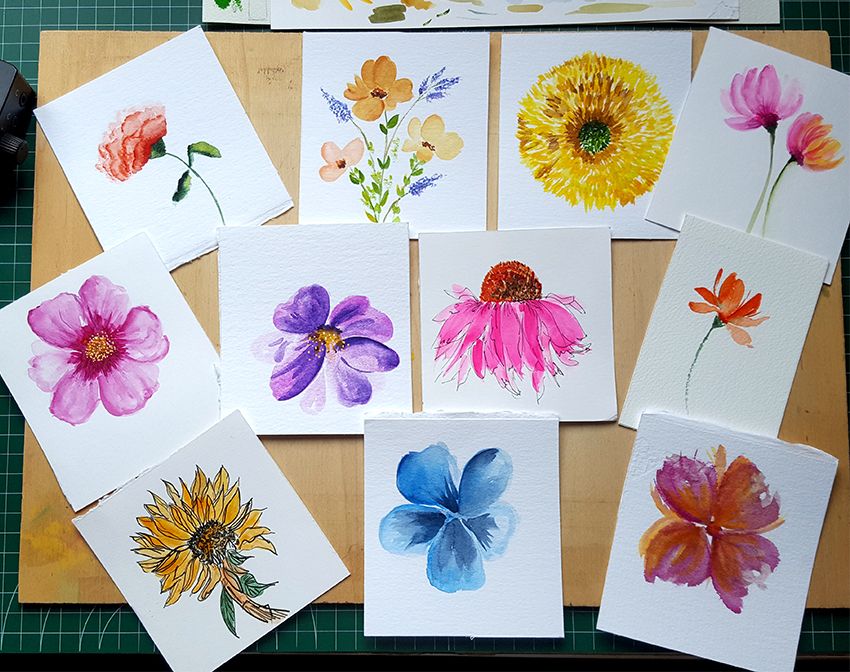
When I cut paper for my compositions, I often have leftover pieces, which I paint mostly with leaves and flowers. It's a fantastic exercise in controlling the water, adapting my hand to the brushes, and playing with different colors. Capturing their shapes while trying to simplify their structure is a fun and educational task, as it requires a lot of practice and determination. I also really enjoy mixing watercolor with other materials such as pencils, crayons, and permanent ink.
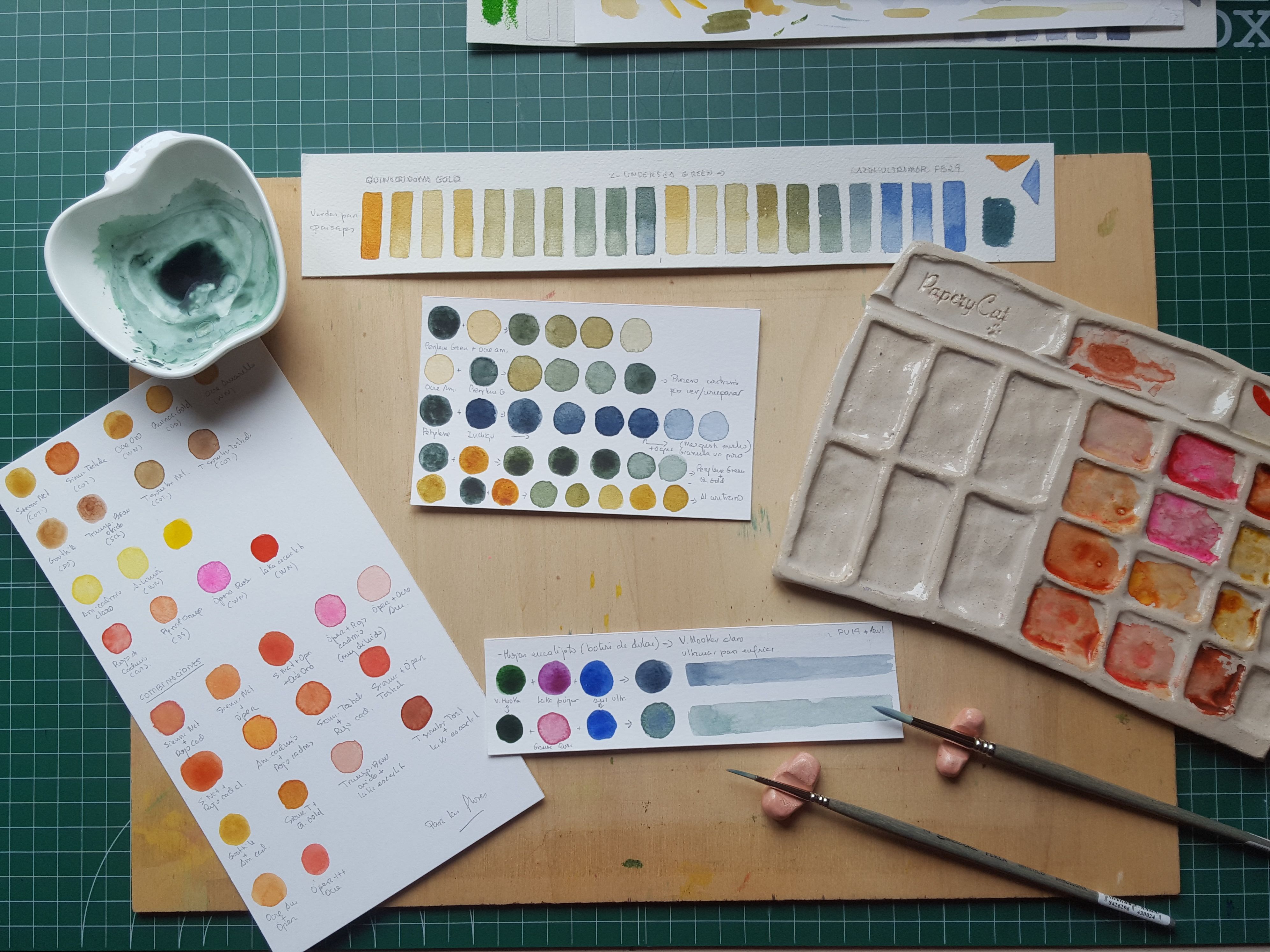
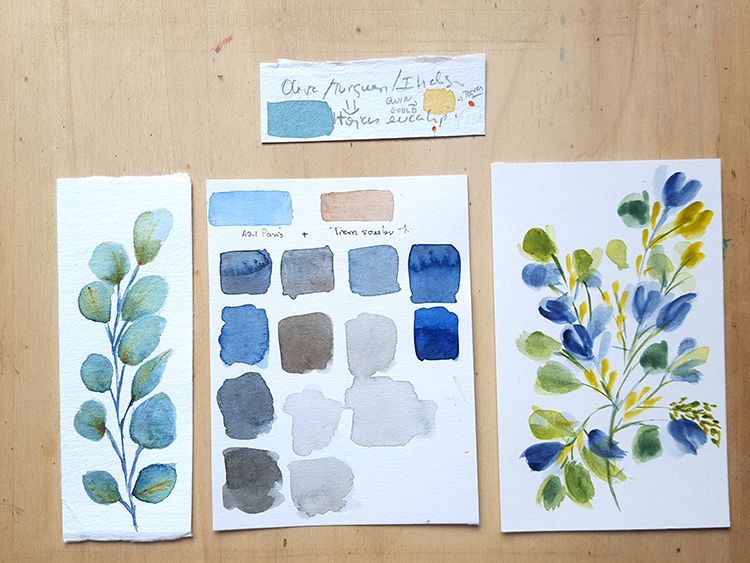
One of my favorite things to do is mix colors. I always start with three single-pigment primary colors and transparent colors (two cool and two warm colors of each) because they're purer and don't get messy when I mix them. This doesn't mean I shouldn't buy multi-pigment watercolors; they're very useful, especially some greens, some oranges, and a violet. Of course, earth tones are essential for my color palette.
For the project, I decided on warm colors with a contrasting green. I drew inspiration from photos or images I've selected from previous projects. I have a very extensive sample that I refer to often. From all the images, I chose the following to create a mood board.
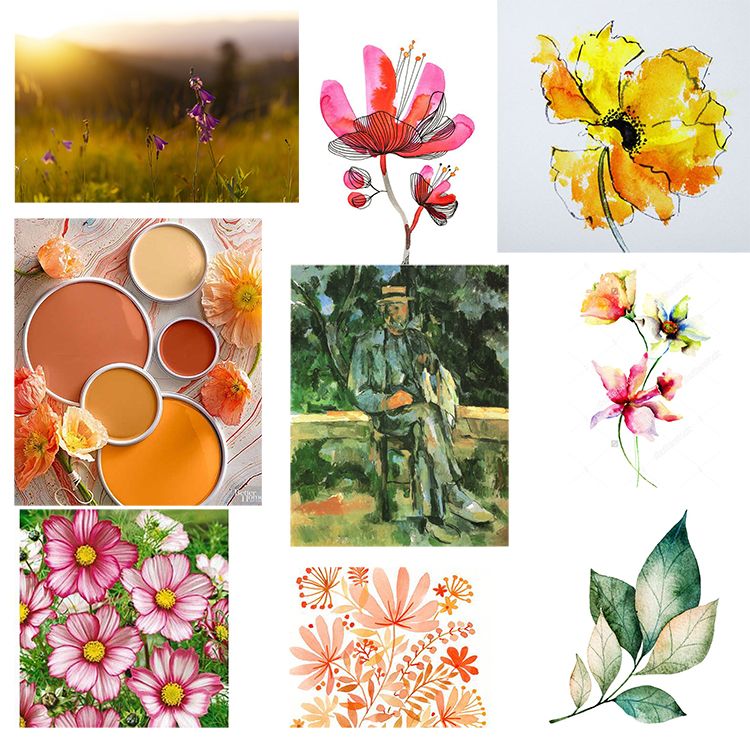
Next, I drew possible illustrations in my sketchbook, following Inga's recommendations and resources on composition. Once I decided what I was going to paint, I began practicing with the previous mixtures to check the tones wet and dry.
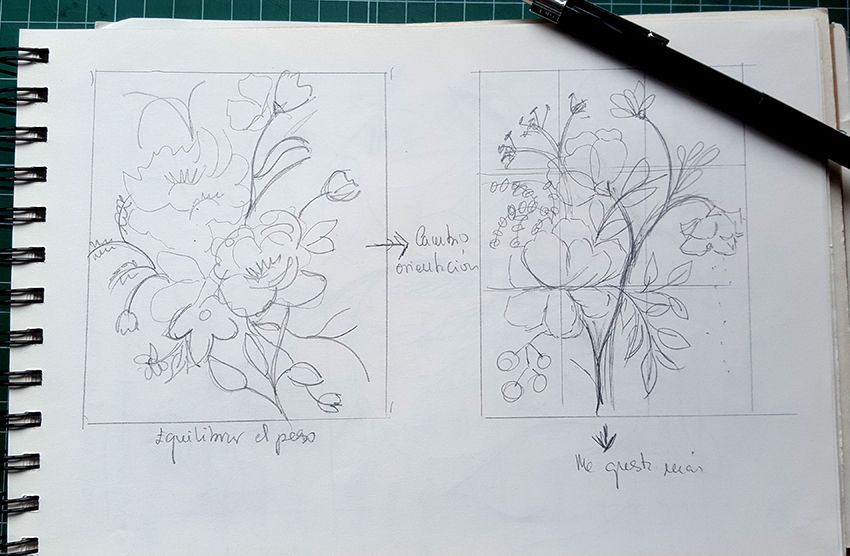
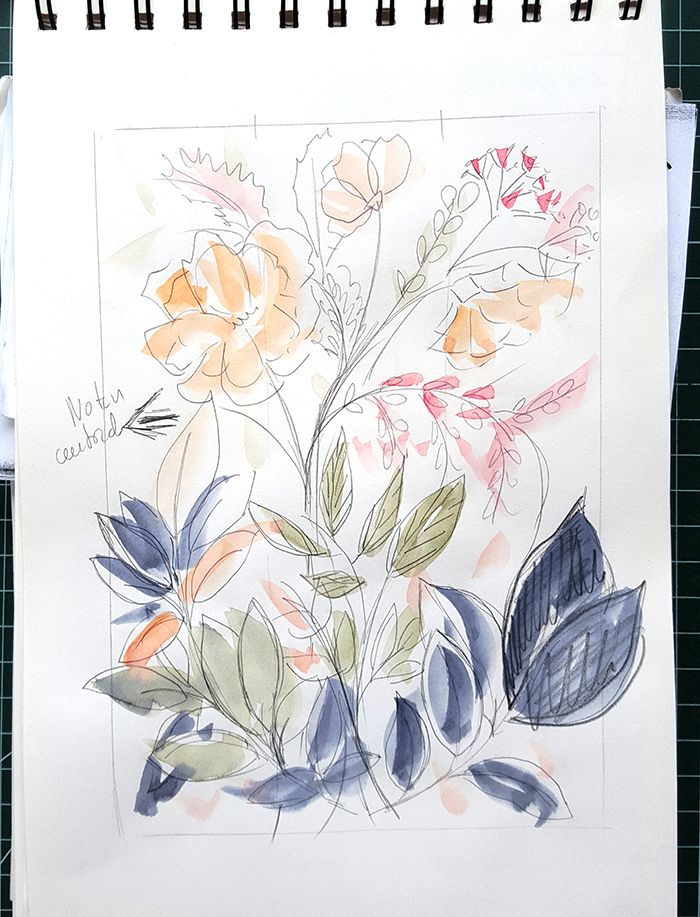
To create the illustration, I used Arches paper, 23x31 cm, 300 gsm cold press, Escoda Pearl brushes, no. 12 – 6 – 2, and Winsor & Newton no. 000.
I use watercolors from Daniel Smith and Winsor & Newton and some from Cotman (the first ones I had and which I'm using up).
Before starting the watercolor, I traced the main leaves and flowers in pencil because I know from experience how to do it correctly. I stretched the Arches paper taut with masking tape to a kraft paper board, dampening it with water to create a wet-on-wet background with warm tones, primarily yellows and ochres. I followed Inga's recommendations and started with the leaves, that is, the dark green tones at the bottom. At the same time, I added more leaves, but toning down the tones (even making them almost transparent) and also adding simpler ones with lines.
Before moving on to the flowers, I let the leaves dry to see the tone of the watercolor once dry. Since the color fades as it dries, I added more brushstrokes, increasing the tone in some of them. The flowers are painted with the warm color mixes I chose for the color palette, and the process was the same as for the leaves.
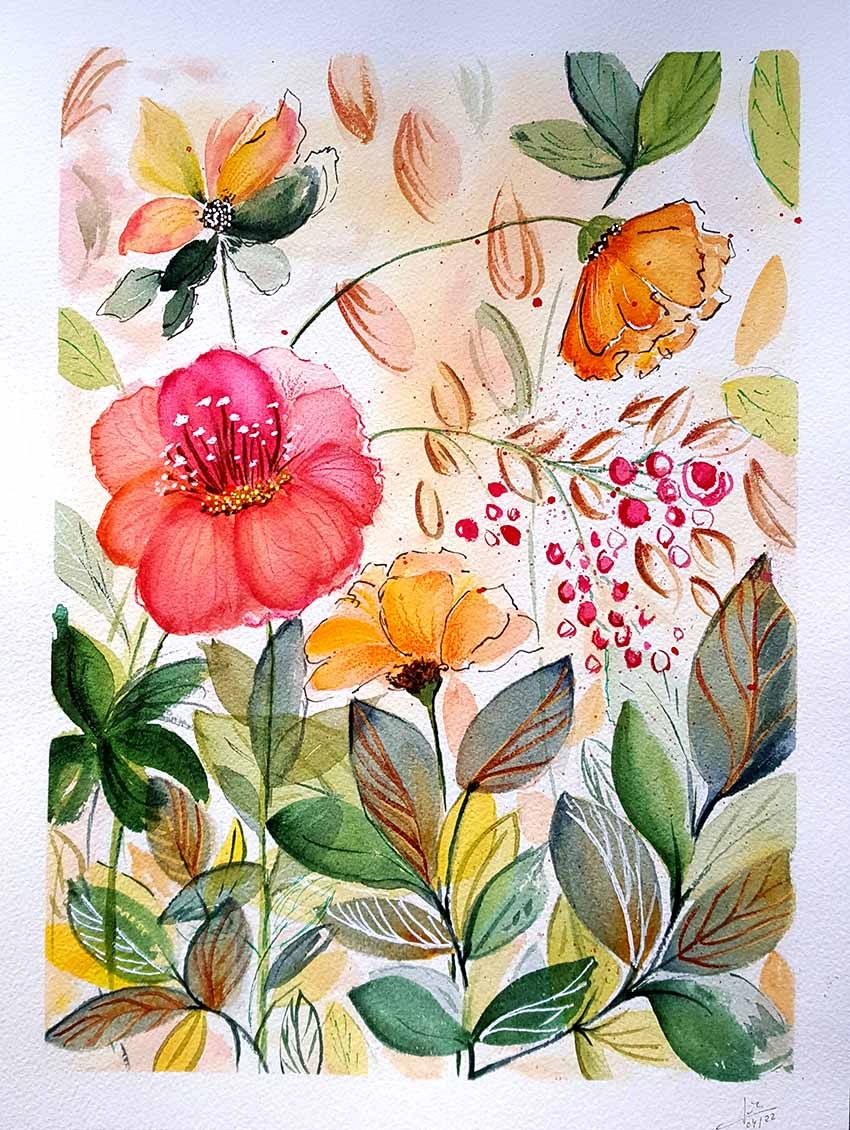
Finally, once the entire main composition was dry, I randomly painted several motifs in the same color range, although emphasizing the red of the berries. I again emphasized areas that needed more depth by applying darker tones, and in other areas, I added a few falling leaves.
Finally, I gave the final details, which you can see in the splashes, the textures, the lines drawn with watercolors or a white gel pen, as well as a few lines painted with indelible ink and applied with a nib.
The work is finished, I just have to thank Inga again for her teachings, her involvement, and her work.
“It was a pleasure being your student.”


1 comentariu
❤ Poze frumoase 🙏💖❣❣❣
@magic45we Mulțumesc foarte mult.
Mă bucur că îți plac.
Salutări
Frumoasă lucrare!
@lucianamiranda Mulțumesc mult! Lucrare făcută cu multă dragoste. Mă bucur foarte mult că îți place.
Un salut
Frumos realizat.
@newcrejaes Mulțumesc foarte mult.
Toate cele bune
Frumos
@apprila Mulțumesc mult, mă bucur să știu că îți place.
Salutări
Foarte frumos :-)
@justyna_marcel Mulțumesc foarte mult și mă bucur că îți place lucrarea.
Salutări
!Ce frumos!
@marietaac A ieșit grozav, mulțumesc mult
Salutări
Atât de frumoasă, iar imaginea de jos este atât de vibrantă! Este toată acuarelă sau tehnică mixtă?
@lifeinglow , Îți mulțumesc foarte mult pentru comentariu și mă bucur că ți-a plăcut proiectul. Ca să răspund la întrebarea ta, am folosit în principal acuarele, deși am făcut detaliile finale, cum ar fi liniile albe, cu un pix cu gel alb și alte linii cu cerneală neștersă, pe care am aplicat-o cu o peniță.
Sper că răspunsul meu răspunde la întrebarea ta.
Vă mulțumesc încă o dată foarte mult și cele mai bune urări.
@lolicrcouselo Mulțumesc pentru răspuns! Interesant, nu am auzit niciodată de cerneală detașabilă. (Mă bucur că Domestika oferă traducere, încerc să învăț spaniolă, sunt încă începător))
@lifeinglow Sunt cerneluri permanente; adică nu pot fi șterse sau îndepărtate. Există multe mărci, cum ar fi Winson & Newton, Roher & Klingner și așa mai departe.
Conectați-vă sau înscrieți-vă gratuit pentru a comenta