
EL MUNDO QUE CREAMOS
by Alex Vigo @alejandro_vi_go_11
- 382
- 4
- 0
Introducción
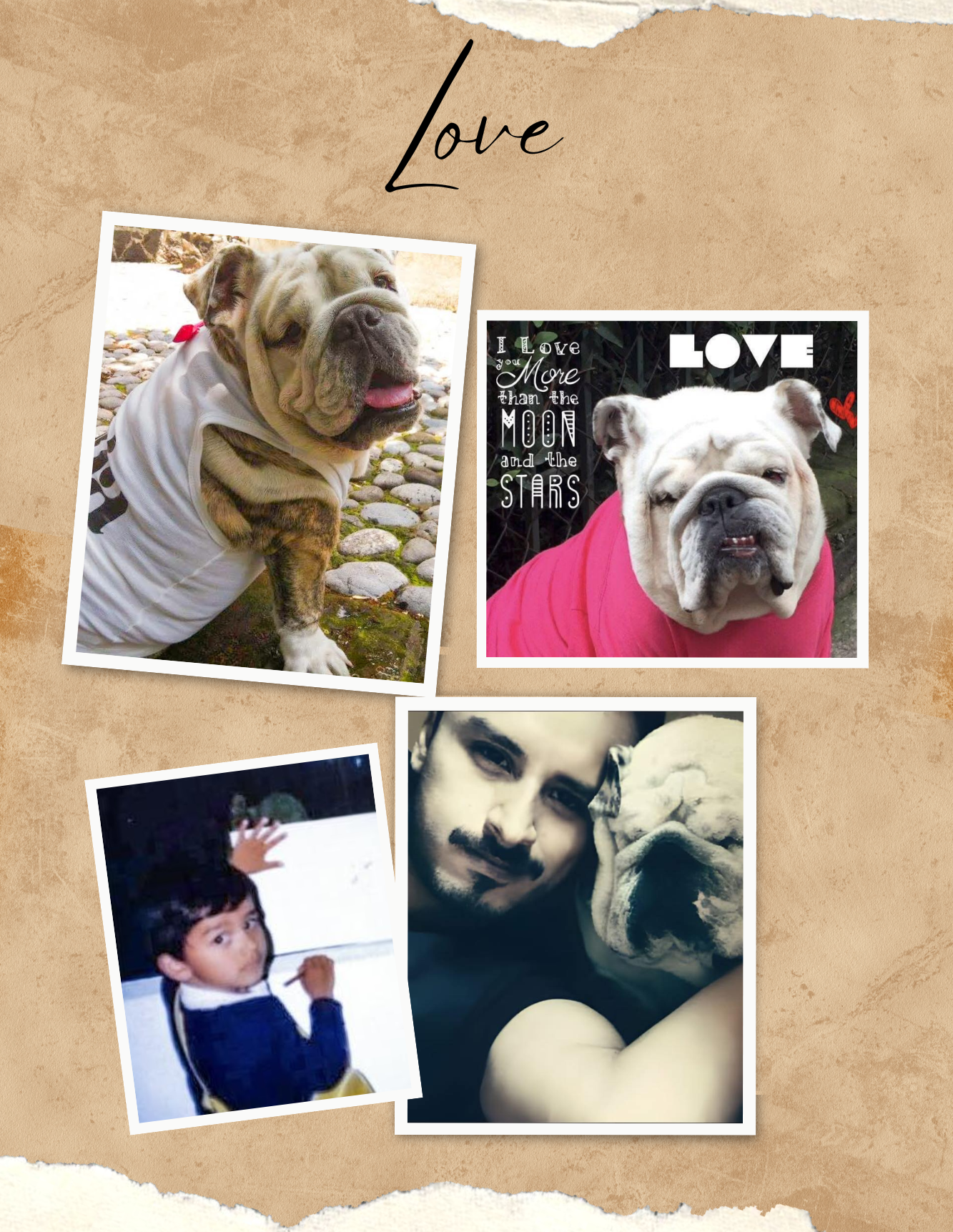
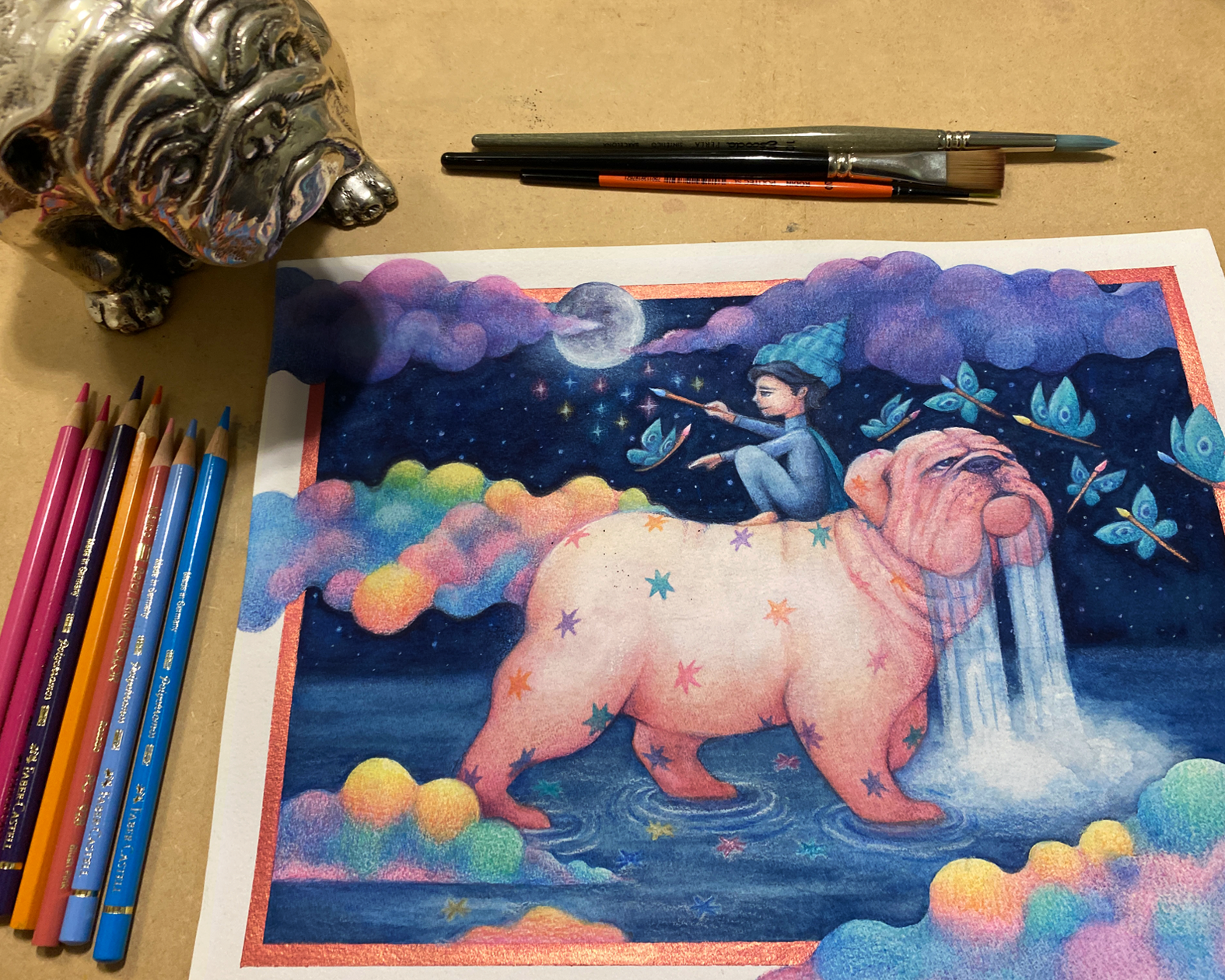
Mi ilustración la hice basada en el mundo que creamos mi perra y yo, ese mundo cotidiano, un mundo especial. Mi bulldog inglés se llamaba Olga y vivió conmigo por 12 años. La amaba, la amo y la amaré profundamente toda mi vida. Y aunque ya no está conmigo porque perdimos la batalla contra el cáncer, mi amor por ella continúa intacto. La perdí hace poco más de un año y desde entonces he hecho varios dibujos y pinturas de ella. Por eso mi inspiré en nosotros para esta ilustración.
Recuerdo que desde muy pequeño me gustaba mucho dibujar y pintar, pero en algún momento de mi juventud dejé de hacerlo y lo retomé cuando Olga llegó a mi vida. Ella trajo alegría, luz y color a mi vida, me devolvió la sensibilidad al experimentar un amor tan puro e incondicional como el que nos dan nuestras mascotas.
Para mi ilustración pensé en unir a ese niño que alguna vez fui y a Olga, ambos ya no existen, pero pensé en qué pasaría si se unieran en una ilustración de fantasía, casi como un sueño lleno de color y con las cosas que nos gustaban a ambos. Así que la idea para esta ilustración fue responder a la pregunta ¿Qué pasaría si ese niño al que le gustaba tanto dibujar conviviera con su perra que tanto amo en un mundo lleno de color y fantasía?
Materiales
Materiales para la fase de idea:
- Fotos de inspiración y referencias (los moodboards los muestro más adelante)
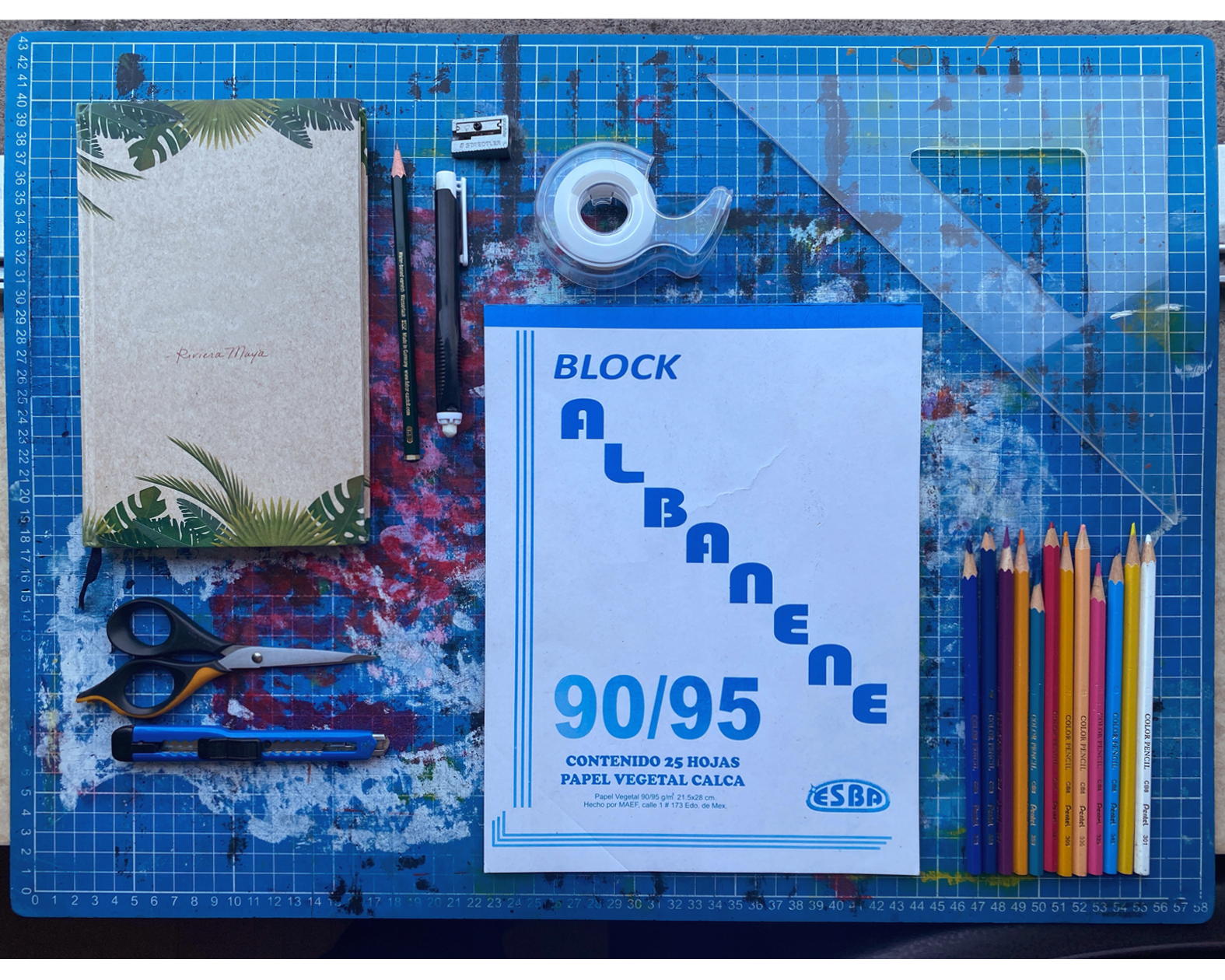
Materiales para la fase de bocetos (foto 1):
- Sketchbook
- Lápiz HB Faber-Castell 9000
- Borrador
- Sacapuntas metálico Staedtler
- Papel albanene o papel de calco
- Cinta adhesiva
- Lápices de color de la marca Pentel (únicamente usé tonos de amarillo, rosa y azul)
- Tabla de corte
- Escuadra sin bisel
- Cutter o tijeras
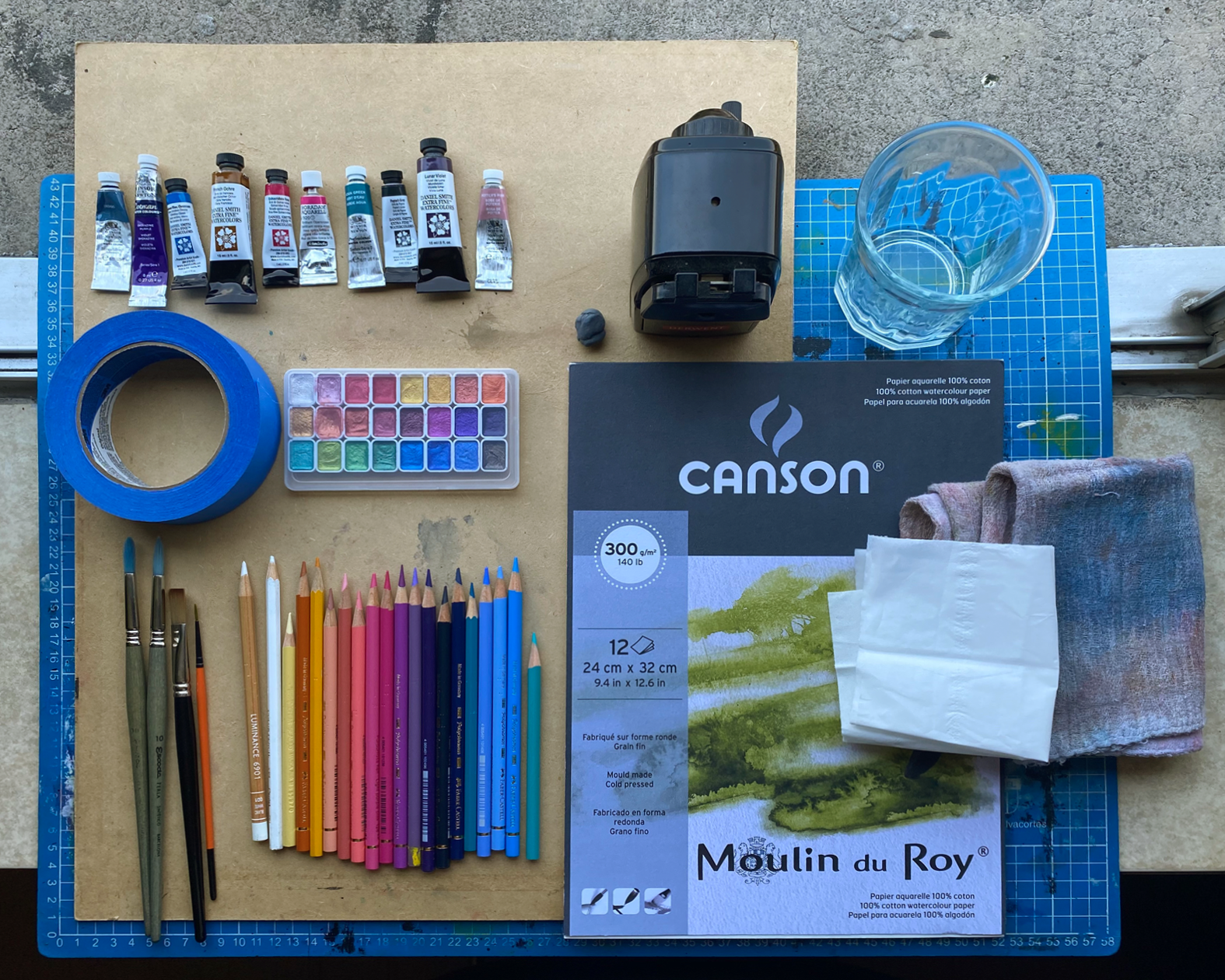
Materiales para la ilustración final (foto 2):
- Papel para acuarela Moulin du Roy de Canson, 300 grs, 100% algodón , Cold pressed, 24cm x 32cm
- Cinta azul para enmascarar Scotch
- Base de madera para fijar el papel
- Acuarelas Winsor & Newton, Daniel Smith y Schmincke:
Indigo (W&N)
Cerulean Blue, Chromium (DS)
Dioxazine purple (W&N)
Quinacridone Rose (DS)
Brillant Opera Rose (Schmincke)
French Ochre (DS)
Aqua Green (W&N)
Paynes's Gray (DS)
Lunar Violet (DS)
Potter's Pink (W&N)
- Pinceles: 2 pinceles Escoda Perla número 10 (uno nuevo y uno viejo), un pincel recto de la marca Jacksons tamaño 1/2'', y pincel fino doble cero de la marca Rodin
- Recipiente para agua y un trapo
- Pañuelos desechables
- Lápices de colores Pentel, Polychromos de Faber-Castell, Prismacolor y Luminance de Caran D'Ache:
White 001 Luminance Caran D'Ache
White 301 de Pentel
Cream 914 Prismacolor
Terracota 186 Polychromos
Amarillo 309 Pentel
Cinnamon 189 Polychromos
Blush Pink 928 Prismacolor
Salmon 130 Polychromos
Light Purple Pink 128 Polychromos
Fuchsia 123 Polychromos
Crimson 134 Polychromos
Lilac 956 Prismacolor
Mauve 249 Polychromos
Dark indigo 157 Polychromos
Indanthrene blue 247 Polychromos
Aqua green 353 Pentel
Light ultramarine140 Polychromos
Skybue 146 Polychromos
Middle phtalo blue 152 Polychromos
Light Aqua 992 Prismacolor
- Borrador moldeable Staedtler
- Sacapuntas Super Point Derwent
- Acuarelas con glitter (desconozco la marca, la paleta me la regaló un amigo)
Materiales para edición de la ilustración final:
- Scanner
- Laptop con Adobe Photoshop
Fase 1. La idea
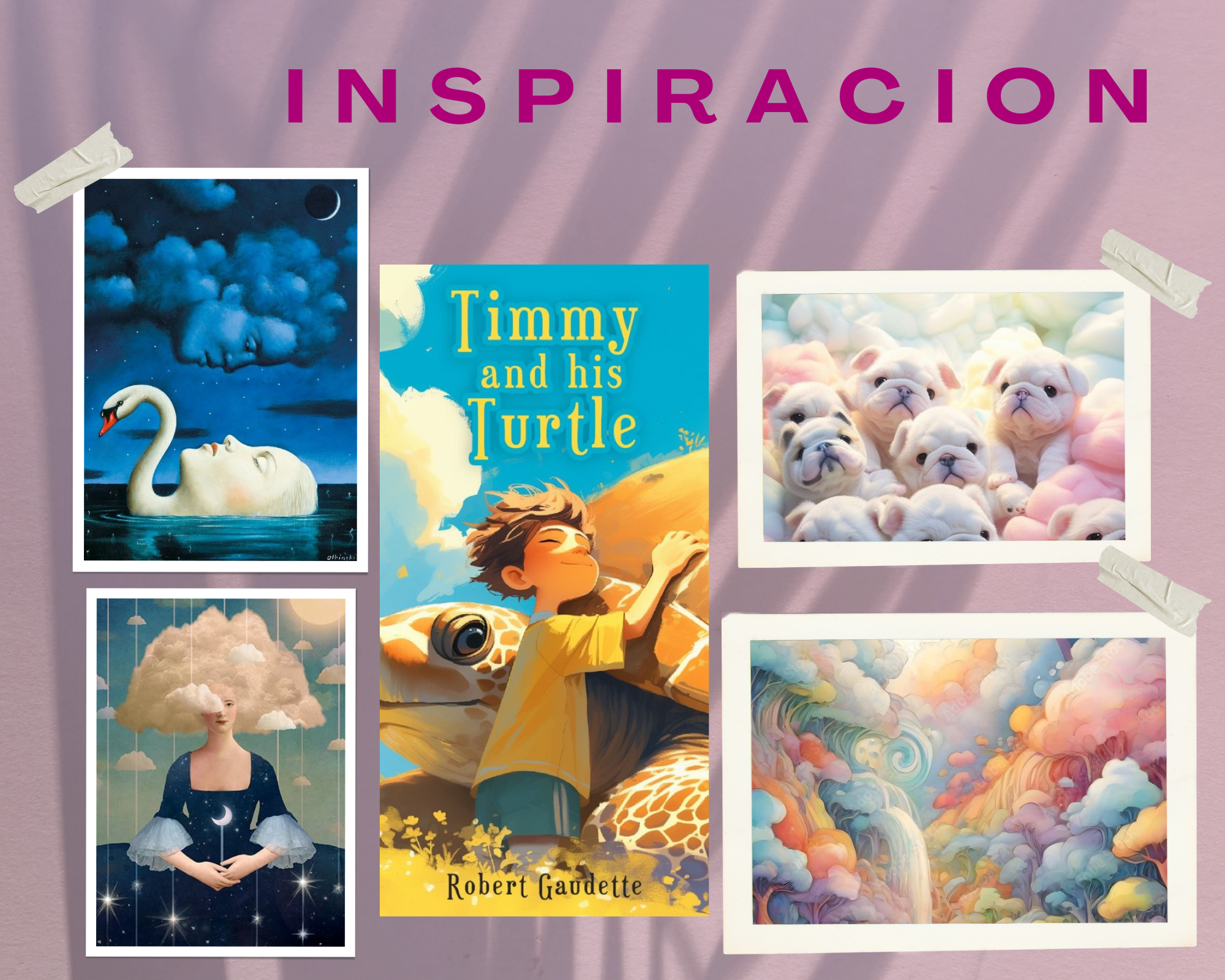
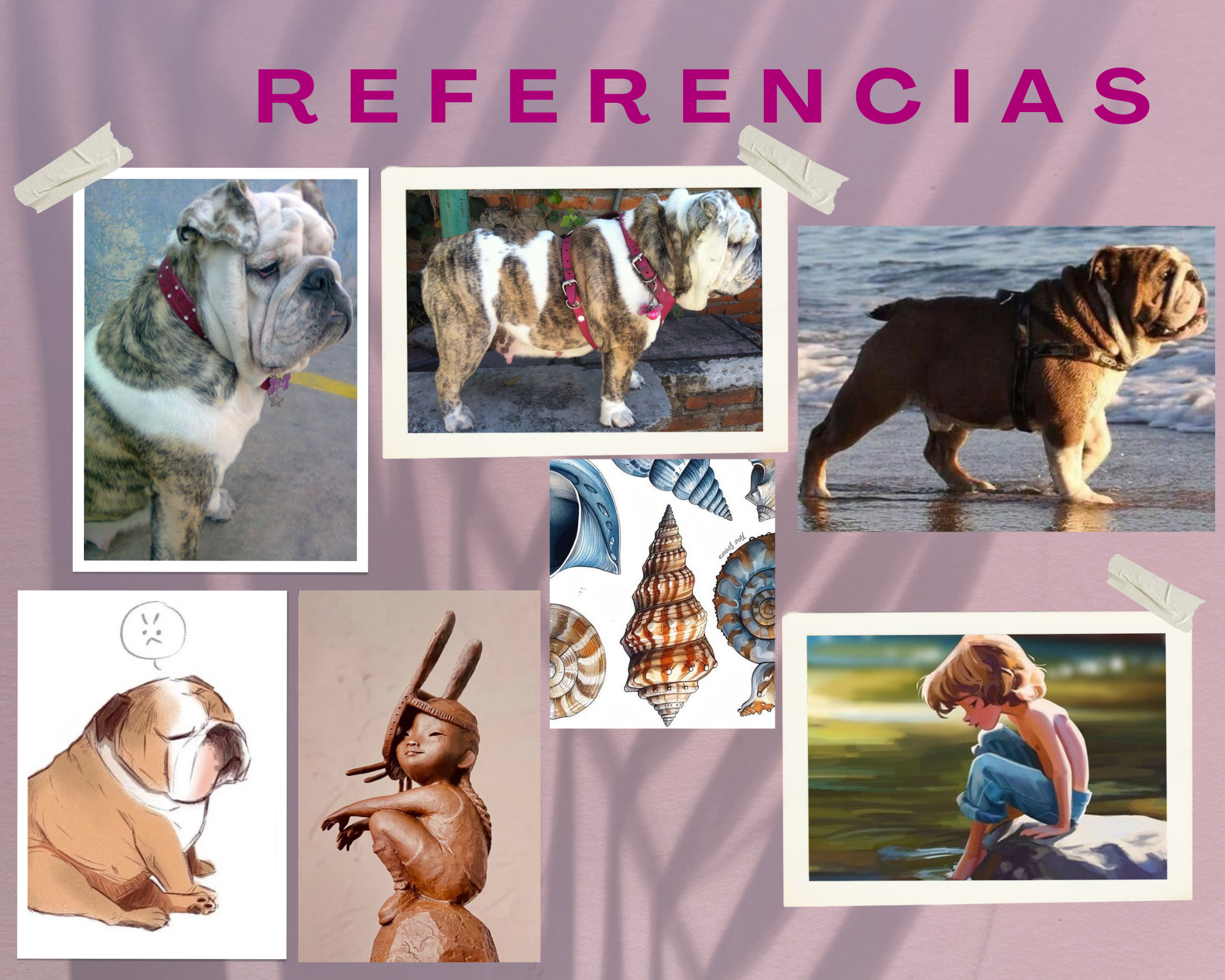
Como decía previamente, mi idea era juntar a mi perra y a mí mismo en mi versión infantil. En la realidad nunca coexistieron, pero de alguna forma su presencia en mi vida hizo que ese niño resurgiera. Deseaba representar una escena en un mundo onírico, con elementos de fantasía y mucho color. Para ello, busqué algunas imágenes de inspiración como lo fue el arte surrealista y también inspiración en el tipo de dibujo ya que quería algo sencillo, al estilo caricatura y con poco realismo.
En este punto sólo tenía claro que me gustaría que en la escena hubiera algunas nubes y un arcoíris. Primero, para dar un ambiente onírico. Segundo, para representar cuando se dice que nuestras mascotas cruzan el puente arcoíris para dejar de estar con nosotros y van al cielo. Y finalmente, para que se viera algo colorido y lleno de fantasía, como la felicidad que sentía cuando tenía a mi perra conmigo y cuando redescubrí mi gusto por el dibujo y la pintura.
Fase 2. Los bocetos
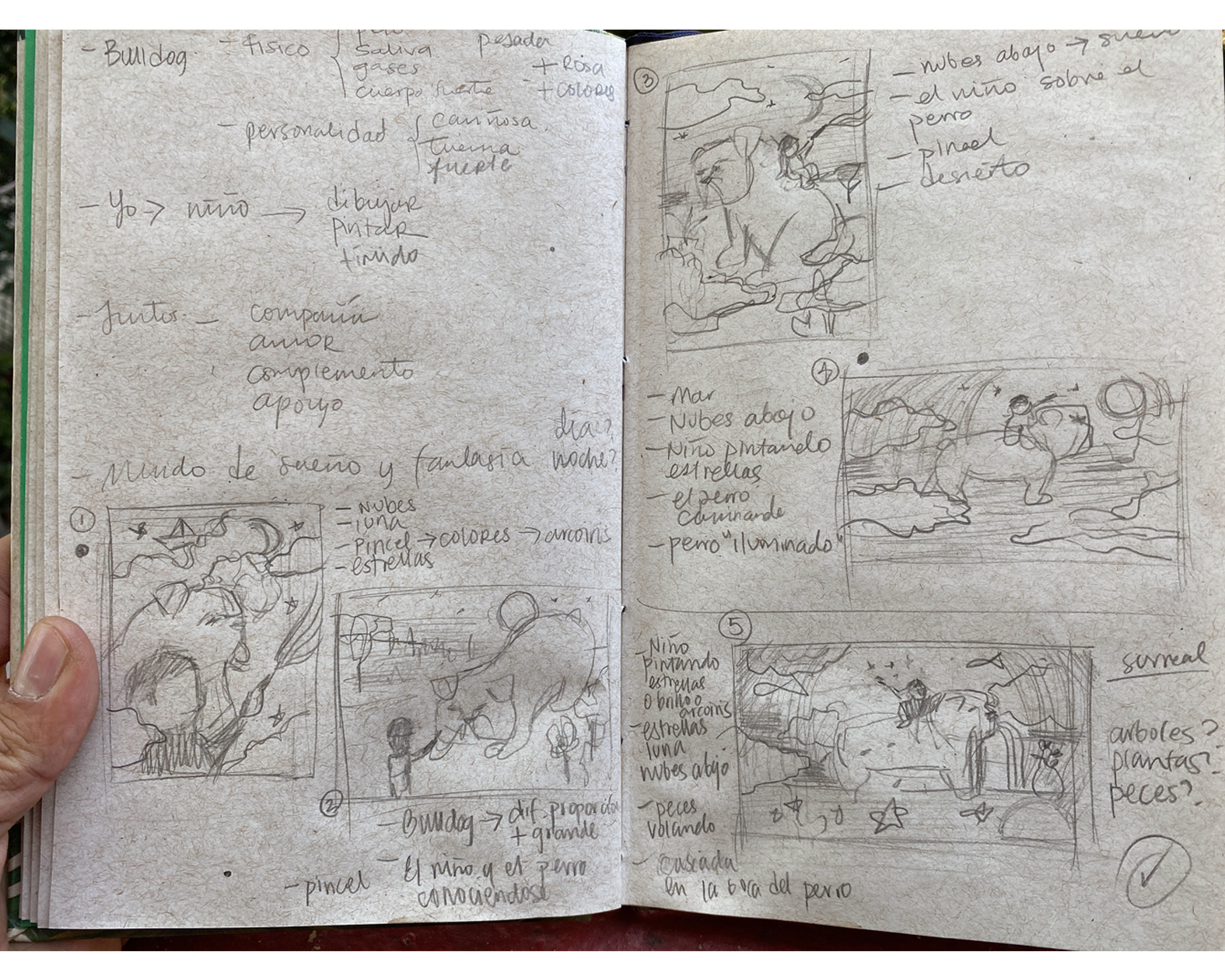
Para iniciar a bocetar, primero comencé escribiendo lo que mi bulldog representaba en mi vida, sus características físicas propias de su raza, y su personalidad. También escribí sobre lo que me gustaría representar mi niñez, mi físico, mis gustos y personalidad. Por otra parte, también escribí sobre nuestra relación y lo importante que fue para mí.
Partiendo de eso, inicie realizando bocetos muy pequeños en mi sketchbook, rápidos y sin detalles. Y escribía a un lado lo que me gustaba de cada uno. Hice 4 pequeños bocetos probando entre la posición horizontal y vertical de la hoja, probando diferentes ubicaciones y proporciones de los personajes principales así como del ambiente y detalle.
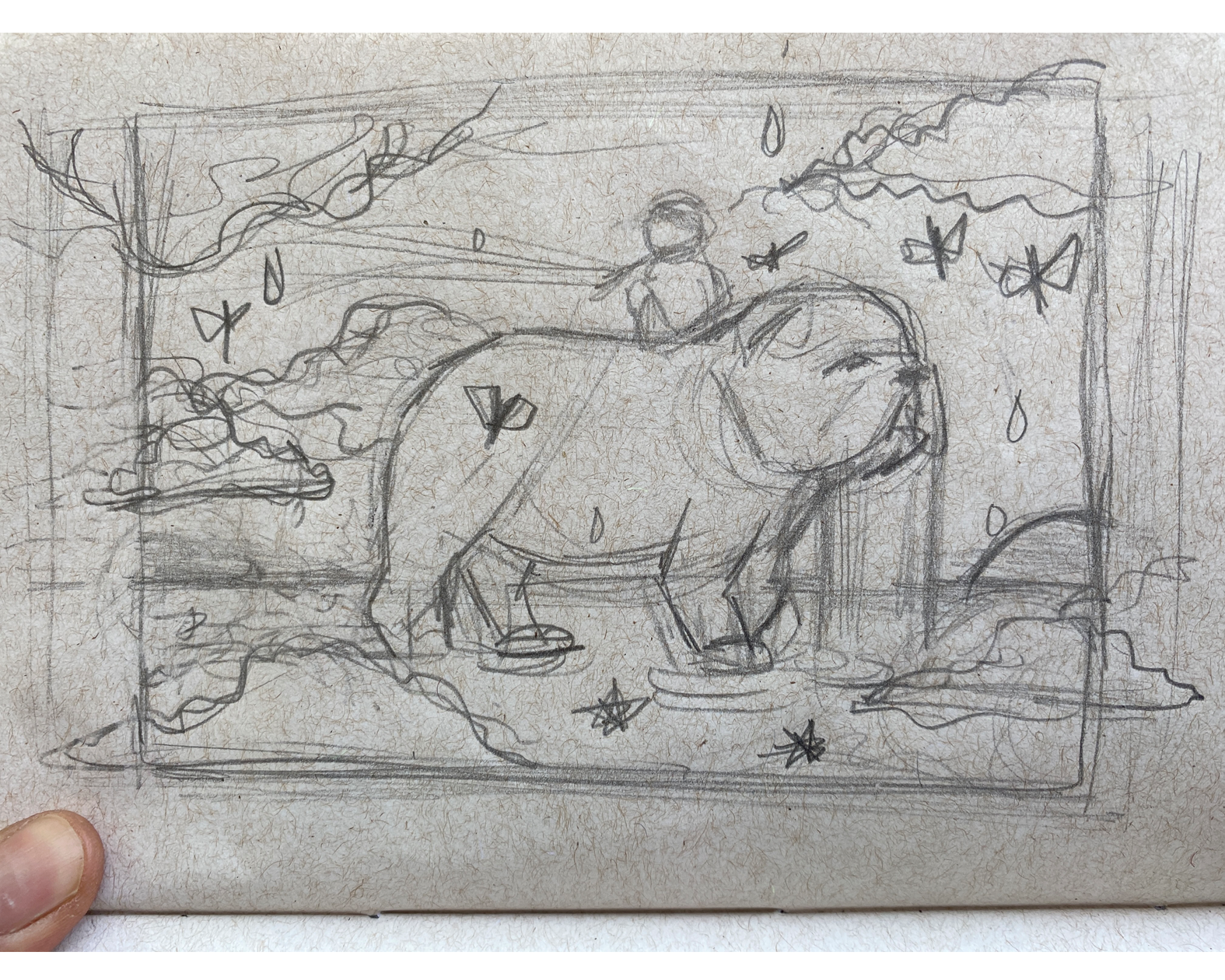
Finalmente realicé un quinto boceto, en el que reuní lo que más me gustó de los 4 bocetos previos. Y después hice ese mismo boceto pero un poco más grande para definir un poco más los elementos que quería dibujar en la ilustración.
Fase 3. Comenzando a dibujar la ilustración y definiendo los colores
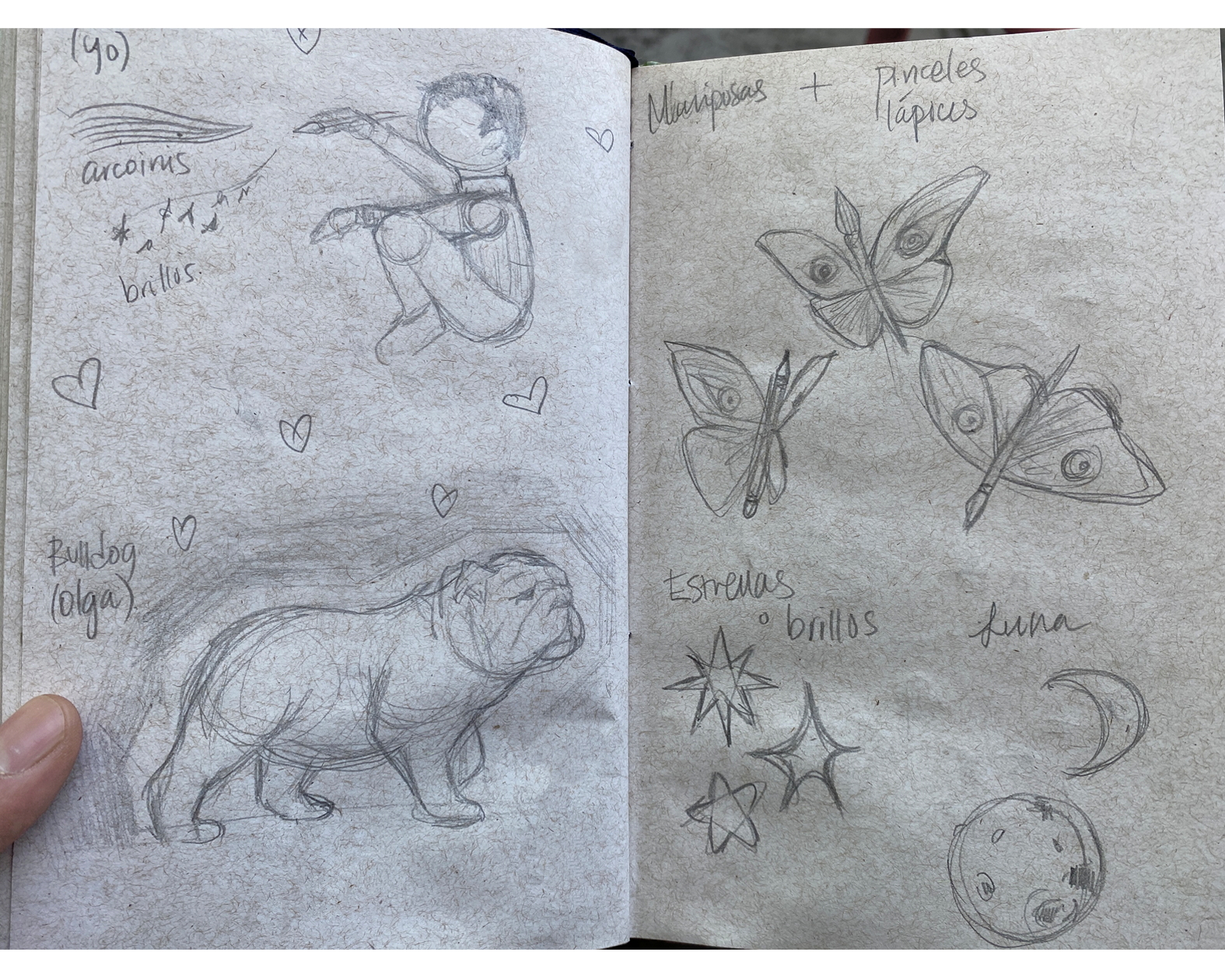
Defiendo la base del boceto general empecé a dibujar con referencias a cada uno de los personajes, tanto al bulldog inglés como al niño. Estuve probando posiciones, posturas y cómo se verían. En esta fase me gusta dibujar los elementos en el papel para calcar. De esta forma, si quiero cambiar algo de su aspecto no tengo que dibujar otra vez desde cero, sino solamente calcar. Además al tener los elementos por separado puedo ir encimando los dibujos e irlos moviendo hasta encontrar la ubicación que más me guste ya que el papel albanene o de calco al ser translúcido me permite ir dibujando sobre capas hasta encontrar la ubicación que me guste de cada elemento.
En esta fase, dibujo los elementos en su aspecto más general porque lo que más me interesa es la composición. Es importante intentar dibujar los elementos al tamaño real desde un principio para que funcione esta técnica de estar calcando continuamente mis propios dibujos.
Para el bulldog inglés me basé en una de mis fotos de referencia y luego lo fui modificando para darle un aspecto más de caricatura o infantil. Fui simplificando y exagerando su aspecto. En el niño probé algunas posiciones y en este punto pensaba dibujarlo con una gorra porque de niño me gustaba mucho usar gorras.
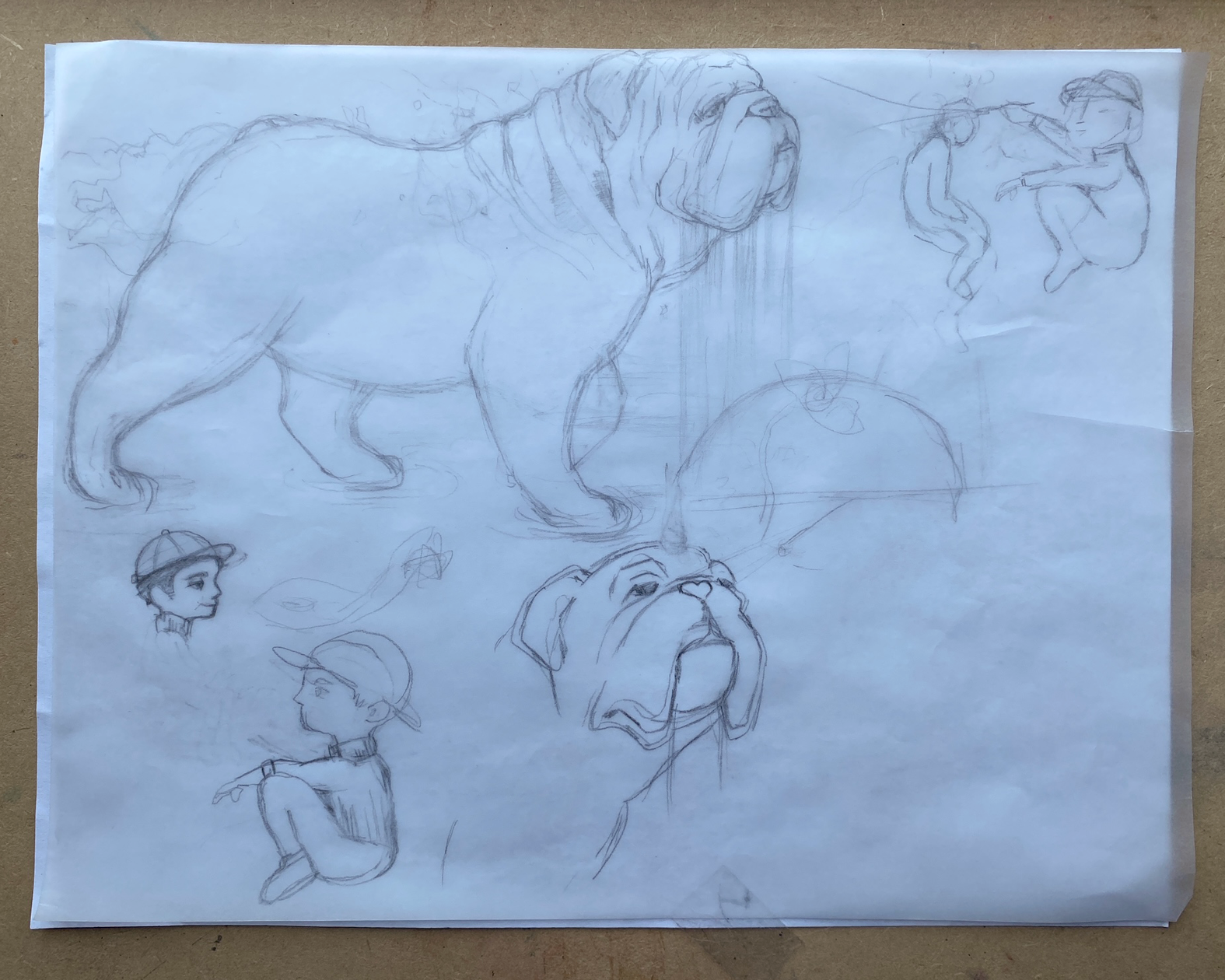
3.1. Primer acercamiento al dibujo
Después empecé a dibujar las nubes, la luna, el mar y evaluaba en dónde ubicaría las mariposas-pinceles. Al perro se me ocurrió dibujarle unas estrellas en su pelaje.
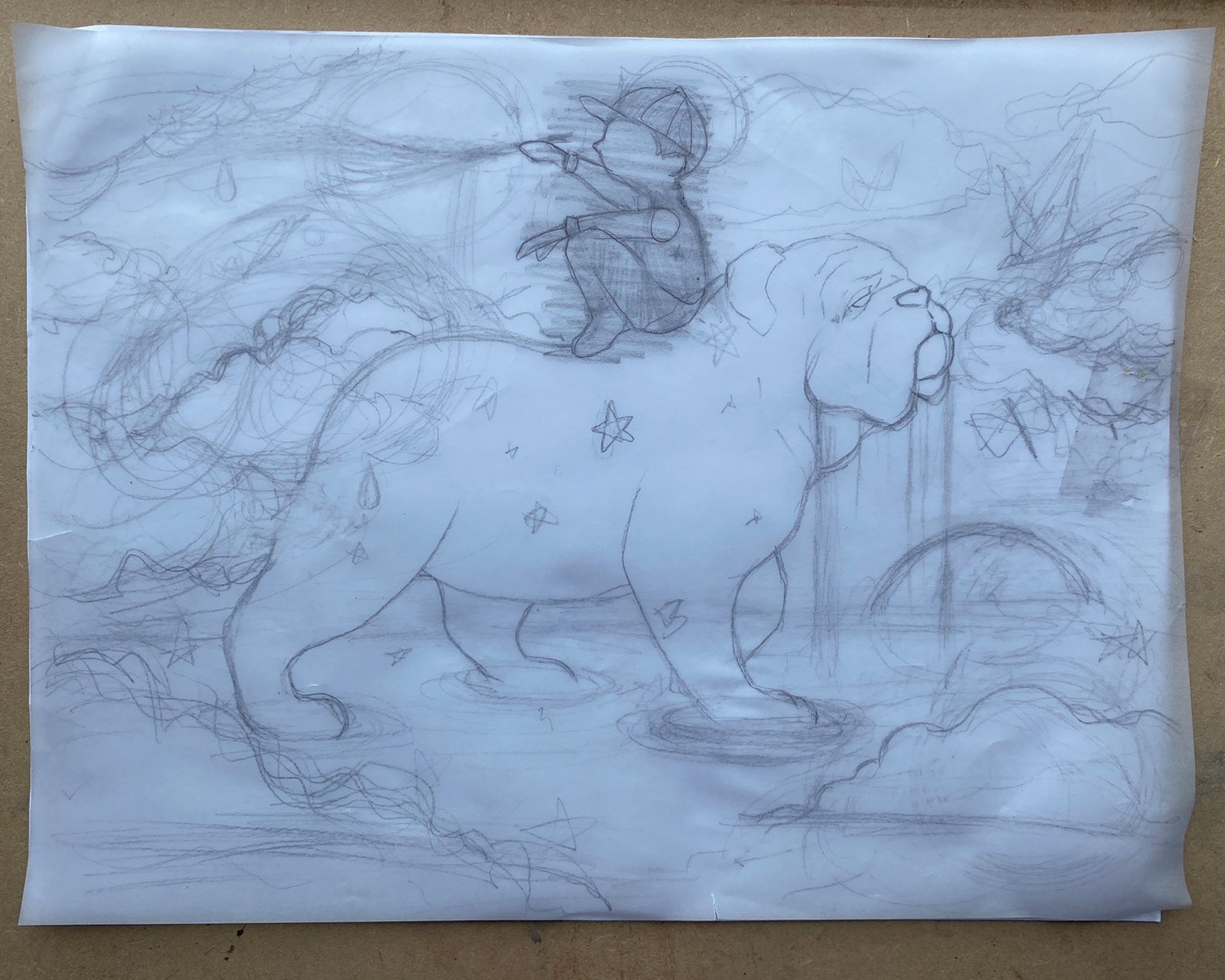
3.2. Modificaciones al dibujo
Si bien me había gustado ese primer boceto decidí modificar la posición de la cabeza del bulldog para que no estuviera de perfil sino 3/4 para que se vieran más sus facciones. También decidí modificar el aspecto del niño porque no me daba el aspecto onírico que quería. Por esta razón decidí que el niño tendría apariencia de un pequeño mago. En lugar de la gorra, utilizaría un sombrero de caracol de mar y además le puse una capa.
Continué detallando las nubes, la luna, las mariposas-pinceles y pensé en agregar una cascada que salía de la boca del bulldog.
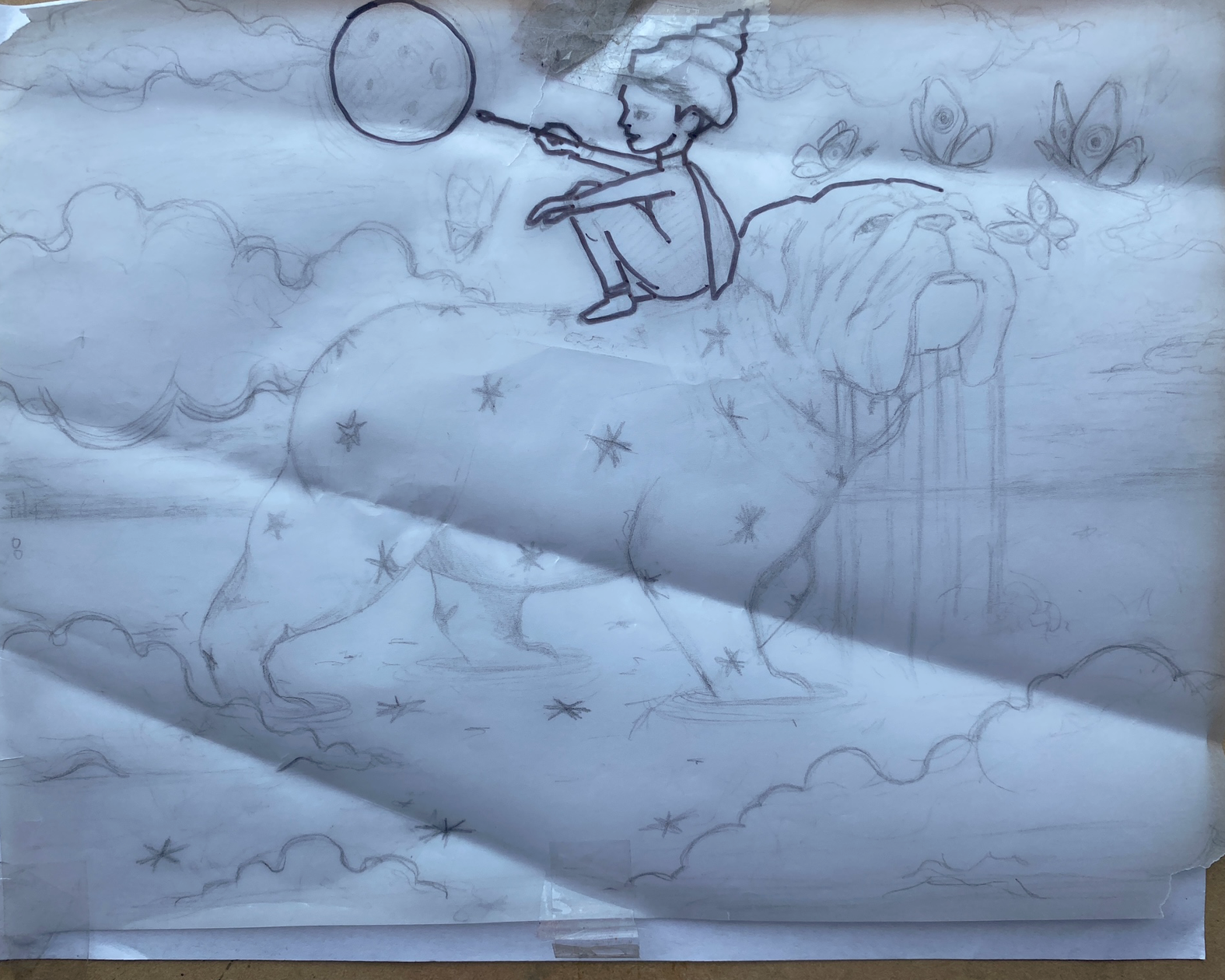
3.3. Dibujo final a tamaño real
Con la composición más o menos definida, volví a cortar papel para calcar a tamaño real, pulí aún más el dibujo y pensé que las alas de las mariposas simularían ser ojos. También pensé que del pincel del niño saldrían algunos destellos o brillos. Y aquí fue donde se me ocurrió que me gustaría que algunos elementos simularían "salir" de la ilustración. Y para enfatizar esta idea, agregaría un marco simulado.
Quedé muy contento con el dibujo final. Me agradó la composición y siento que logré esa sensación onírica y surreal que deseaba desde el inicio. Además me gustó porque todos los elementos que agregué están ahí por un motivo y significan cosas para mí.
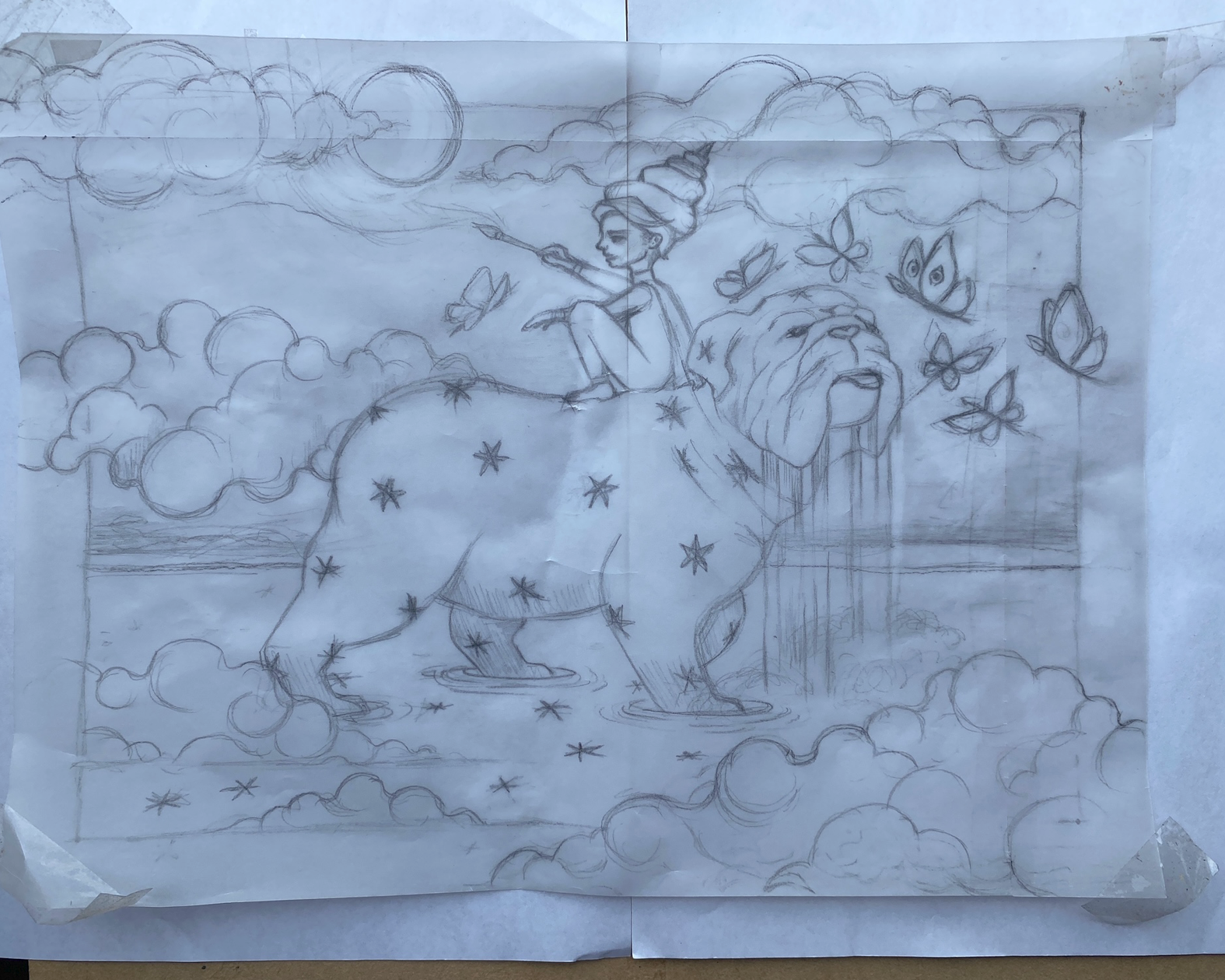
3.4. Definiendo los colores para la ilustración
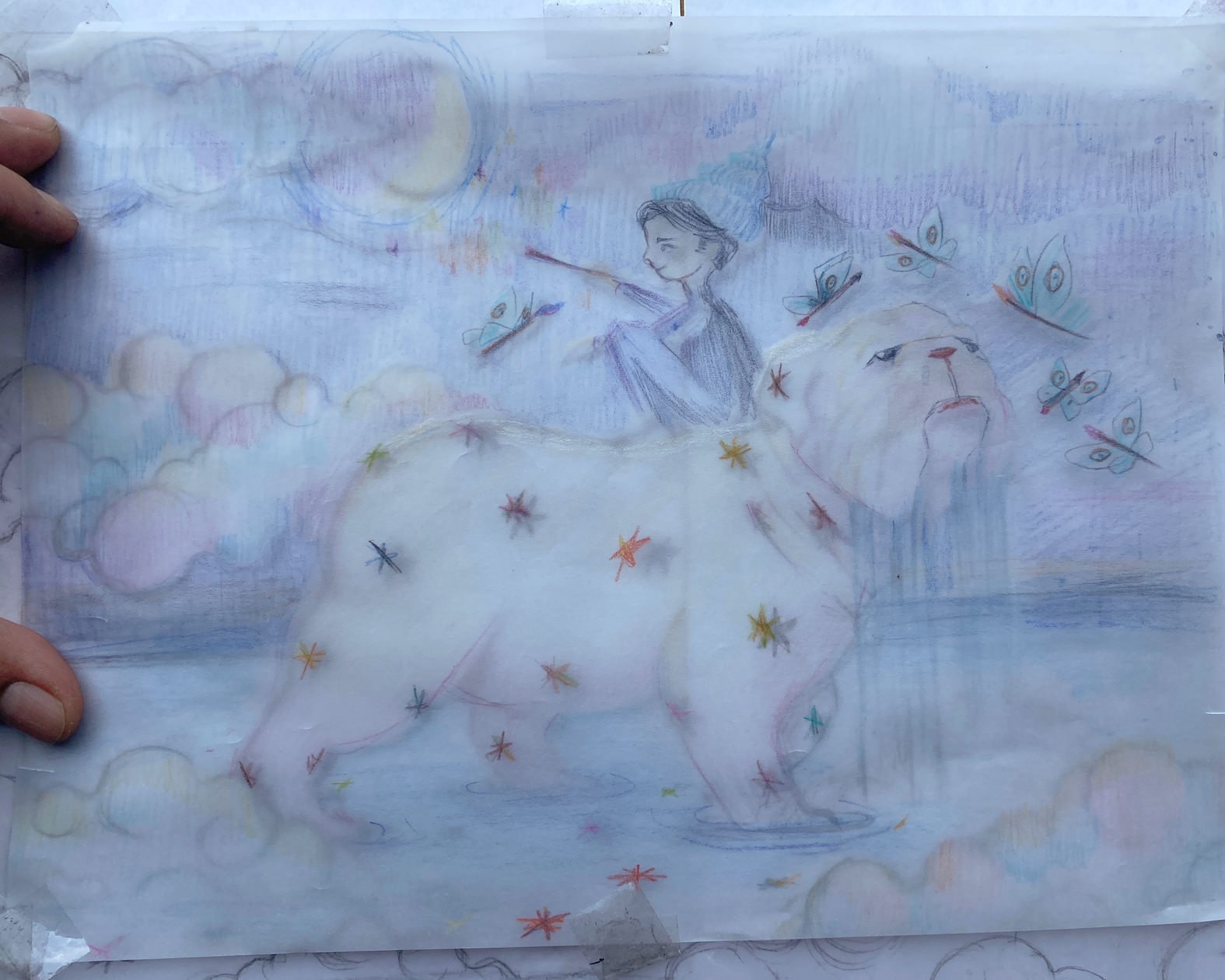
Después usé nuevamente papel para calcar para ponerlo encima del dibujo final y utilicé lápices de colores para colorear en ese papel e ir definiendo los colores de la ilustración. Con esto, evito tener que colorear sobre el dibujo final o tener que hacer un dibujo nuevo.
Este coloreado sencillo lo hago para crear un mapa general de color que me serviría de guía al momento de comenzar a pintar con acuarela. Usé los lápices de colores de la marca Pentel porque pigmentan bien y al ser de mina dura no se corren tanto en el papel para calcar.
Fase 4. La ilustración final. 4.1. Transfiriendo el dibujo al papel de acuarela
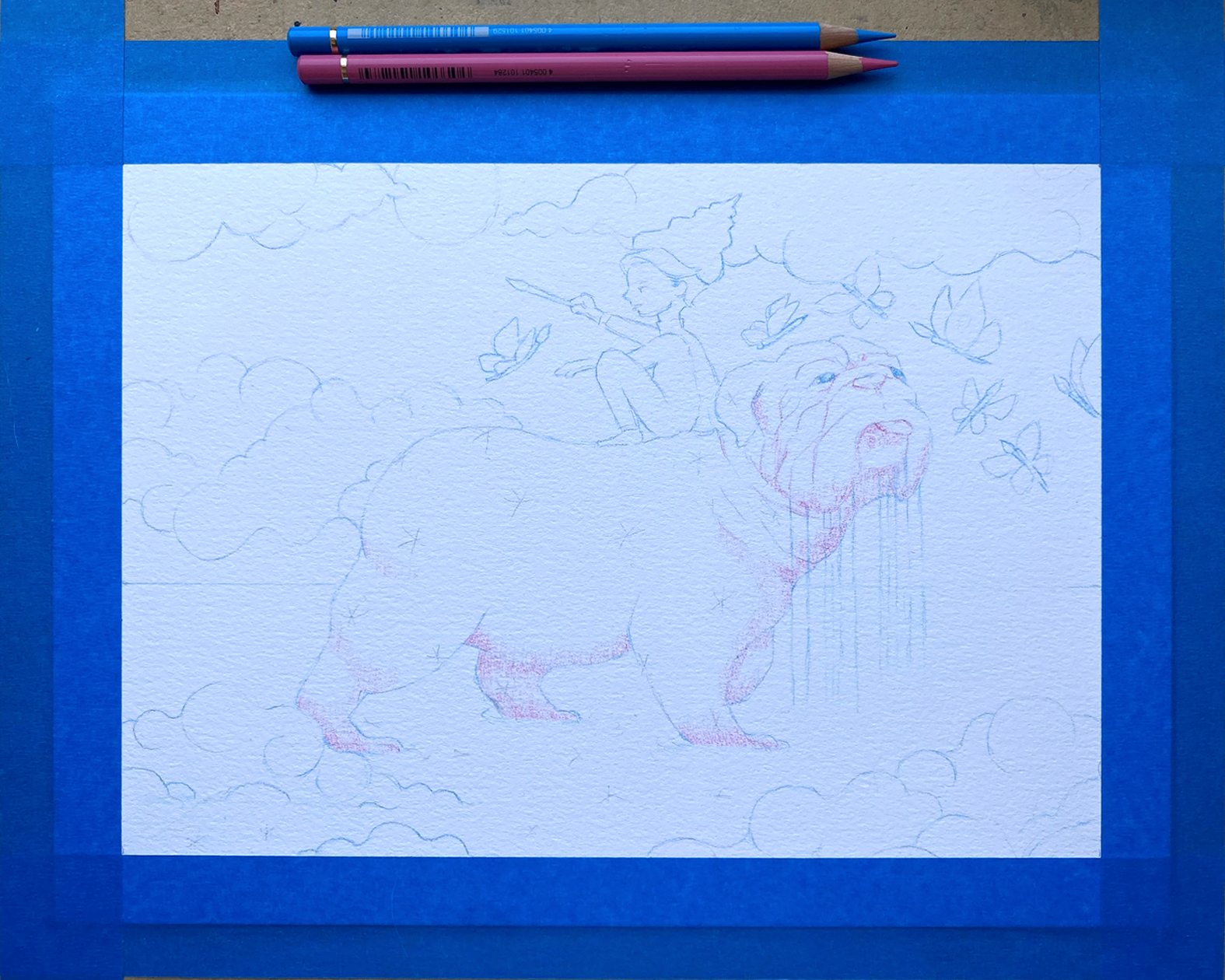
Con el dibujo final y sus colores definidos, sabía que debía comenzar con la acuarela y después utilizaría lápices de colores. Por ello, utilicé 2 lápices de color para transferir mi dibujo al papel de acuarela. Usé el color Fuchsia y el Middle Phtalo Blue de Polychromos. Con esto evito usar grafito y que se puedan notar más los trazos o que al momento de usar la acuarela se pudieran ensuciar los colores al crear tonos grisáceos.
Usé el lápiz azul para las zonas más oscuras o donde habrían más presencia de color azul o tonos análogos. Y utilicé el lápiz rosa para el bulldog porque habría más presencia de colores rosa y coral.
Elegí el papel Moulin du Roy porque su textura es muy fina y suave lo que me permitiría trabajar bien tanto con acuarela como con lápices de colores y crear pequeños detalles.
Para transferir el dibujo solamente puse mi dibujo final en una ventana con mucha luz, encima coloqué mi papel de acuarela y utilicé los lápices de color para dibujar sobre el papel. Después fije el papel a una base de madera con cinta azul para enmascarar. Esta cinta me gusta porque se desprende fácilmente, no daña el papel y deja líneas muy prolijas al retirarla.
4.2. Pintando con acuarela (el fondo)
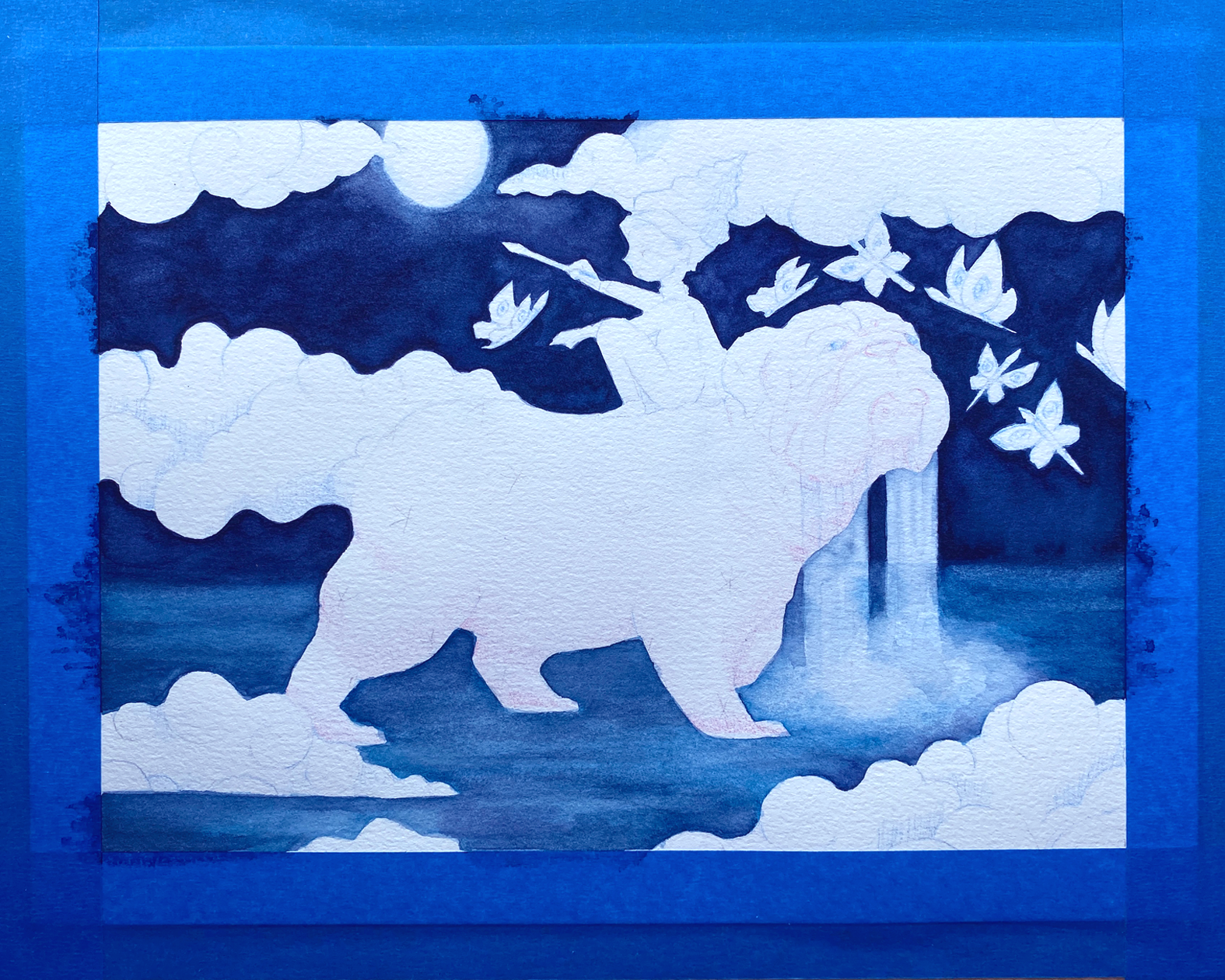
Comencé pintando todo el fondo. Esto debido a que necesitaba un fondo muy oscuro en la mitad superior y quería tenerlo bien planteado desde un inicio para poder pintar a los personajes con el valor correcto sin tener que estar dando muchas capas. Para el segmento superior usé una combinación de color índigo y un poco de dioxazine purple. Ambos colores los mezclaba directamente en el papel para que hubiera variaciones sutiles de color. La consistencia era como de leche, necesitaba un color profundo porque en etapas posteriores dibujaría estrellas y y brillos y al ser más claros necesitaba un contraste potente.
No usé liquido enmascarador por lo que con mi pincel tenía que ir evitando las zonas donde no quería presencia de esta mezcla espesa de azul y morado. Para ello, usé 2 pinceles iguales, uno más viejo y uno nuevo. El nuevo lo usaba para ir pintando de forma definida porque el pincel tiene la punta afilada al ser nuevo, y cuando llegaba a algún área más grande utilizaba el pincel viejo para usar más pintura y hacer trazos más amplios sin miedo a manchar otras áreas.
Cerca de la mitad de ilustración esa mezcla de morado y azul índigo, la difuminaba con agua porque una vez seca es donde comenzaría lo que representa un mar. Para la parte de la mitad inferior usé una mezcla de color índigo y azul cerúleo. En esta zona no tenía que evitar áreas muy definidas así que usé mi pincel viejo, me gusta mucho porque con el uso las cerdas se han hecho muy suaves.
Para el mar, iba mezclando el azul índigo y el azul cerúleo con la técnica húmedo sobre húmedo para crear líneas que simularan el movimiento del mar. Y en algunas zonas, pasaba mi pincel seco para absorber un poco la pintura y crear algunos trazos más claros.
En la parte donde se encuentran unas cascadas que salen de la boca del bulldog apliqué agua y luego algunas líneas con un poco de azul cerúleo para dar una sensación de movimiento. Y al final de las cascadas aplicaba un poco más de agua para difuminar y con un pañuelo desechable absorbía el exceso de color para crear un efecto de espuma en donde las cascadas tocan el mar.
4.3. Pintando con acuarela (bulldog)
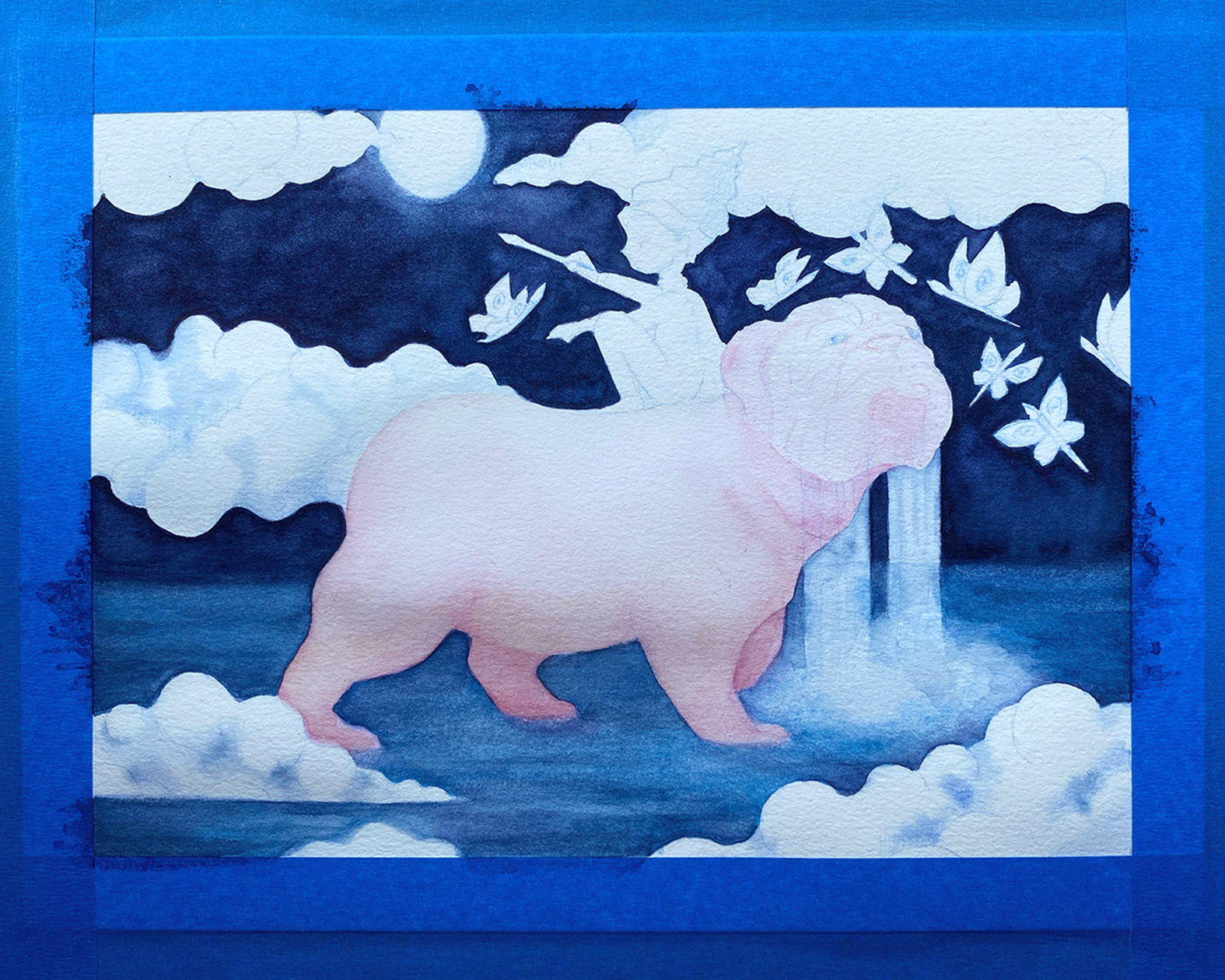
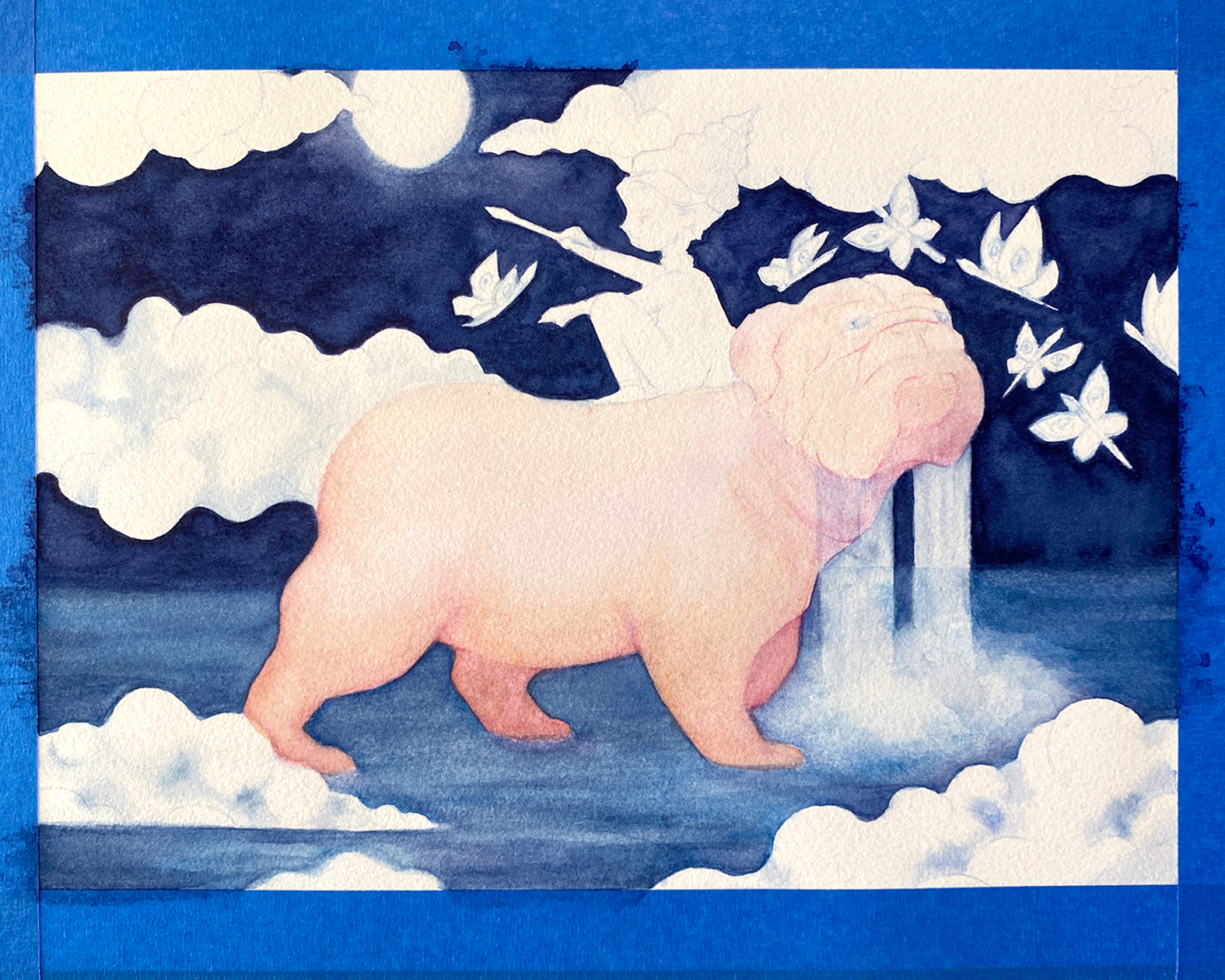
Con el fondo listo, comencé a pintar a mi perra. La parte superior prácticamente la dejé sin color y de la mitad hacia abajo aplique el rosa quinacridona. Primero puse agua limpia y luego pinté con el rosa muy diluido para que con la técnica de húmedo sobre húmedo hubieran transiciones sutiles. Una vez seca la pintura rosa, di una capa con ocre francés con la misma técnica.
Además aproveché para poner un poco de color índigo en "las nubes" inferiores, y use nuevamente la técnica de húmedo sobre húmedo. Esta técnica da un efecto difuso, lo que quería para estas nubes que llevarían mucho color.
Di un par de capas más al bulldog con los mismos colores que ya había usado. Estas capas las hice para ir moldeando el cuerpo y los volúmenes del perro.
4.4. Pintando con acuarela (el niño y las mariposas-pinceles)
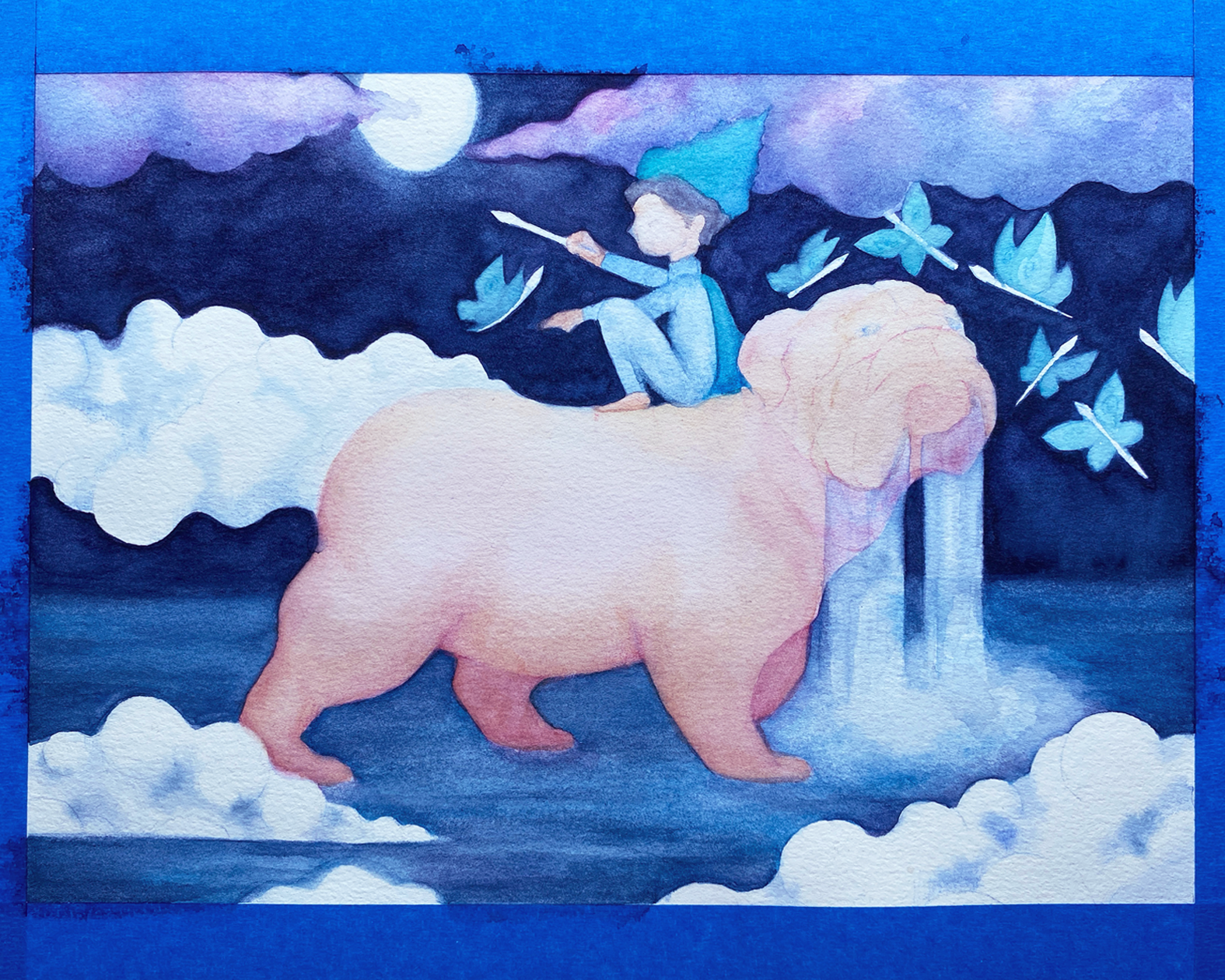
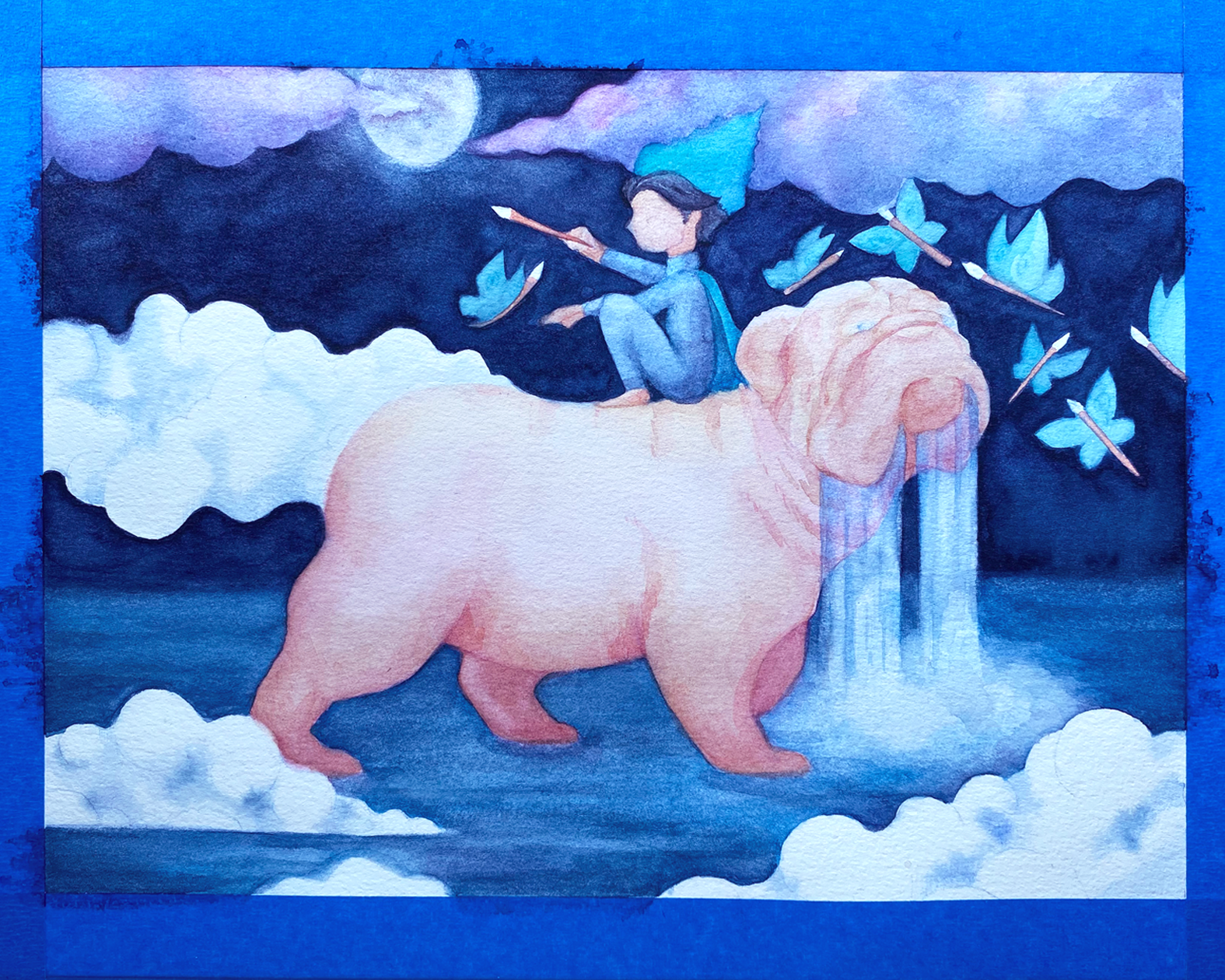
Comencé dando una capa muy ligera a todo el perro con el color opera rose, un rosa muy brillante, di una capa muy ligera para resaltar el color ya que lo veía un poco apagado.
Pinté las nubes superiores con la técnica húmedo sobre húmedo utilizando azul índigo, azúl cerúleo, dioxazine purple, rosa quinacridona y opera rose.
Ahora también era momento de comenzar a pintar al niño. Para le piel use una mezcla de ocre francés y opera rose. Para el pelo usé azul índigo con un poco de gris de Payne. Para su ropa utilicé azul cerúleo y azul índigo. Para su sombrero de caracol y su capa usé aqua green. Aquí usé mi pincel nuevo Escoda Perla número 10. En todo el personaje usé la técnica de húmedo sobre seco.
También pinté la base de las mariposas-pinceles usando el color aqua green para las alas. Y para el pincel que es el cuerpo de la mariposa usé ocre francés, con rosa quinacridona y muy poca cantidad de azul cerúleo.
Di un par de capas extras al cuerpo y cabeza del perro para definir más su estructura y volúmenes.
Toda esta aplicación de acuarela por secciones comenzaba a ser la base de la ilustración. Es una etapa en que se trabaja por aquí y por allá para ir uniendo los elementos y los colores.
4.5. Comenzando el uso de lápices de colores: color amarillo
Con la fase de pintura con acuarela terminada era momento de usar los lápices de colores para dar vida a las nubes multicolor. Comencé con el color amarillo y lo apliqué sobre la base que había trabajo previamente con acuarela con la técnica de húmedo sobre húmedo.
4.6. Aplicando color a las nubes multicolor
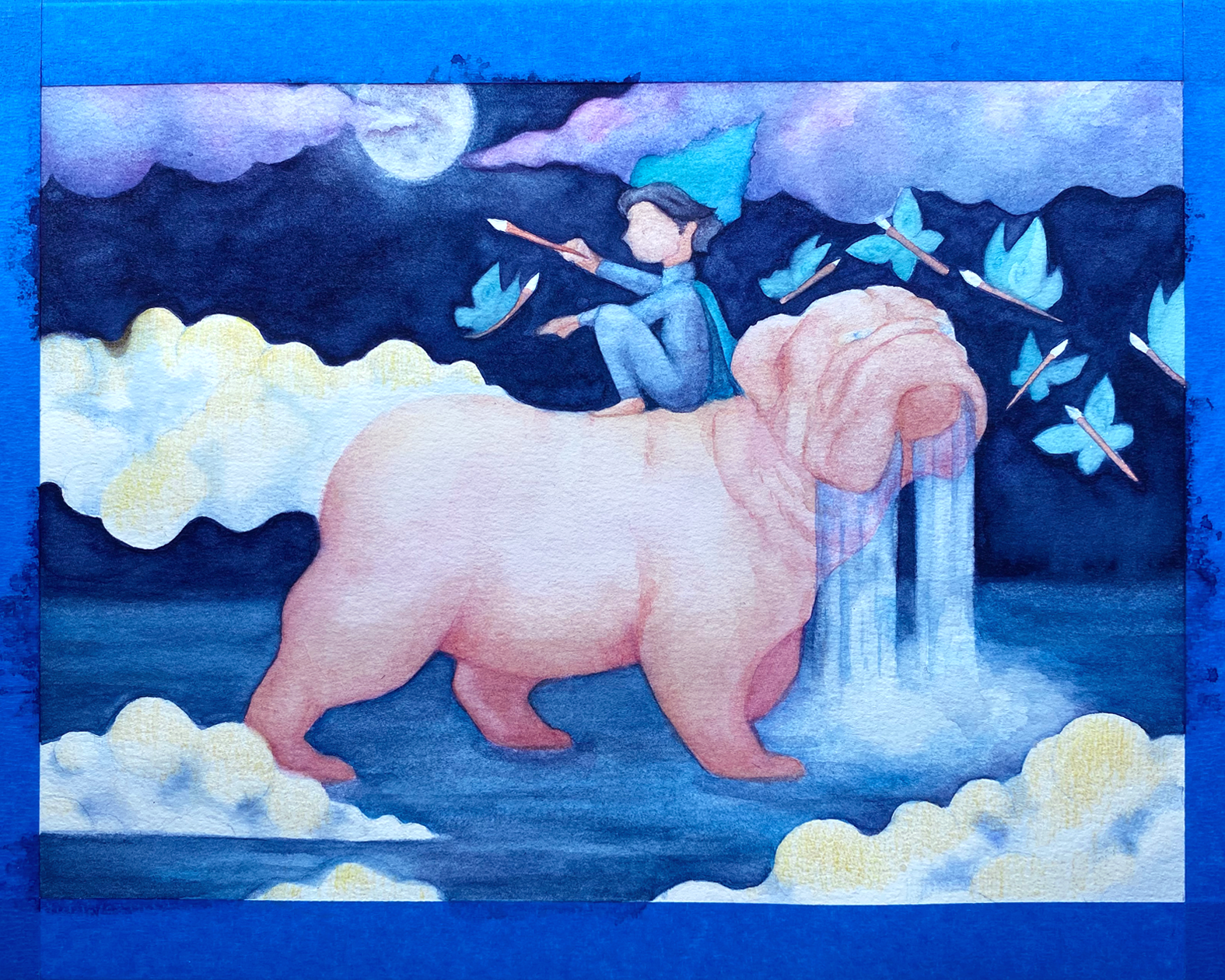
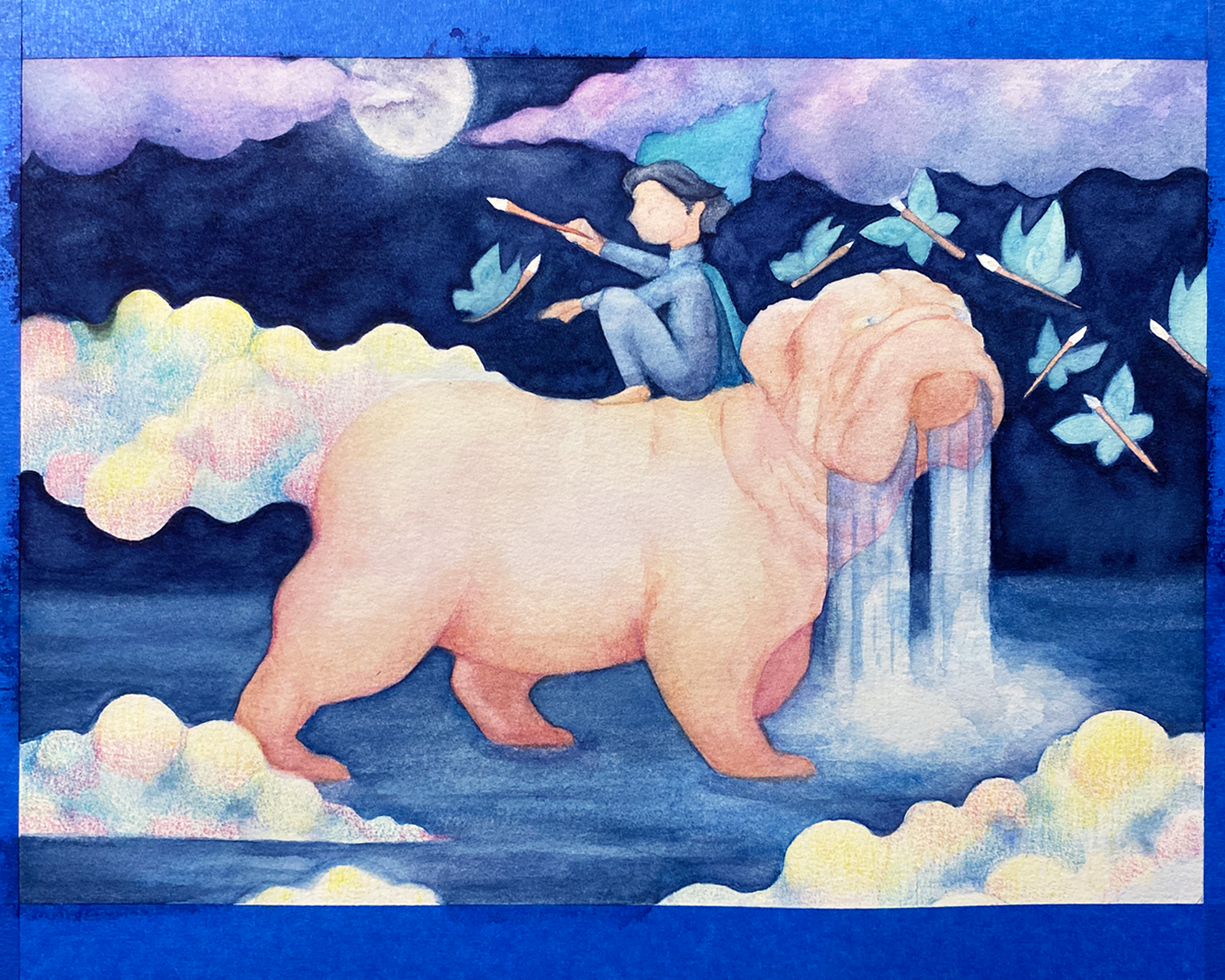
Después del amarillo, apliqué varios tonos de rosa y azules para ir creando las nubes multicolor. En esta fase es importante tener paciencia e ir poco a poco aplicando el color para no saturar el papel y que los colores se mezclen sutilmente. Prefiero dar muchas capas con poca presión del lápiz sobre el papel, es como si rozara el lápiz sobre el papel.
De este modo, al solo haber usando tonos de amarillo, rosa y azul, se pueden crear anaranjados, violetas y verdes sin haber utilizado lápices de esos colores.
4.7. Incrementando la saturación del color
Seguí trabajando las nubes multicolor para ir aumentando la saturación del color. Es importante pensar la textura que queremos darle a las zonas donde aplicamos los lápices de color. Me gusta aplicarlos de diferentes maneras dependiendo el dibujo o la ilustración. En esta ocasión todos mis movimientos los hice de forma vertical.
Para ayudar a difuminar suelo partir de un punto y hacia el color con el que quiero difuminar suelto la presión del lápiz.
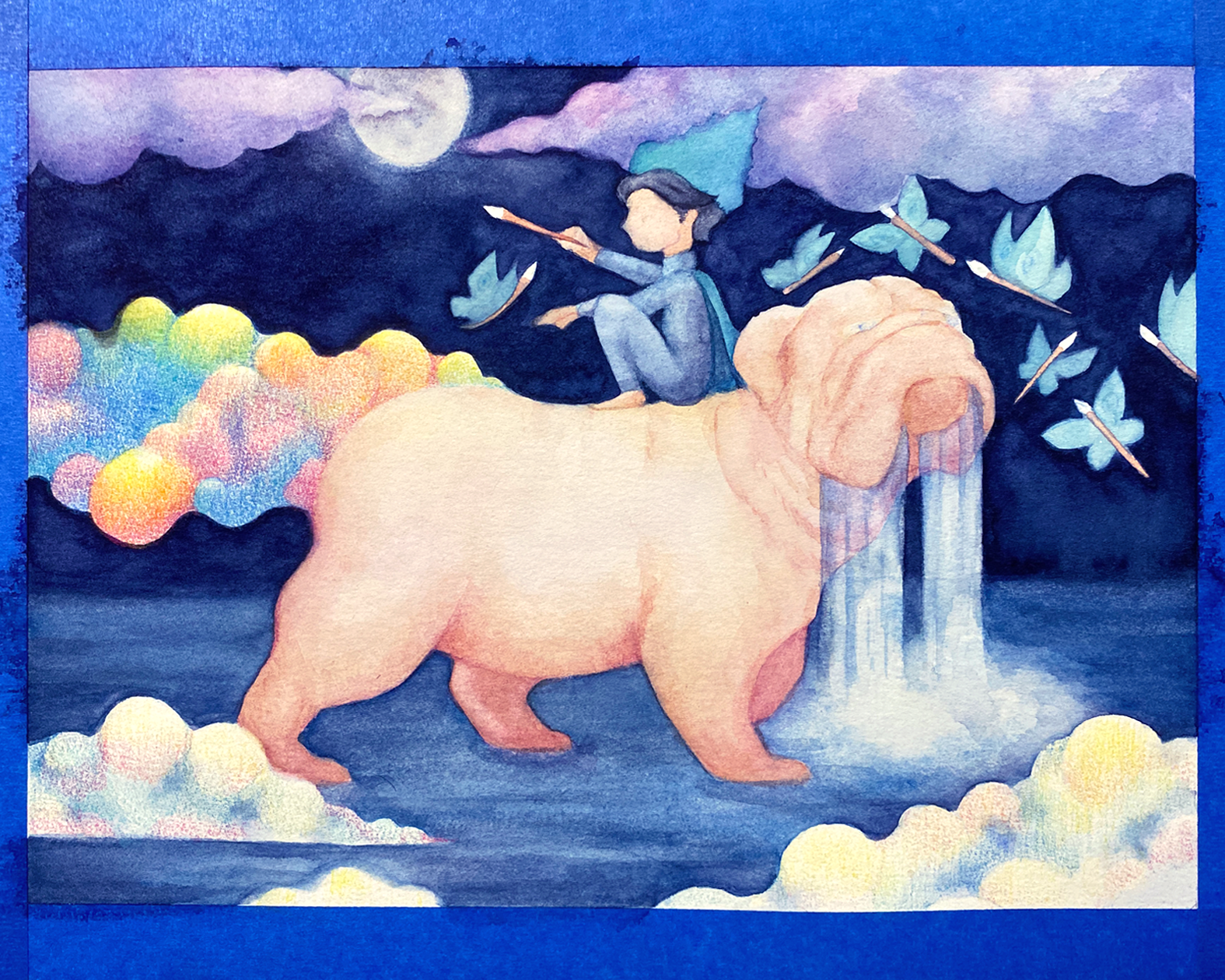
En este punto ya tenía una base más concreta de la ilustración en cuanto a color y los elementos. Por ello, decidí retirar la cinta para enmascarar ya que también debía trabajar los elementos que simulaban salir de la ilustración.
4.8. Retirar cinta de enmascarar
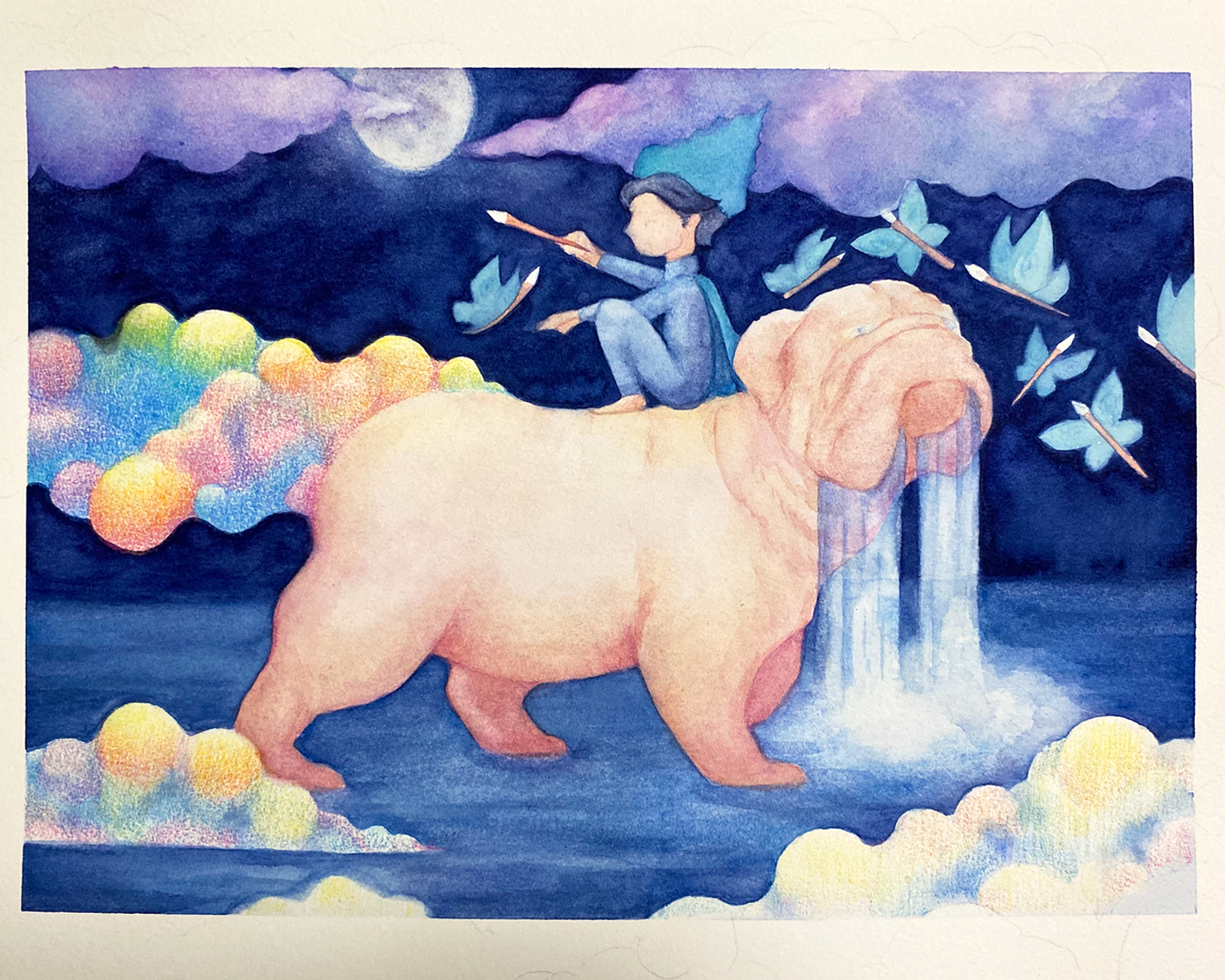
Sin la cinta de enmascarar, dibujé los elementos que "saldrían" de la ilustración. Esto me serviría de guía cuando aplicará acuarela en esas zonas.
4.9. Dibujando elementos que "salen" de la ilustración
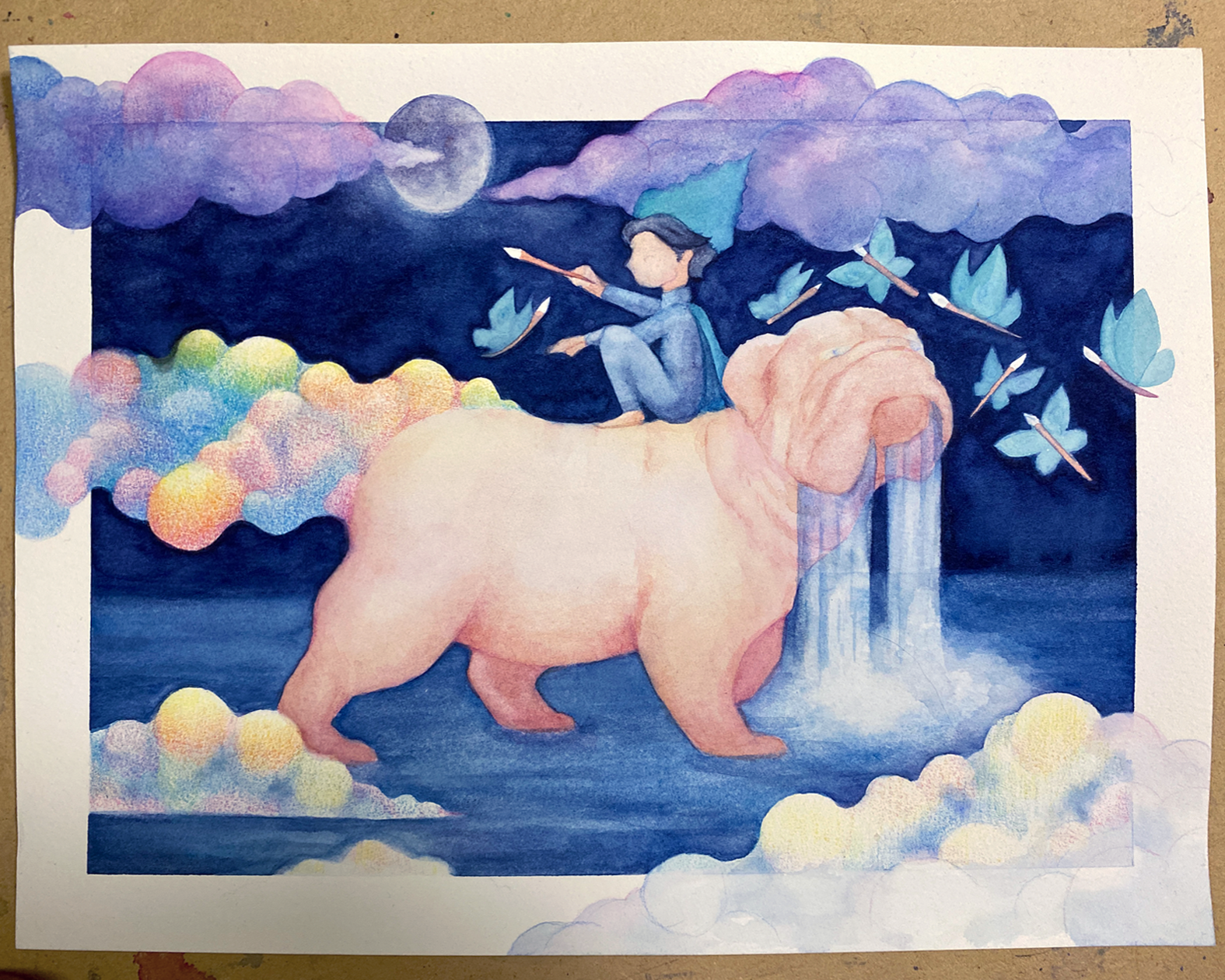
Los elementos que salían de la ilustración los pinté con acuarela y después con lápices de color del mismo modo en que trabajé anteriormente. En este punto me interesaba que no se notara demasiado la línea que quedó marcada por la cinta de enmascarar.
4.10. Aumentando la saturación a los elementos
En este punto, continuaba trabajando con los elementos que simularían salir de la ilustración. También aproveché para pulir la forma de las mariposas-pinceles.
Nuevamente es ir trabajando por capas e irse moviendo por toda la ilustración para lograr que los elementos se vayan fundiendo unos con otros. Retoqué al niño, al perro, la luna y todas las nubes.
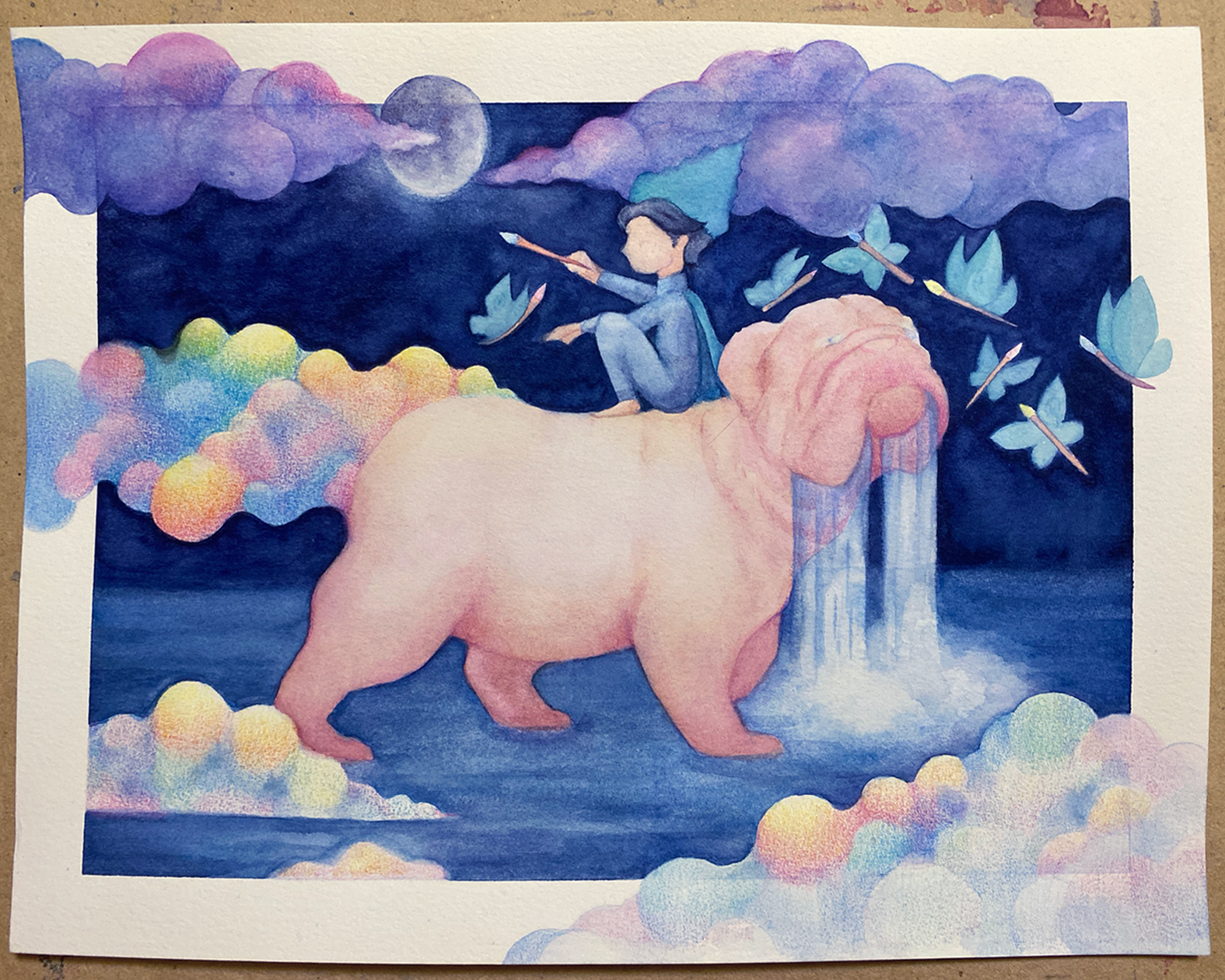
4.11. Comenzando a detallar la luna, mariposas y al niño
En esta parte seguía dando capas a todo. Pero aproveché para ir definiendo el sombrero-caracol del niño e ir poniendo detalles a las mariposas-pinceles (ojos en sus alas). Aquí puse mas atención a pintar la luna y usé el color lunar violet y potter´s pink combinados con un poco de índigo. Pinté con esos colores para que la luna quedara con un aspecto granulado o jaspeado, y para que tuviera tonos similares a los de las nubes en esa zona.
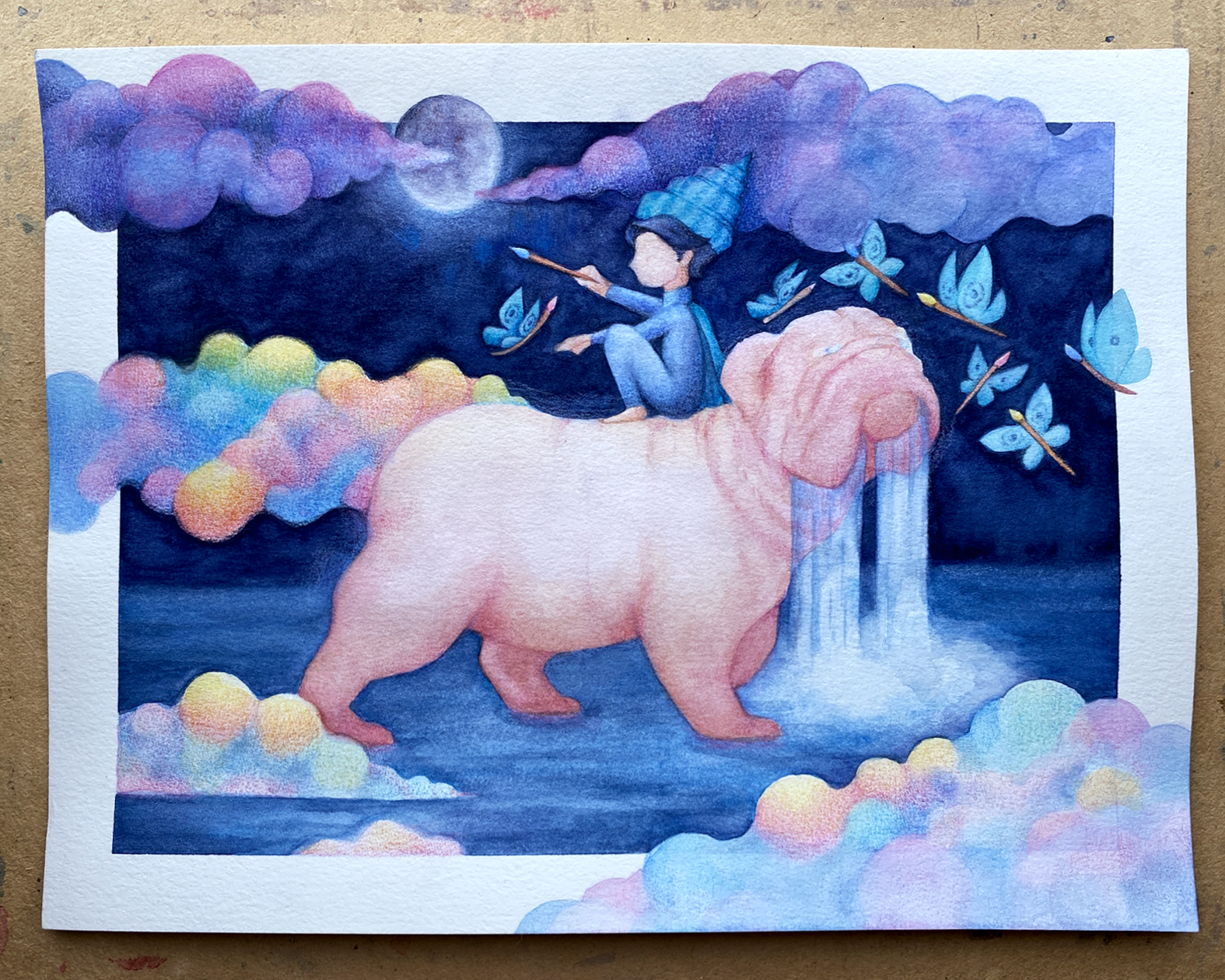
4.12. Agregando más detalles al perro y poniendo algunos elementos decorativos
En este punto trabajé más la cara del bulldog, agregué las estrellas de su pelaje, y seguí dando capas de color a las nubes así como a las mariposas-pinceles.
También trabajé con lápiz blanco algunos efectos en las cascadas y en el agua para simular el movimiento del agua alrededor de las patas del perro.
Y comencé a agregar los brillos que saldrían del pincel del niño. Para hacer esto, inicié usando tonos de azul, rosa y amarillo para matizar la oscuridad del fondo. Después usé un poco de color blanco para simular el brillo.
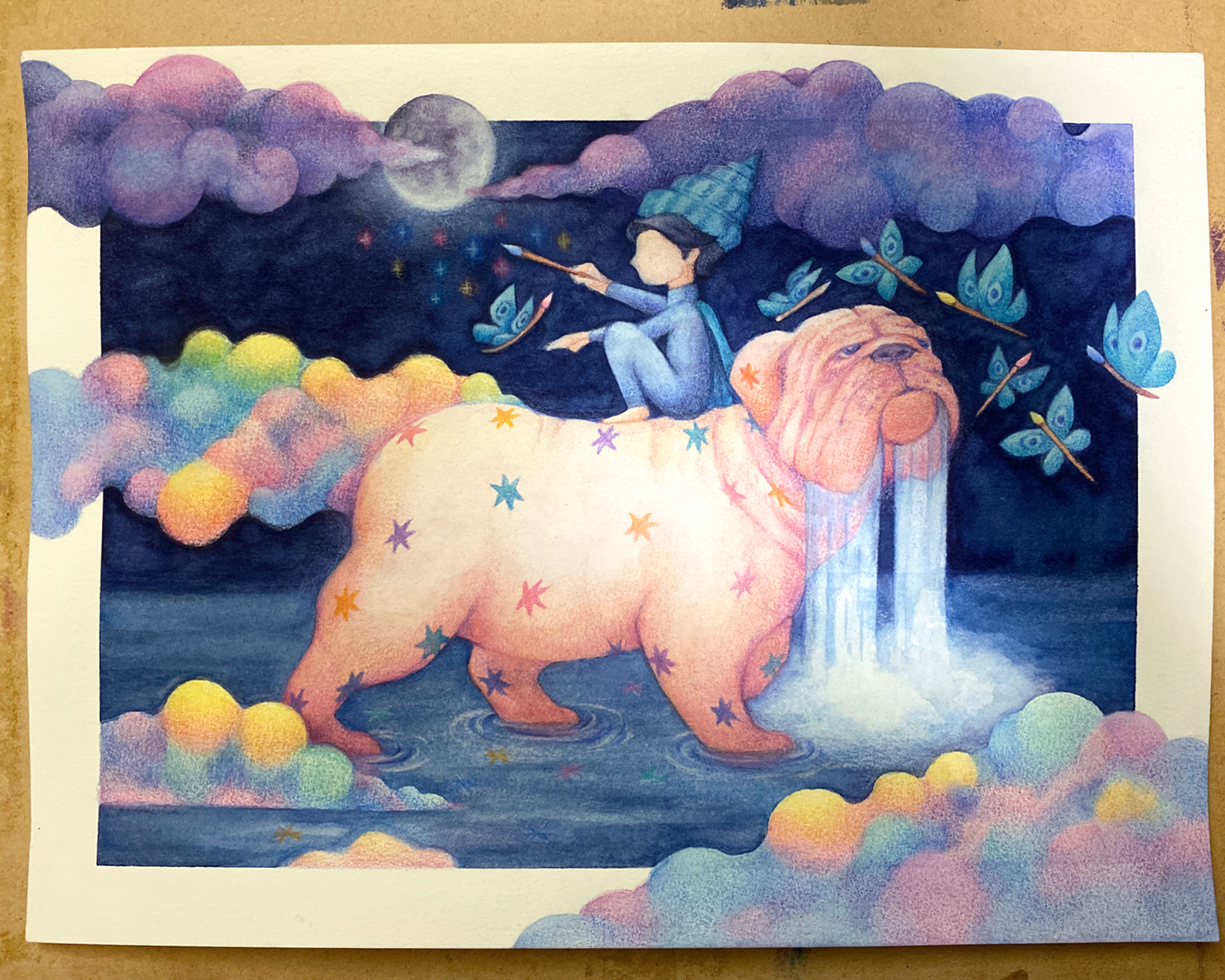
4.13. Detallando la cara del niño y trabajando más los elementos decorativos
Con el lápiz de color índigo oscuro muy afilado detallé las facciones y el pelo del niño. Seguí dando capas de color a todos los elementos y pulía todas las formas.
Enfaticé las nubes, al bulldog, las mariposas y los brillos de colores que salen del pincel del niño, es trabajo de mucha paciencia para ir detallando y uniendo todos los elementos de la ilustración.
Finalmente, agregué algunas estrellas al fondo. Usé el lápiz de color blanco Luminance de la marca Caran D´Ache porque al ser muy cremoso es muy cubriente. Solamente dibujé algunos puntos por aquí y por allá, unos más pequeños y otros más grandes.
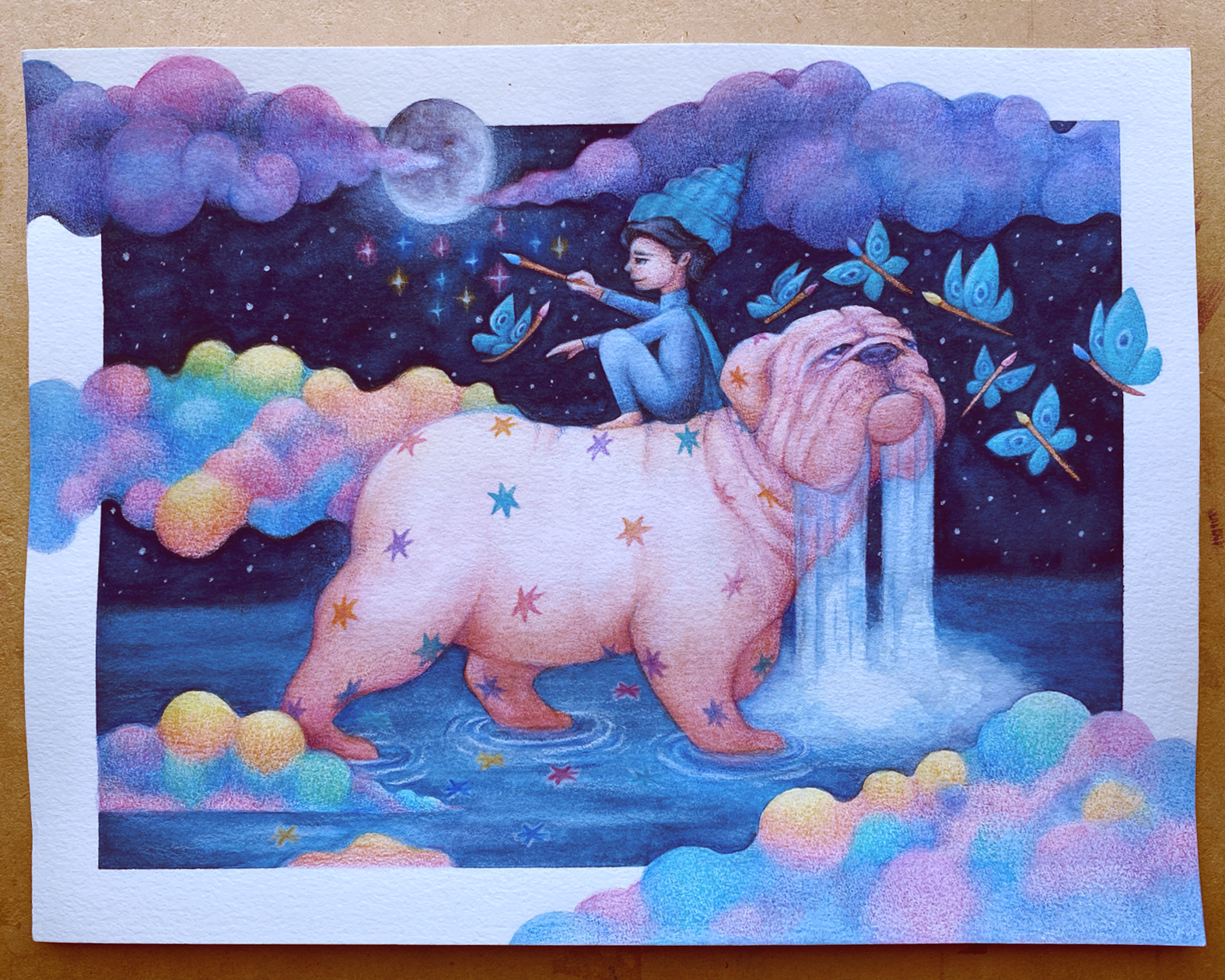
4.14. Enmascarar nuevamente para aplicar acuarela con glitter
Era momento pintar el marco simulado y para ello usaría una acuarela con glitter en tono cobre rosado. Para evitar tener que pintar todo a pulso y tener un terminado más prolijo decidí usar cinta para enmascarar nuevamente. Corté algunos pedazos de esta cinta y la pegué con cuidado para que en donde quería bordes prolijos estuviera bien pegada, y en las zonas donde ya había puesto lápices de colores pegar la cinta suavemente para evitar levantar mucho color. Sabía que al usar cinta se levantaría parte del trabajo con lápices de colores.
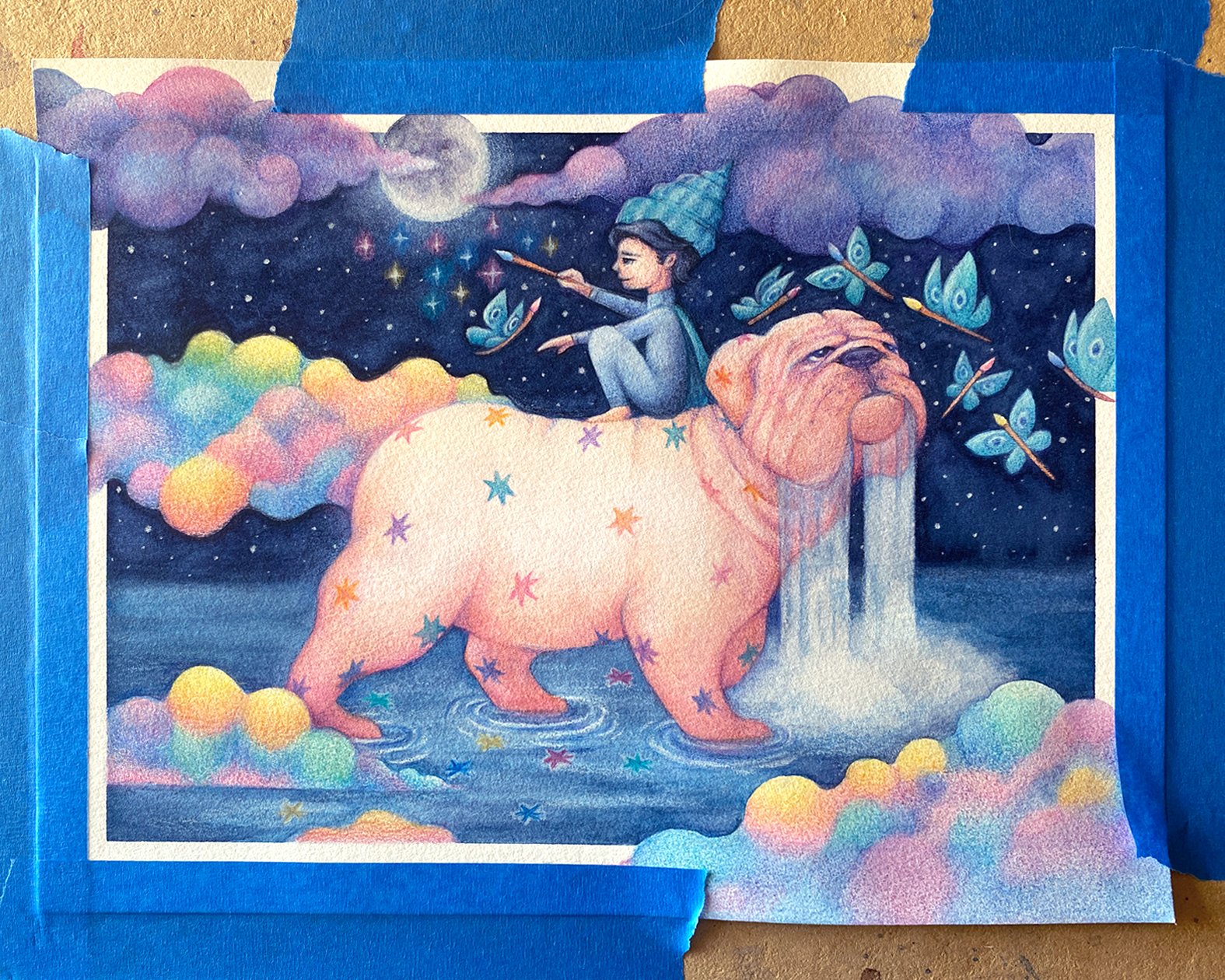
4.15. Pintando con acuarela con glittler
La acuarela con glitter funciona igual que las acuarelas comunes pero para el efecto que quería darle al marco la usé con una consistencia muy espesa. Lo hice de esta forma para evitar que si la usaba con mucha agua se pudiera correr por debajo de la cinta si es que en alguna zona no la había pegado bien.
Apliqué la acuarela con glitter con un pincel recto para avanzar más rápido y que el terminado fuera uniforme. Dejé secar bien la acuarela con glitter y retiré la cinta de enmascarar con mucho cuidado. Era momento de observar dónde debería retocar la ilustración ya que se había levantado un poco del trabajo hecho previamente con los lápices de colores.
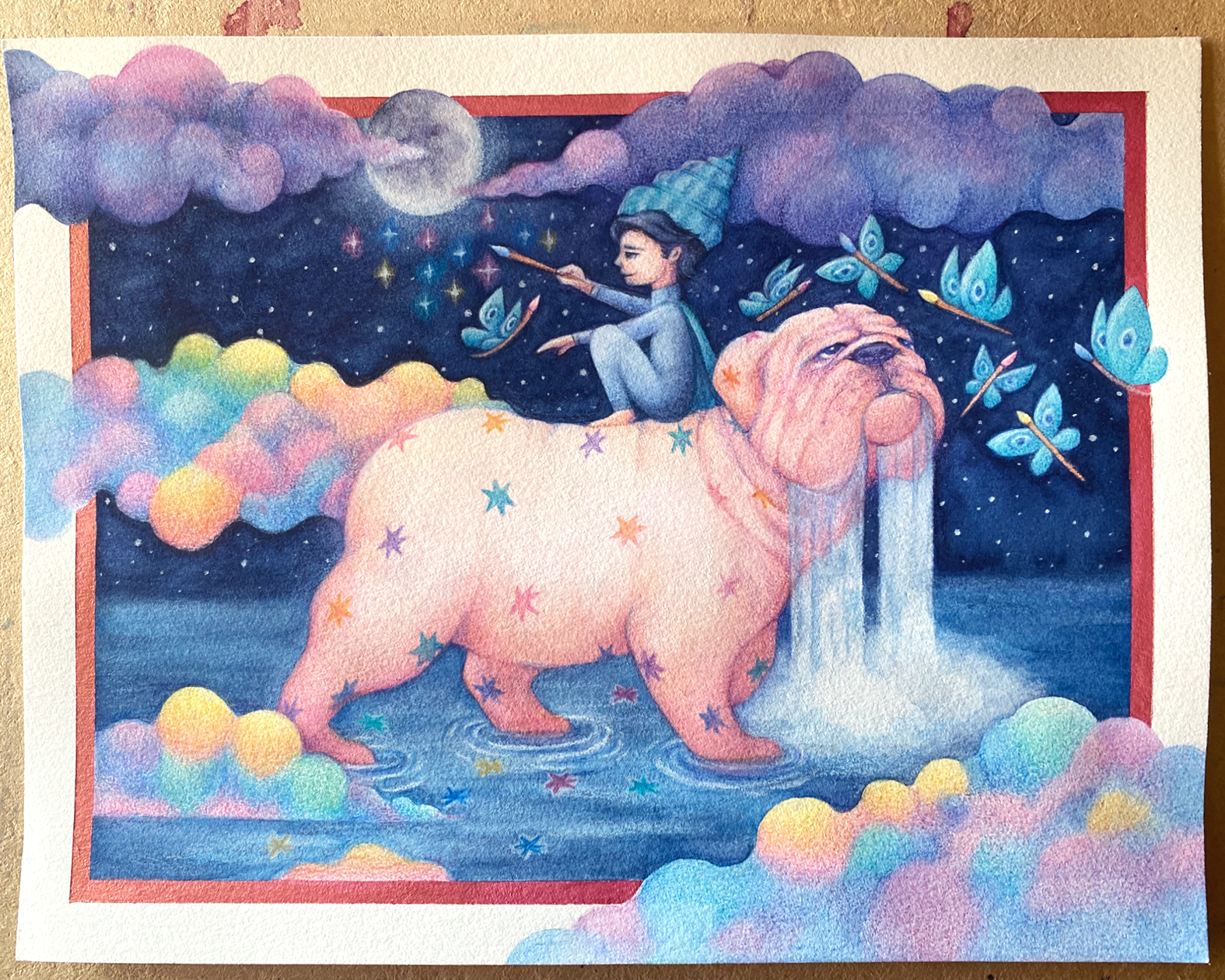
4.16. Últimos retoques
Y después de varias capas con lápices de colores en todos los elementos, pensé en matizar con azul y morado algunas estrellas blancas. Y finalmente volví a pulir todo el dibujo. Y con eso, di por terminada mi ilustración.
Si bien la ilustración original sería para mí, siempre me gusta tener un registro digital de todo lo que hago. Por ello, procedería a su digitalización y edición en Photoshop.
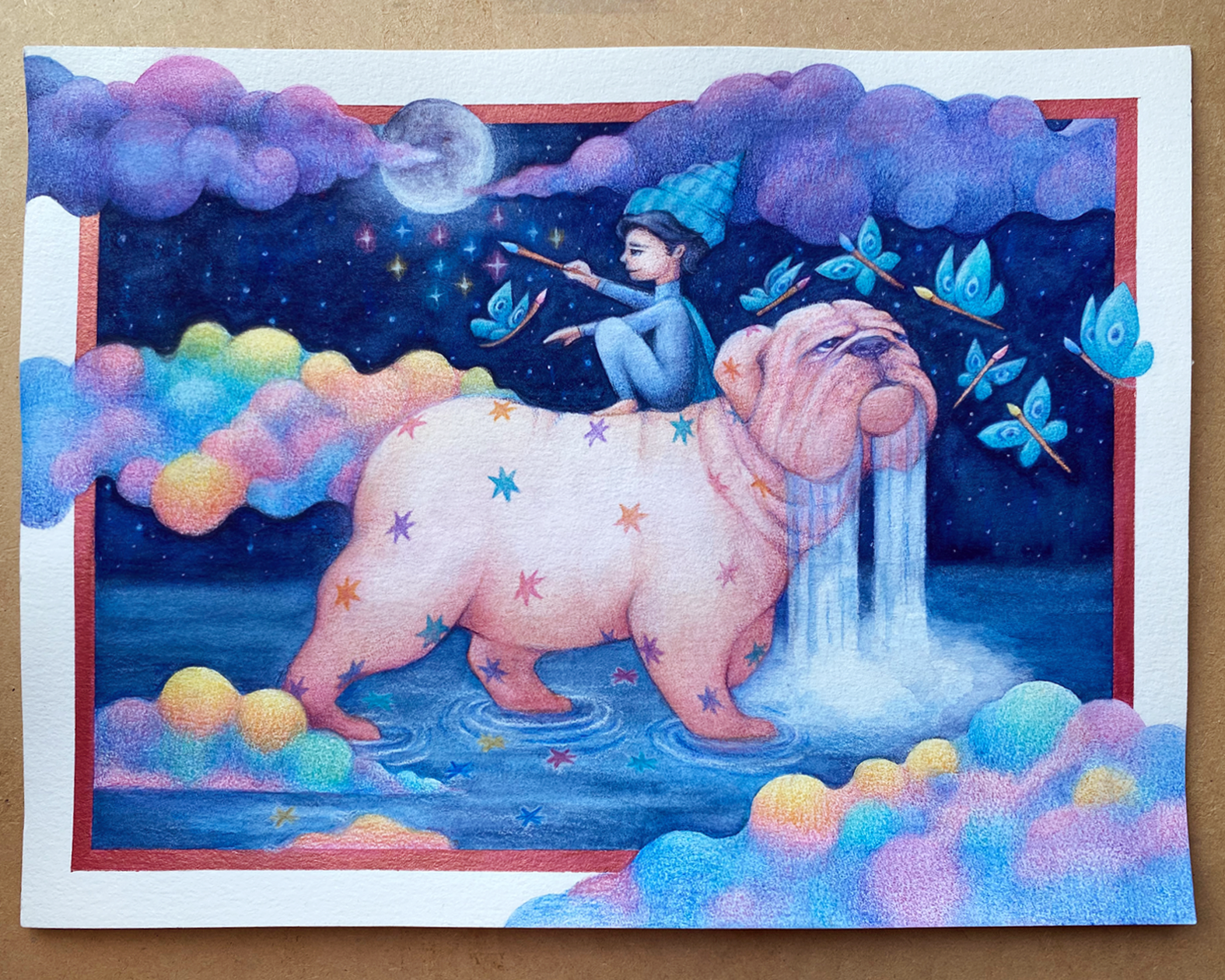
Fase 5. Digitalización y edición de la ilustración final
Mi ilustración la puse en mi scanner y la digitalicé a 600 dpi. Después en mi laptop, usé Adobe Photoshop para retocar los colores. Al hacer la edición, tenía mi ilustración original a un lado porque buscaba que los colores se vieran en pantalla tal cual se ven en la ilustración original.
También edité un poco los bordes que había dejado la cinta de enmascarar y fue todo lo que edité. Creo que siempre es bueno tener una versión digitalizada de todo lo que pintamos o dibujamos.
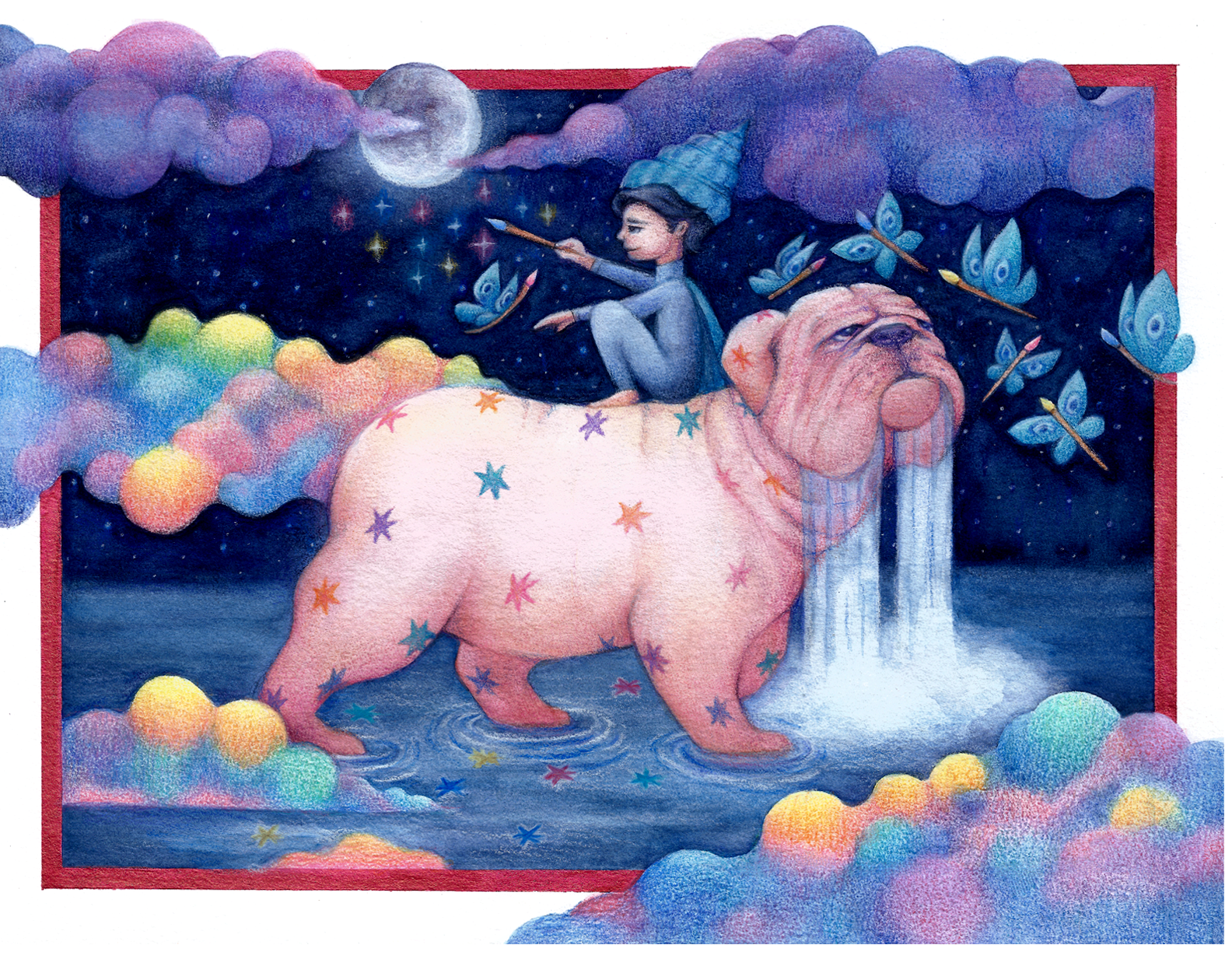
Comentarios finales
Fue un proceso de muchas fases y trabajo de mucha paciencia, pero me gustó el resultado final porque todos los elementos y el colorido representan varias cosas de mi perra y mías. Quedé satisfecho con la ilustración porque era lo que quería hacer desde un inicio, algo muy colorido y una escena como de ensueño.
Esta ilustración representa el mundo que creamos Olga y yo por 12 años, un mundo que extraño mucho, pero que lo llevo en mi corazón y en mis recuerdos.


0 comments
Log in or join for Free to comment