
Improving BPIAD: UX Research on a Data Analysis Service for Psychology Students
Improving BPIAD: UX Research on a Data Analysis Service for Psychology Students
de Fuad A. Fajri @fuadafajri
- 75
- 0
- 0
Introduction
As part of the undergraduate academic requirements at the Faculty of Psychology, Universitas Muhammadiyah Surakarta (UMS), every student is required to complete a thesis involving a structured research process. This begins with preparing Chapters 1 to 3 under the guidance of a thesis advisor, followed by data collection, data analysis, and writing the discussion and conclusion sections.
In the data analysis stage, students are expected to meet standards of validity and reliability based on credible academic sources, in order to produce a high-quality and scientifically sound thesis. To support this process, the faculty provides academic assistance through the Bureau of Psychological Information and Data Analysis (BPIAD), which plays a key role in maintaining the quality and integrity of students’ data analysis.
From December 2024 to December 2025, BPIAD offered a service called Independent Data Analysis, a supervisory model where students conducted their own analysis and submitted the results to be reviewed and approved by the BPIAD team. During my time working at the bureau, I witnessed firsthand how critical this service was in helping students complete their theses, while also ensuring that the analysis met academic and ethical research standards.
However, formal evaluations of this service have remained limited and are mostly confined to informal discussions among internal staff. In response to this gap, this project aims to evaluate the BPIAD service using a user-centered research approach, in order to uncover the real experiences of students, understand their needs, and formulate data-driven recommendations for future service improvements.
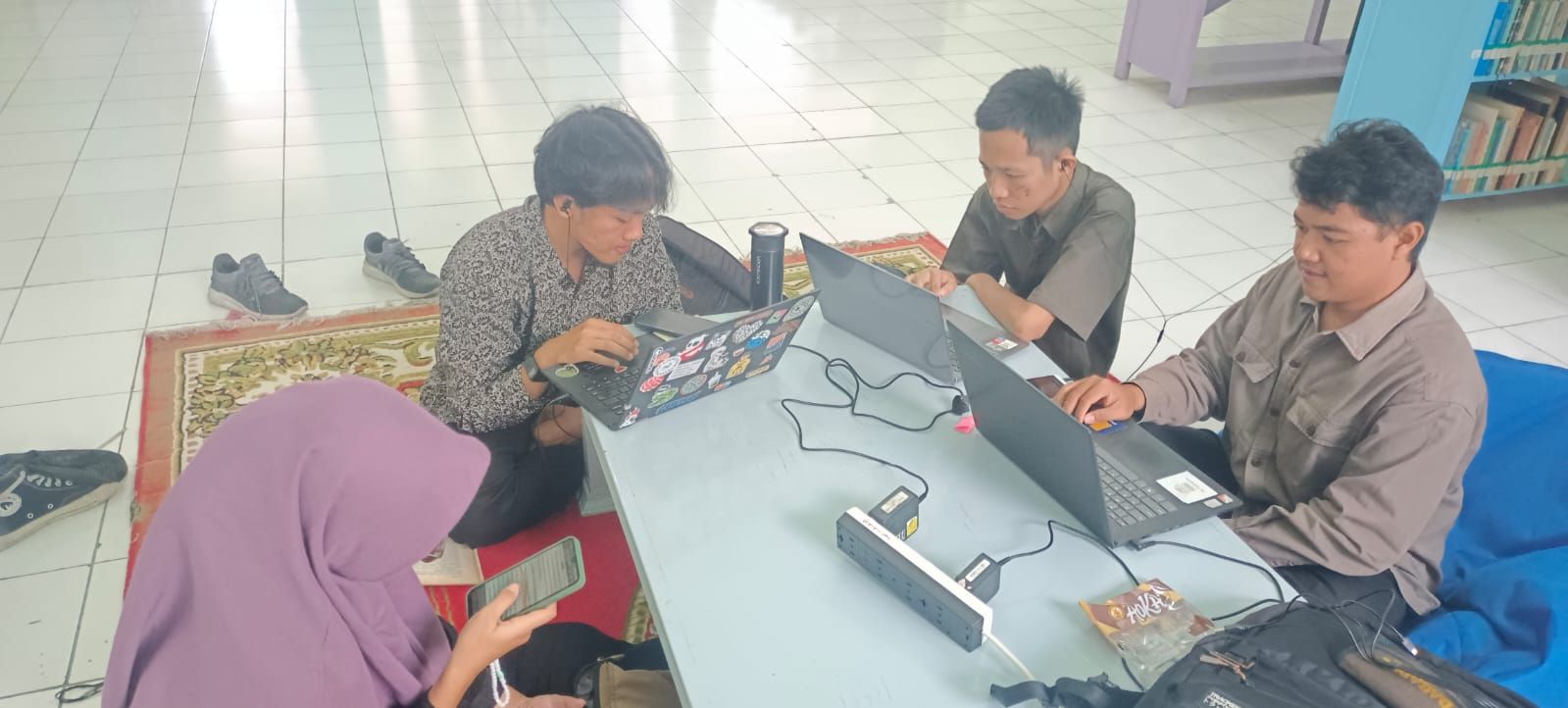
Supplies
- Online interview tools (WhatsApp)
- Survey tool (Google Forms)
- AI support tool (ChatGPT)
- Visualization and design (Canva)
✏️ Step 1: Introduction & Background
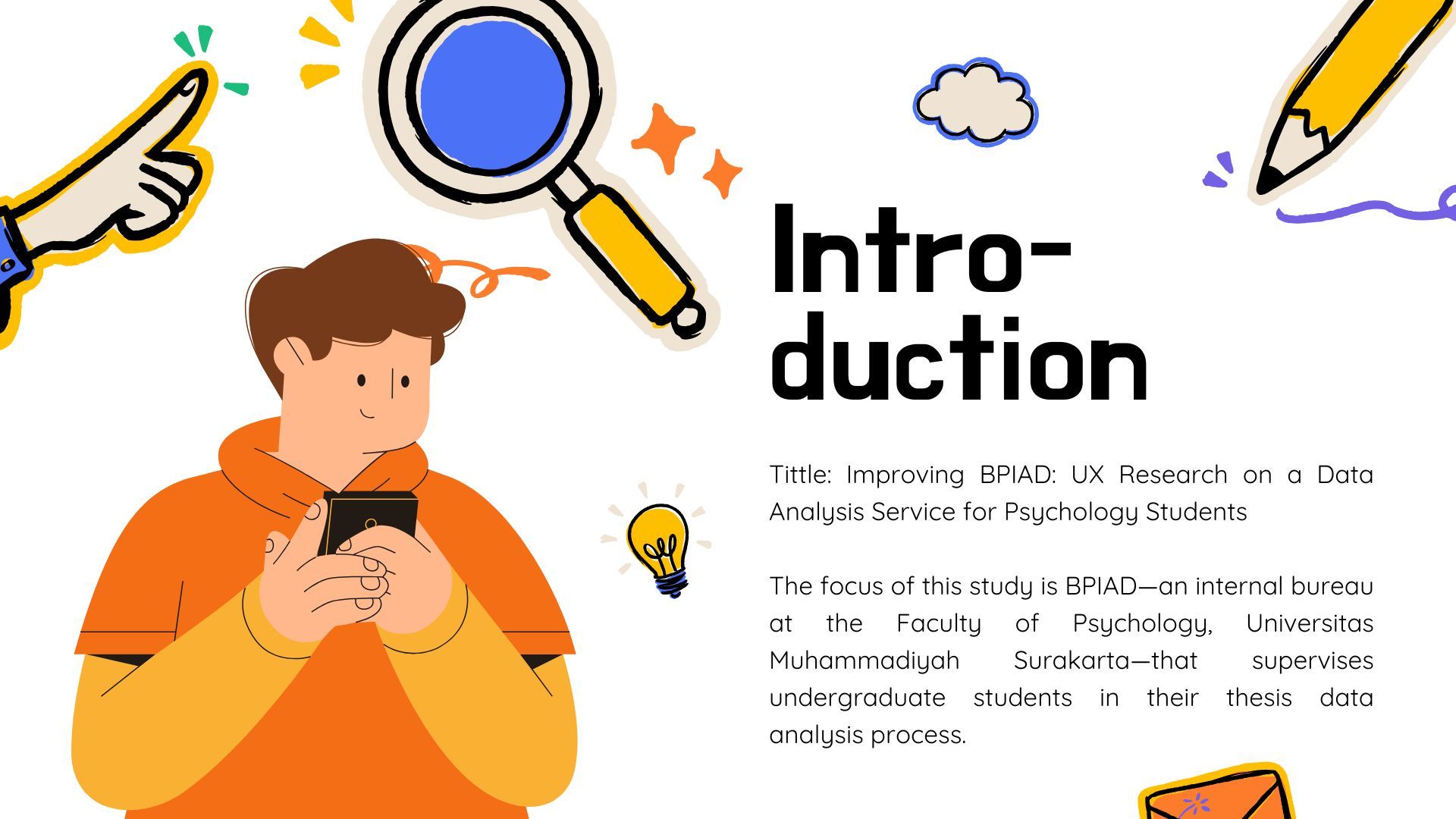
Tittle: Improving BPIAD: UX Research on a Data Analysis Service for Psychology Students
This project is part of my UX Research 101 coursework, in which I applied user-centered methods to evaluate a real-world academic support service. The focus of this study is BPIAD—an internal bureau at the Faculty of Psychology, Universitas Muhammadiyah Surakarta—that supervises undergraduate students in their thesis data analysis process.
🧩 Step 2: Research Planning
📄 Description
To evaluate BPIAD from a user-centered perspective, I began by planning a small-scale qualitative study. The goal was to explore how students and faculty perceived the Independent Data Analysis service, what challenges they encountered, and what improvements they would suggest.
🔍 Research Objectives:
a. Understand how students experience the process of data analysis supervision from BPIAD
b. Identify pain points in service communication, clarity, and feedback
c. Gather insights from thesis supervisors regarding the academic and procedural impact of the service
d. Explore expectations and opportunities for service improvement
👥 Target Participants:
I selected two main groups of participants:
a. Final-year psychology students, who used the BPIAD service between December 2024 and June 2025.
b. Thesis supervisors (faculty members), who interacted with the service indirectly through their students or through institutional processes.
This combination allowed me to capture both the 'user experience' and the 'academic stakeholder perspective'.
🧪 Research Method:
I conducted 'semi-structured interviews' via WhatsApp voice notes and direct conversations. Students shared their experiences as service users, while lecturers provided insight on how BPIAD affected thesis quality, workflow, and academic expectations.
🛠 Tools Used:
a. WhatsApp (for voice interviews and asynchronous responses)
b. Google Docs (for transcription and thematic coding)
c. Google Forms (to collect participant background info)
d. ChatGPT (to draft and refine the interview questions)
📄 Interview Guide (Excerpt)
To gather meaningful insights from both students and lecturers, I developed two sets of semi-structured interview questions tailored to each group:
🧑🎓 For Students:
a. How would you describe your overall experience using BPIAD's Independent Data Analysis service?
b. What parts of the process were easy or clear for you?
c. Were there any moments of confusion, difficulty, or frustration?
d. How helpful was the feedback you received? Did you understand it fully?
e. In what ways do you think the service could be improved for future students?
👩🏫 For Thesis Supervisors:
a. How familiar are you with BPIAD's Independent Data Analysis service?
b. How do you see the service affecting your role as a thesis supervisor?
c. Have your students ever raised concerns or questions about the data analysis process?
d. Do you think the service helps or complicates the thesis supervision process?
e. What suggestions would you give to improve the collaboration between BPIAD and academic staff?
🧠 Transition:
In the next step, I will describe how I conducted the interviews and share the key findings from each group of participants.

🧩 Step 3: User Interviews & Key Findings
📄 Description:
To evaluate BPIAD from multiple perspectives, I conducted semi-structured interviews with two primary groups:
a. Final-year psychology students who used the service between December 2024 and June 2025
b. Thesis supervisors who guide students and interact indirectly with the service
The interviews were conducted using WhatsApp voice notes and written messages. Responses were transcribed and thematically analyzed to identify both common patterns and outlier cases.
🎯 Key Findings from Students:
✅ Positive Aspects:
a. Emotional reassurance: Students expressed feeling supported and more confident knowing their data was being reviewed by an institutional team.
b. Reduced stress: The existence of BPIAD helped reduce the anxiety surrounding statistical analysis and final thesis preparation.
⚠️ Challenges and Concerns:
a. Unequal experiences: Some students felt that different peers received different treatment or evaluation standards. This perceived inconsistency raised concerns about fairness.
b. Misunderstanding of the analysis process: Several students lacked basic understanding of how data analysis should work. Some even appeared to have outsourced parts of the process, raising concerns about academic integrity.
c. Inconsistent knowledge of table formatting: Students used various formats for data tables, and many did not understand common symbols or test results.
d. Misinterpretation of research logic: Some believed the results “must” support their hypothesis, without considering the validity or integrity of actual findings.
e. Difficult access to service location: A few participants reported confusion about where the BPIAD office was located, leading to wasted time and frustration.
f. Delays in feedback and grading: Some students experienced delays in receiving feedback, which affected their ability to register for final thesis examinations.
🎯 Key Findings from Thesis Supervisors:
a. Gap between theory and practice: Some supervisors acknowledged they still use outdated statistical approaches, which may conflict with BPIAD’s more current standards.
b. Struggles with evolving methodology: Supervisors noted that modern psychometrics and statistical tools are advancing quickly, while they feel unprepared to catch up.
c. Role ambiguity: Some lecturers expressed uncertainty about where their advisory role ends and BPIAD’s responsibilities begin.
d. Desire for integration: Faculty hoped for better alignment between supervision, bureau processes, and evolving methodological standards.
🧠 Interpretation:
These findings point to deeper issues beyond service logistics—touching on **academic culture, student learning, supervisor adaptation**, and **ethical boundaries**. Addressing these issues will require more than procedural fixes; it will take a re-alignment of values, expectations, and communication across all actors.
📌 Transition to Next Step:
> In the next step, I will visualize these insights through a user persona and an experience map to highlight the emotional and practical journey students go through when engaging with BPIAD.

👤 Step 4: Personas & Experience Mapping
To synthesize key insights from the interviews, I created a UX persona and an experience map based on real student responses. These tools help visualize not only how students interact with the BPIAD service, but also the emotional and academic challenges they face during the data analysis process.
👤 UX Persona: Alya (pseudonym)
Profile:
Alya is a 23-year-old psychology student currently writing her undergraduate thesis.
Goals:
Graduate on time, complete her thesis independently, and ensure her data analysis meets academic standards.
Motivations:
She wants peace of mind when submitting her analysis but lacks confidence in statistical reasoning.
Pain Points:
* Confused by the language used in BPIAD’s feedback
* Unsure how to format her analysis tables
* Doesn’t understand statistical symbols
* Thinks her results must always match her hypothesis
Behavior:
Relies on WhatsApp communication and classmates for guidance. Hesitant to ask supervisors and tends to follow examples from peers or seniors.
Needs:
Clear table formatting guides, simplified feedback language, faster responses, and fair, consistent service across all students.
Emotions:
Starts feeling hopeful, becomes confused during the process, feels anxious while waiting for feedback, and experiences relief after receiving validation.
🗺️ Experience Map: Alya’s Journey with BPIAD
1. Thesis begins
Emotion: Curious
Pain Point: No early introduction to BPIAD
Opportunity: Include a brief about BPIAD in the thesis preparation seminar
2. Reaches out to BPIAD
Emotion: Anxious
Pain Point: No clear explanation of process or waiting time
Opportunity: Use an automatic response message and share a basic checklist
3. Prepares data
Emotion: Confused
Pain Point: No standard format for analysis tables
Opportunity: Provide clear examples and a formatting guide
4. Submits data
Emotion: Hopeful
Pain Point: Doesn’t know what is being evaluated
Opportunity: Include a checklist of items reviewed by BPIAD
5. Receives feedback
Emotion: Mixed—relief and confusion
Pain Point: Feedback uses technical terms that are hard to understand
Opportunity: Add plain-language explanations or a simple glossary
6. Revises thesis
Emotion: Unsure
Pain Point: Still unclear if revisions are correct
Opportunity: Offer an optional follow-up or recheck service
7. Waits for final grade
Emotion: Frustrated
Pain Point: Delay in grading affects thesis defense schedule
Opportunity: Communicate expected response and grading timelines
These representations show how UX tools like personas and experience maps can expose emotional friction points, confusion, and unmet expectations. They helped shape practical and user-centered recommendations in the next step. I am applied a Persona Canvas for Empatyze a User Persona in UX Research because I think that some method I can.

🧩 Step 5: Improvement Ideas & Recommendations
📄 Description
Based on the interviews and the user journey analysis, I identified several areas where the BPIAD service could be improved. These ideas are based on real pain points experienced by both students and supervisors and aim to improve communication, reduce confusion, and enhance the learning experience.
💡 Improvement Recommendations:
1. Create a Visual Formatting Guide
A one-page example showing how to present tables from SPSS/Jamovi could help students reduce errors and standardize submissions.
2. Use Clearer Language in Feedback
Replace or explain technical terms in plain language, especially for students with minimal statistical background.
3. Add an Automatic WhatsApp Welcome Message
A short auto-reply with a checklist, estimated response time, and FAQ link could help set expectations early.
4. Provide a Basic Glossary
A list of common terms used in BPIAD feedback (e.g., SD, p-value, mean) with simple definitions and icons could help students understand and learn.
5. Align with Supervisors via Info Sheet or Briefing
A shared document that outlines BPIAD's scope and responsibility could help clarify the division between the bureau and the academic advisor.
6. Clarify Service Timeline
Clearly communicate how long students should wait for results, especially near deadlines.
7. Improve Physical Visibility
Add signage or digital maps to help students locate the BPIAD office easily on campus.
These solutions aim to reduce confusion and increase trust in the service. Most of them are **low-cost, high-impact improvements** that can be implemented through simple communication updates, visual aids, and internal alignment.
📌 Transition to Final Step:
> In the final step, I will share my personal reflections and what I learned during this UX research process.

🧩 Step 6: Personal Reflection & Takeaways
📄 Description
This project was my first time applying UX research methods in an academic setting, and it challenged me to balance data, empathy, and ethics. As someone with a background in psychology and experience in data analysis, I often focused on accuracy—but this project reminded me that clarity, emotional experience, and fairness are equally important.
🌱 What I Learned:
a. Research is not just about collecting answers, but about asking the right questions
b. Even “small” services like a thesis data bureau have a big emotional and academic impact
c. Communication design (how we give feedback, explain terms, or respond to confusion) plays a key role in user experience
d. Real UX improvement doesn’t always need a big system overhaul—sometimes, it’s just a better checklist or a simpler sentence
🔍 Personal Challenges:
a. I had to adapt my role from “analyst” to “listener,” and avoid jumping to conclusions too early
b. Navigating ethical tension when discovering student behavior that may indicate academic dishonesty
c. Respecting both user voices and institutional constraints in the way I framed my recommendations
💡 Takeaways:
This experience deepened my understanding of how UX research can improve not only products, but also systems that support human learning and growth. I now feel more confident in applying user-centered thinking in educational contexts—and more sensitive to how services can unintentionally create stress, confusion, or inequality.
📌 Closing:
I look forward to continuing to build my skills in both UX research and communication, and I hope this project contributes to small but meaningful improvements for students like Alya.
1 comentariu
Conectați-vă sau înscrieți-vă gratuit pentru a comenta